
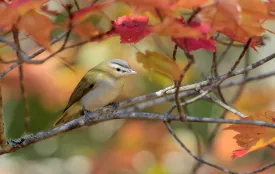
Recent news on North American bird populations has been largely negative. Two studies published in Science – one in 2019 estimating the loss of 3 billion birds (a 30 percent decline)…
Discoveries
September 1st 2026
Beavers Can Help in the Battle Against CO2 Emissions
Beavers are renowned for their role as ecosystem engineers. They construct dams on streams to create ponds and wetlands that provide safety from predators as well as underwater storage sites…
September 1st 2026
Forest Trails Can Act as Partial Barriers to Small Mammal Movement
When people think about anthropogenic barriers to wildlife movement across the landscape, many of us likely picture 8-lane highways or heavily urbanized neighborhoods. However, recent research…

June 1st 2026
Predicting Roadkill Hotspots
An estimated 4 million miles of vehicular roads run through the United States, and they fragment habitat, alter animal behavior, isolate populations of wildlife, and impose wildlife mortality…

June 1st 2026
Invasive Plants Mirror the Leaf Traits of Native Species
One of the prevailing theories explaining why invasive species do so well in their new homes is that they leave behind most – or all – of their natural predators and pathogens,…

March 1st 2026
iNaturalist Has Become a Burgeoning Tool for Conservation Scientists
Developed in 2008 by three students at University of California Berkeley’s School of Information as a final master’s product, iNaturalist is a digital platform for nature…
March 1st 2026
Forest Gaps Help Fight Hemlock Woolly Adelgid and Improve Bee Diversity and Abundance
Across North America, forest managers are increasingly tasked with managing forests for multiple goals: protecting biodiversity, sustaining timber production, combating invasive species, and…

March 1st 2026
Moose Droppings Nurture Native Earthworms in Canadian Forests
A group of scientists from New Brunswick Museum have discovered a connection between one of North America’s largest and most majestic mammals – the moose (Alces alces) – and…

December 1st 2025
Protecting Snow Cover in the Face of Climate Change
The winter snowpack – defined as the accumulation of snow on the ground that persists through winter – plays important climatological, ecological, and economic roles in northern…

December 1st 2025
Battling Invasive Plants Across Private Forestland
Invasive species pose significant ecological and economic problems; a 2021 study published in the journal NeoBiota estimated that invasive species cost the North American economy $26 billion…
December 1st 2025
Can Adding Iron Strengthen Wood?
The production of steel and concrete is responsible for approximately 13½ percent of global carbon emissions, according to a 2022 article in the journal Nature. After clean water,…
September 1st 2025
Reassembly of Disturbed Forests Portends Climate Resilience but Diversity Loss
As climate change continues to reshape ecosystems across the globe, forests – key players in the Earth’s carbon cycle – are also undergoing significant transformations. A…

September 1st 2025
Enhancing Pollinator Habitats Along Natural Gas Pipeline Rights-of-Way
Insect pollinators provide critical ecosystem services across the planet. A 2011 study in the journal Oikos estimated that between 75 and 95 percent of the planet’s flowering plant…

September 1st 2025
New Bacteria Discovered in Rabbit Ticks
People are exposed to ticks across diverse outdoor environments, from backyard gardens to backcountry wilderness. To limit tick-borne diseases, we can discourage ticks from biting us by…
June 1st 2025
Predicting Urban Tree Cooling at Citywide Scales
Exacerbated by climate change, extreme city heat is an increasingly common concern. Thankfully, trees can help. For decades, city managers have turned to oak, maple, linden, and other species…

June 1st 2025
Modeling Species Interactions
One of the core goals of ecologists is identifying how species interact. Does species A, for instance, have a positive, negative, or neutral impact on species B? Elucidating such relationships…
June 1st 2025
How Private and Public Management Affects Oaks
In much of the eastern United States, oaks are declining, while generalist species such as red maple (Acer rubrum) are on the rise in historically oak-dominated forests. This shift is in part…

March 1st 2025
The Health Benefits of Maple Syrup
Swirl a bit of maple syrup into your coffee or tea instead of refined table sugar. With this simple choice, you can enjoy an especially delicious morning beverage and support the sugarmakers…
March 1st 2025
Soil Management Shapes Understory Health
Beneath the towering beeches, wintergreen-scented birches, and bright red fall maples that dot the canopy of a northern hardwood forest, a vast array of plants makes up the understory. When…

March 1st 2025
Community Science Shows Bald Eagles Vulnerable to Lead Poisoning
From bald eagles to black bears to red foxes, many of the most iconic northeastern animals scavenge the remains of big game, leaving them vulnerable to consuming fragments of toxic lead…