
Invasive species pose significant ecological and economic problems; a 2021 study published in the journal NeoBiota estimated that invasive species cost the North American economy $26 billion per year. Trying to control invasive species, however, can be very difficult.
One of the major challenges complicating management of invasive species is that they are often able to cross property boundaries with ease. More than half of the forestland in the United States is privately owned or managed, and differences in property use and motivations – such as managing for recreation versus timber production – can significantly influence the spread of invasive plants. These differences in land-use motivations shape the timing and intensity of potential management actions and, ultimately, can determine the scale of ecological and economic impacts. Moreover, land managers and conservationists must often tackle large invasive species problems with limited budgets.
To help guide decisions about where financial resources should go, Shady Atallah, an associate professor of agricultural and consumer economics at University of Illinois, Urbana-Champaign, developed a bioeconomic approach to examine how differences in landowner preferences affect the dynamics of invasive species spread and associated external costs.
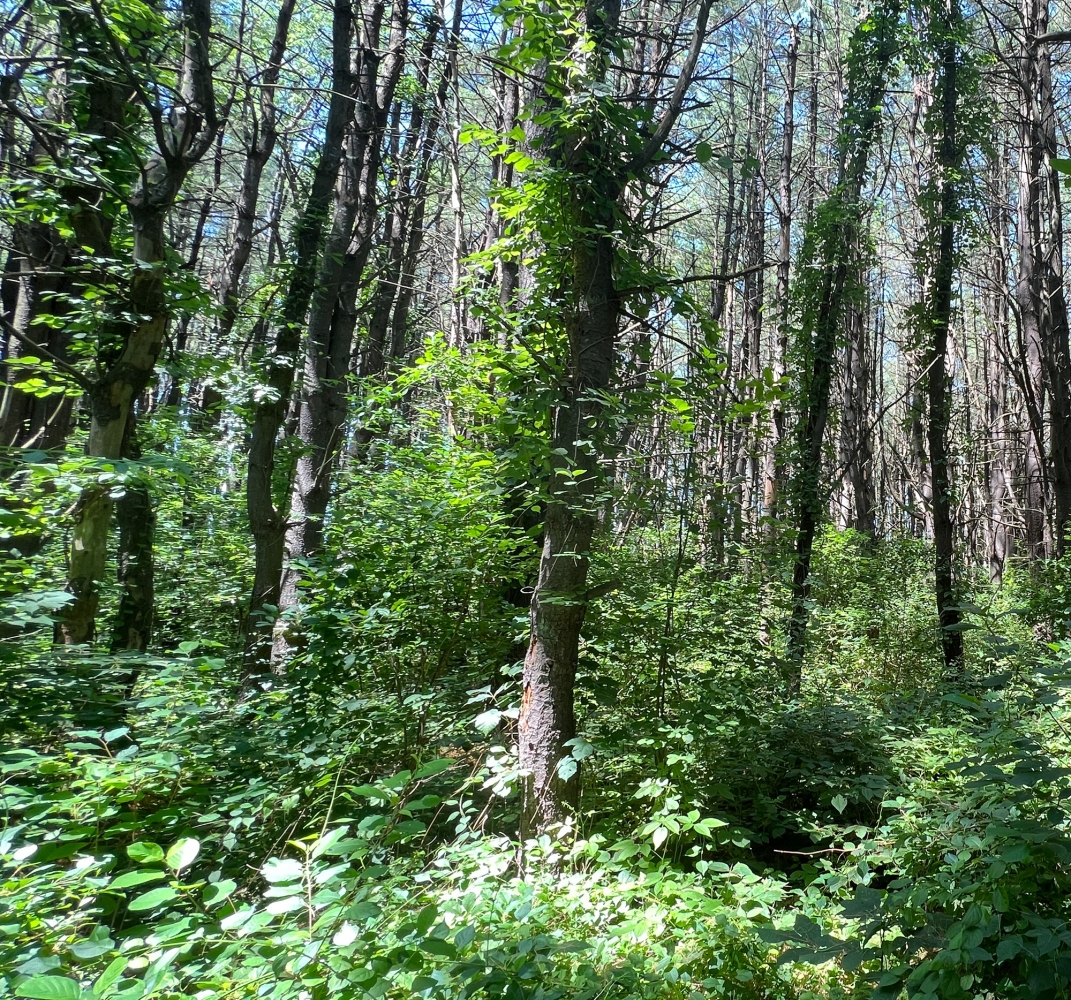
For this work, Atallah used the example of invasive glossy buckthorn (Frangula alnus) growing in an eastern white pine forest in the Northeast. Glossy buckthorn is a European shrub that has become common in the Northeast and can negatively impact recreation, wildlife habitat, and timber harvest. In his bioeconomic models, Atallah used an estimated cost for controlling buckthorn of $1,500 to $3,000 per acre, and a scenario in which buckthorn affects two landowners: one who manages their property for recreation and the other for timber. Atallah considered how these different goals influence if and when landowners control the invasive buckthorn. The basis for the modeled behavioral actions of the landowners came from private forest landowner surveys Atallah used in a prior study assessing landowner preference, motivations, and willingness to remove buckthorn.
Atallah employed a mathematical framework called “game theory.” Economists and behavioral ecologists use game theory to analyze how one person’s decisions are shaped by the decisions made by others. In Atallah’s study, game theory helped model the invasive species spread and costs like a strategic game: Landowner A acts (or doesn’t act) when the invasion reaches their land, and Landowner B acts (or doesn’t) when the invasion reaches their land. The core element of this approach is that the players’ choices affect each other.
The findings from this study are presented in the May 2025 issue of the journal Land Economics, and in short, Atallah found that the order of invasion and the landowner’s land-use preferences strongly influence the magnitude of both the invasion and the societal costs. For example, if the buckthorn starts on the recreation-focused property, the social cost of the invasion (the harm it causes across both properties) becomes much higher. That’s because the recreation landowner, who does not earn direct income from the forest, often chooses to not spend money controlling the buckthorn. This inaction gives the invasive species a head start and causes more harm to the recreation landowner’s property and the neighboring timber-focused property.
On the other hand, if the buckthorn starts on the timber property, the owner tends to invest in control to protect future timber revenue. This action limits the spread of the invasive species on both the timber harvester’s property and the recreational land, thereby reducing the total social cost.
To examine where financial resources would be most effective, Atallah explored different subsidy scenarios. The author found that targeted subsidies focusing on the “weaker link” (the landowner least likely to act) perform better than uniform subsidies. In this case, Atallah found that providing higher subsidies to the recreation-focused owners can lead to better landscape-wide outcomes, even if the timber owners get no, or heavily reduced, subsidies. The exception to this scenario is when the invasive species spreads rapidly across large distances; in that case, subsidies for all landowners are necessary to help reign in the invasive species.
By understanding these dynamics, policymakers can design smarter incentive programs that target subsidies or outreach efforts to landowners who are less likely to take action against invasive species on their own.