
“Perhaps the passage of time is a kind of healing, or a kind of salvation granted equally to all people.”—Mizuki Nomura Inari, Finland, is the cultural center of the Sami…
Outdoor Palette
February 12th 2015
Winter 2014
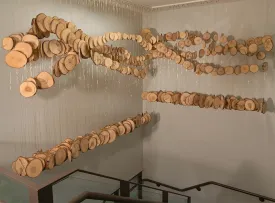
"The closer the connection we feel to nature, the more we're likely to stand up and defend it." - Charles Johnson How do hundreds of sawn discs hanging from a ceiling evoke a…
November 26th 2014
Autumn 2014
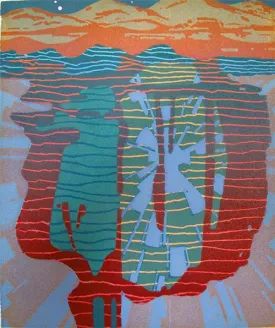
What is the definition of environmental art? The simplest, shortest explanation is that it is art that addresses environmental or ecological concerns. Historically, environmental art grew out…
August 25th 2014
Summer 2014
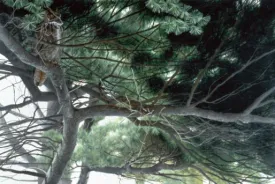
My visit to Thom Egan’s Hardwick, Vermont, studio this early spring came at the end of a very long, gray winter. It felt like my rods and cones – the retina’s receptors for…
February 24th 2014
Spring 2014
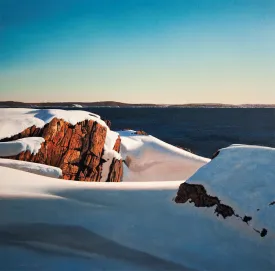
Fifteen years ago, on its centennial anniversary, The National Audubon Society recognized 100 “Champions of Conservation” in the twentieth century. All are individuals who have…
November 22nd 2013
Winter 2013
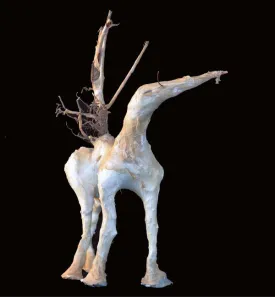
Thomas Crotty, a Massachusetts native, moved to Maine in 1964, drawn by the power and beauty of its coastal landscape. At the solo retrospective of his work at the Portland Museum of Art, then…
November 19th 2013
Autumn 2013
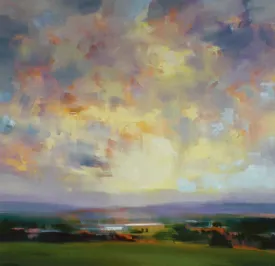
Riki Moss looks into the forest and imagines another world; a world filled with spirits and ambiguous life forms. For years, she has been engaged with her ever-growing, ever-shifting…
August 14th 2013
Summer 2013
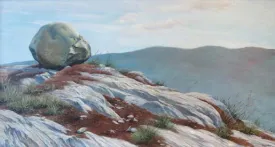
Craig Mooney is a master of atmospheric perspective. He manipulates his oil paints to reflect the effect that weather, atmosphere, and shifting light have on the appearance of a place. Mooney…
May 23rd 2013
Spring 2013
Many of us are familiar with Rebecca Merrilees’ work from the indispensable field guide Trees of North America, which she illustrated 34 years ago. It is probably on all of our…
November 20th 2012
Winter 2012
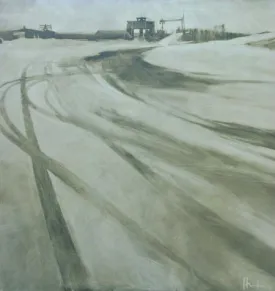
Those of us who live in the Northeast are familiar with the vicissitudes of winter. We know firsthand that not every day sparkles with rime ice or delivers fluffy drifts of sun-dappled snow.…
November 20th 2012
Autumn 2012
Bryan Nash Gill, Leader, 2011 30.5" x 21.5", relief print on Okawara paper We often come to understand things by isolating them. We pluck something from its environment, look at it…
August 15th 2012
Summer 2012
Dianne Shullenberger, Yellow Peony, 12” x 11”, fabric and thread, 2006 The surprise in Dianne Shullenberger’s work is that her “paintings” are not made with…
May 21st 2012
Spring 2012
Betsey Garand Hark II 17 3/4” x 15 5/8”, Lift-ground aquatint monoprint and monotype, 2010 Hark: v. to listen attentively, to pay close attention. Hark is an apt word to describe…
November 22nd 2011
Winter 2011
Mark Wiener Spiral 45” x 36” acrylic and sumi ink on vellum, 2008 Mark Wiener keeps the door of his studio open seven hours a day, six days a week. Working in the Chelsea neighborhood of…
August 26th 2010
Autumn 2010
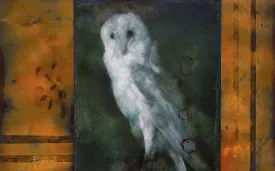
Oftentimes the first question a young child asks upon entering a natural history museum and seeing the stuffed specimens is: “Are these real?” Barn Owl with Rust #2 begs the same…
June 1st 2010
Summer 2010
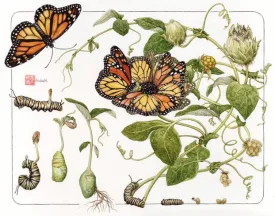
The primary goal of natural history illustration is scientific accuracy. Since the work is used to educate, it must portray a species with precision and a high level of detail. If it’s…

March 1st 2010
Spring 2010
I like to think of Sarah Knock as a topographer. She records the surface features of water as light purls across it, showing us with amazing verisimilitude the fusion of light and liquid.…
September 30th 2008
Autumn 2008
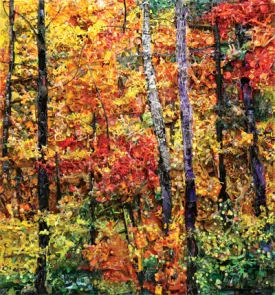
Thomas Deininger is an artist, an environmentalist, and an iconoclast. His large assemblages often fracture traditional artistic premises in an overt and seductive manner. By using decidedly…