
When I worked at a barn one summer during college, I marveled at the swallows that nested in the structure’s eaves and corners. I watched the iridescent birds swoop, flutter, and dart with…


May 28th 2024
May: Week Five
This Week in the Woods, there are several showy wildflowers coming in bloom, including lady’s slippers, columbine, rhodora, and painted trillium. Meghan McCarthy McPhaul took this photograph of…

May 22nd 2024
How Fungi Return to Disturbed Forest
Two common ways that forest fungi spread to new locations are by releasing spores into the wind, and through transport by animals, including the consumption – and defecation – of fungal…
May 22nd 2024
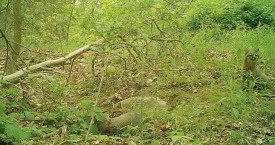
A Rare Glimpse into a Gray Fox Den
Gray foxes inhabit areas of dense cover, usually close to water. They den in the ground, cavities between rocks and ledges, brush piles, tree holes, and hollow logs. In 2018, in a wooded residential…

May 22nd 2024
Western New York Forests Are Growing Less Fired Up
In 1900, much of the forest in the eastern United States was filled with oaks and other trees that tolerated fire. This structure in part reflected previous centuries of shaping by Indigenous peoples,…

May 20th 2024
May: Week Four
This Week in the Woods, we’re continuing last week’s theme of high bird drama with two images (courtesy of Tig Tillinghast) of a male red-winged blackbird attacking a crow. Moments before,…

May 20th 2024
Jesup’s Milk-Vetch: A Rare Beauty
A few ledges along the Connecticut River are home to a rare plant commonly known as Jesup’s milk-vetch (Astragalus robbinsii var. jesupii). In fact, this species, which has been listed as…
May 16th 2024
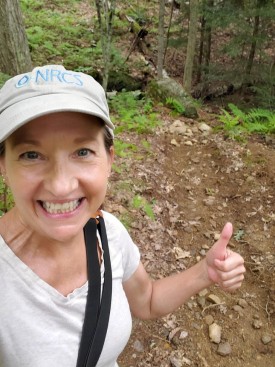
Working Lands Conservation with Wendy Ward
A lifelong resident of Keene, New Hampshire, Wendy Ward has held a love and curiosity for the natural world for as long as she remembers. For the past 29 years she’s worked with the USDA’s…

May 15th 2024 4 - 7 pm
Spring Open House
When: May 15th 2024 4 - 7 pm
Where: at Northern Woodlands Office
Join us in celebrating spring and learn about our plans for a pollinator garden! We’ll share the design and show you what we’re growing. Alicia Houk of the Wild Garden Alliance will be on…

May 14th 2024
April 2024
Your April photos showed a profusion of spring wildflowers, from showy bloodroots to often-overlooked wild ginger. In Adams, Massachusetts, Sharon Bombard had the lucky find of an infant moth perched…

May 14th 2024
Seeing Red
A reader found these bright red forms among the leaf litter and spring ephemerals near the Northern Woodlands office, in an east-facing cove forest of mature sugar maple and ash trees. What are these?

May 13th 2024
Native Cherry Trees: Spring Beauty, Ecological Gold
Each spring, cities from New York to Texas celebrate the spectacular blooming of ornamental cherry trees. In many cultures, the lovely, delicate pink and white cherry blossoms symbolize rebirth and…

May 13th 2024
May: Week Three
This week in the woods, the summer canopy is rapidly closing, which means that the window of opportunity to easily observe summer forest birds is closing, too. Scarlet tanagers are especially hard to…

May 6th 2024
May: Week Two
This Week in the Woods, bald eagle chicks are growing quickly, and by this point, many have shed their white baby fuzz. The eaglet in this nest (photographed with a high magnification lens from across…

May 6th 2024
A Young Red Squirrel Grows Up
Years ago, a hitchhiker found a baby red squirrel beneath a tree and brought it to the nature center where I worked as a naturalist and wildlife rehabilitator. The squirrel kit had not yet opened its…

May 1st 2024
Writing is Natural for Naila Moreira
Naila Moreira teaches science writing at Smith College. Her journalism, nature writing, fiction, and poetry have appeared in The Boston Globe, The Seattle Times, Scientific American, numerous literary…
April 30th 2024
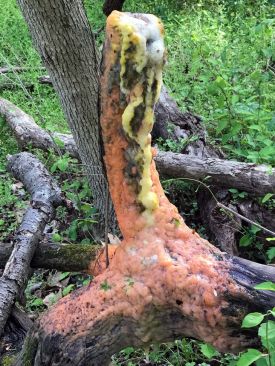
Sweet and Slimy
A Northern Woodlands staff member was walking along a river in Virginia when she found this sweet-smelling, multicolored goo dripping down the side of a toppled stump, directly under some recently cut…
April 29th 2024
Learning the Language of Birding
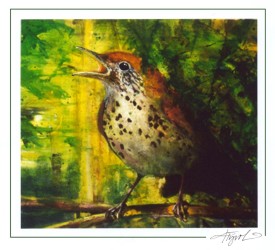
The shift begins around the time we turn the clocks ahead, a gradual transition from winter’s steady chorus of chickadees, squawking jays, and crows cawing over the compost pile to – well,…
April 29th 2024
May: Week One
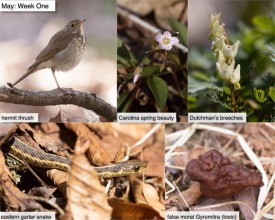
This Week in the Woods, hermit thrushes are back and flitting around in pairs, with stops along the way to rummage in leaf litter for tasty invertebrates. One of the key identifying traits of these…
April 22nd 2024
April: Week Four
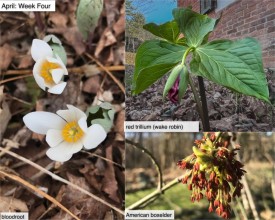
This week in the woods, one of our most exquisite spring ephemeral wildflowers is starting to bloom. Bloodroot — a member of the poppy family that gets its name from the red juice in its roots…