
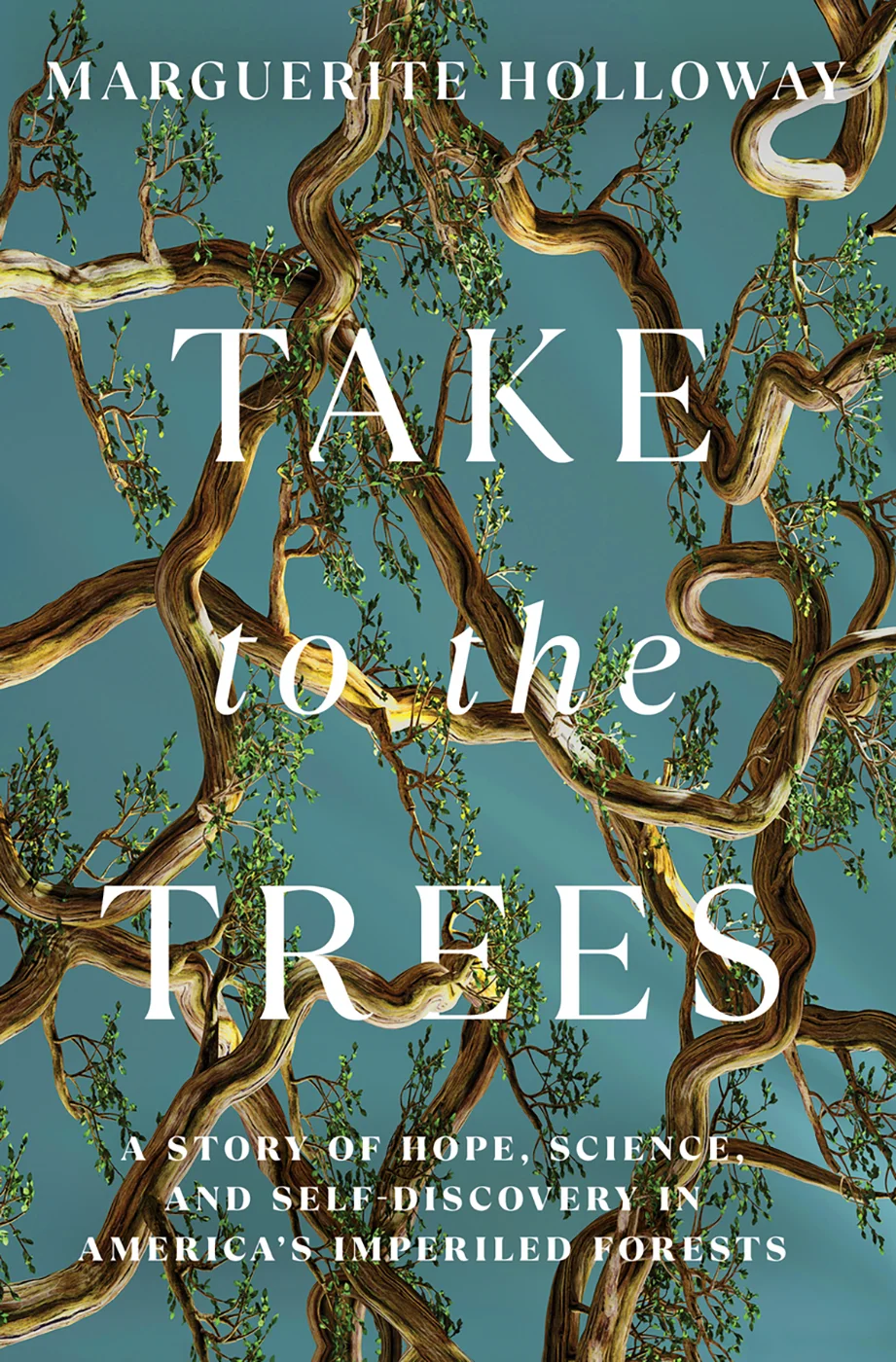
by Marguerite Holloway
W.W. Norton & Company, 2025
Marguerite Holloway opens Take to the Trees: A Story of Hope, Science, and Self-Discovery in America’s Imperiled Forests with her first visit to the Women’s Tree Climbing Workshop at Camp Hi-Rock in Mount Washington, Massachusetts. Run by identical twins, Bear LeVangie and Melissa LeVangie Ingersoll, the workshop mostly trains women arborists; however, it also attracts “lichenologists, ornithologists, primatologists, other ologists, circus performers, dancers, artists, photographers, writers, and the generally arboreally curious.”
“I was there to be in the trees and to better understand them,” writes Holloway, who is a journalism professor at Columbia University. “Trees and forests are facing existential threats because of climate change, but it can be a struggle to grasp the extent of the danger or to make sense of the complex and deadly interactions playing out between heat, drought, fire, water, disease and pests. I hoped that being in trees would allow me to better see them through the eyes of people, like the LeVangies, who care for trees and who perceive so much more about trees and forests than many of us do.”
To be in the trees, Holloway has to learn how to climb them, and to overcome her fear of heights. For her and many women she climbs with, it is a transformative experience that includes the satisfaction of overcoming fears and meeting challenges, a stronger sense of self, camaraderie in the climbing community, personal self-discovery, and the joy of being on the tree, especially at the top. Some workshop participants find it to be a spiritual experience, and many tell Holloway the workshop made them more confident or more centered.
Climbing provides a thread through the book; however, much of the book focuses on meeting with scientists to learn about what is happening with trees in their areas, leading to a series of chapters named after tree species they focus on. Holloway’s ongoing reflections on family tragedies is another theme revisited throughout Take to the Trees. Human interactions with trees loosely connect those three storylines.
The book is highly episodic, spread across many locations, introducing scores of people, and sharing dozens of shorter stories within the main stories. A passion for trees is what brings all those people and stories together. Many of the people in this book have loved trees since childhood, are passionate about understanding them, taking care of them, and working to save them. For Holloway, climbing helps her to pull things together.
“As I learned to climb, I did things I never thought I could do,” she writes. “I overcame physical weakness and phobias. I came to rely on other people and trust myself in new ways. I came to terms with tragedy and loss in my family. I found a new way to confront climate anxiety. I came to know trees more deeply. I began to look closely, to see and understand our profound connection to them.”
Marked by many successes, the human accounts Holloway shares are hopeful and sometimes inspiring. For the trees, it’s more complicated. The stories about oaks, beeches, whitebark pines, Atlantic white cedar, and other trees make clear that they face some very serious challenges – from a changing climate to invasive species. Holloway’s engaging stories about the scientists, climbers, and others who are working to help trees offer an optimistic outlook and remind us of the myriad ways trees enrich our lives and world – even if we don’t climb them.