
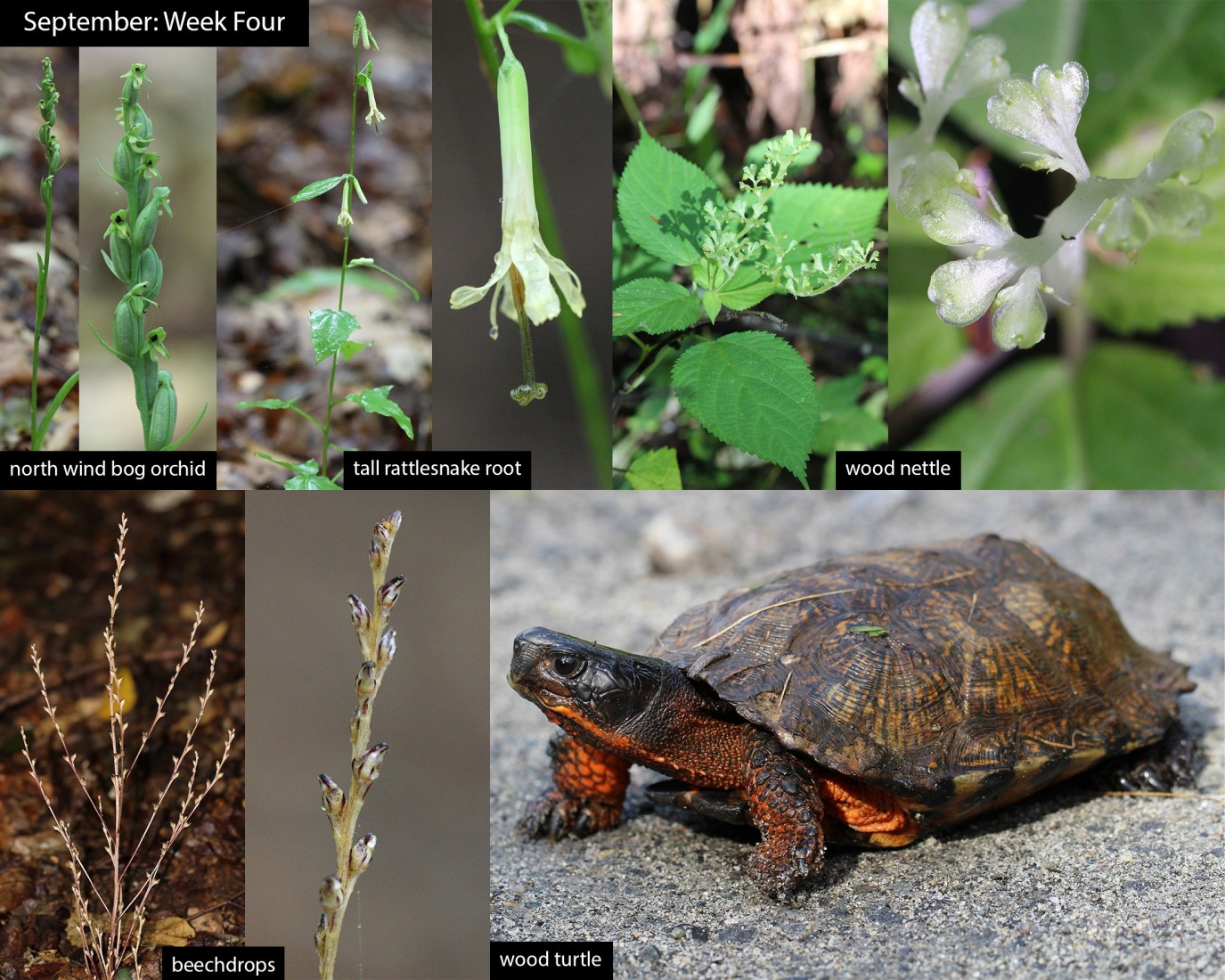
This week in the woods, some late-blooming flowers may still surprise us, even as the daylight hours shorten. Easy to miss but worth taking a close look at, north wind bog orchid flowers through September, not only in swamps, fens, seepages, and bogs, as its common name might suggest, but also in moist forests. Its stalkless, light yellow-green flowers make up an inflorescence that rises above a stem with narrow, tapering leaves. While sometimes aided by mosquitos, the tiny flowers more often self-pollinate, with pollen sacs spilling their contents onto waiting stigmas below.
In the same hardwood forest, near the orchid, tall rattlesnake root, also known as tall white lettuce, appeared in bloom. It can reach up to eight feet in height, and its variably shaped leaves and stout stem release a white, milky latex when broken.
Yet another unflashy bloomer, wood nettle has wide, whitish-green flowers spreading in loose, branching clusters from leaf axils. The perennial creates dense carpets in rich, moist forests and river floodplains. The sting from the hairs on its petioles and stems lasts only temporarily. We have several nettle species in the Northeast, but only wood nettle has alternate leaves.
Our final subtle flower (so subtle it might not even strike the viewer as a flower), beechdrops has numerous tubular, short-stalked little blossoms – white or creamy, with purplish-brown stripes – that cover a yellow-brown, branching slender stem. It lacks obvious leaves or even chlorophyll, and thus any green, because it parasitizes the roots of American beeches and has no need to photosynthesize (much like the parasitic pinesap and ghost pipe we wrote about in August). While the dual factors of beech bark disease and, increasingly, beech leaf disease threaten the host species (and, in turn, beechdrops), the parasitic activity doesn’t last long enough to damage the beeches. The stalks of the beechdrops will dry and darken, come October, and stand watch throughout the winter.
The shell of the wood turtle inspires both its Latin name (Glyptemys for “carved turtle” and insculpta for “sculpted”) and its common name: the concentric rings of the large, rough scutes on the upper shell resemble a tree’s growth rings. If the name came from the turtle’s habitat, it would only be partially right, as this species relies on both streams and adjacent woodlands, wetlands, and fields. Summers for wood turtles largely entail laying eggs in terrestrial habitats and foraging there for earthworms, snails, slugs, berries, and mushrooms. Seldom more than a quarter mile from the safety of water, they will soon transition more fully to stream bottoms for overwintering. Like more than half of the world’s turtle species, the wood turtle has become vulnerable to extinction since the 1960s. On top of the illegal pet trade, human development has cleared streamside habitats, elevated risk of collision with vehicles and mowers, and spurred the populations of common nest predators such as raccoons, skunks, crows, and cats. The wood turtle is frequently petitioned for listing under the Endangered Species Act, designated as species of conservation concern in all 17 states in which it occurs, and is considered endangered by the International Union for Conservation of Nature.
What have you noticed in the woods this week? Submit a recent photo for possible inclusion in our monthly online Reader Photo Gallery.