
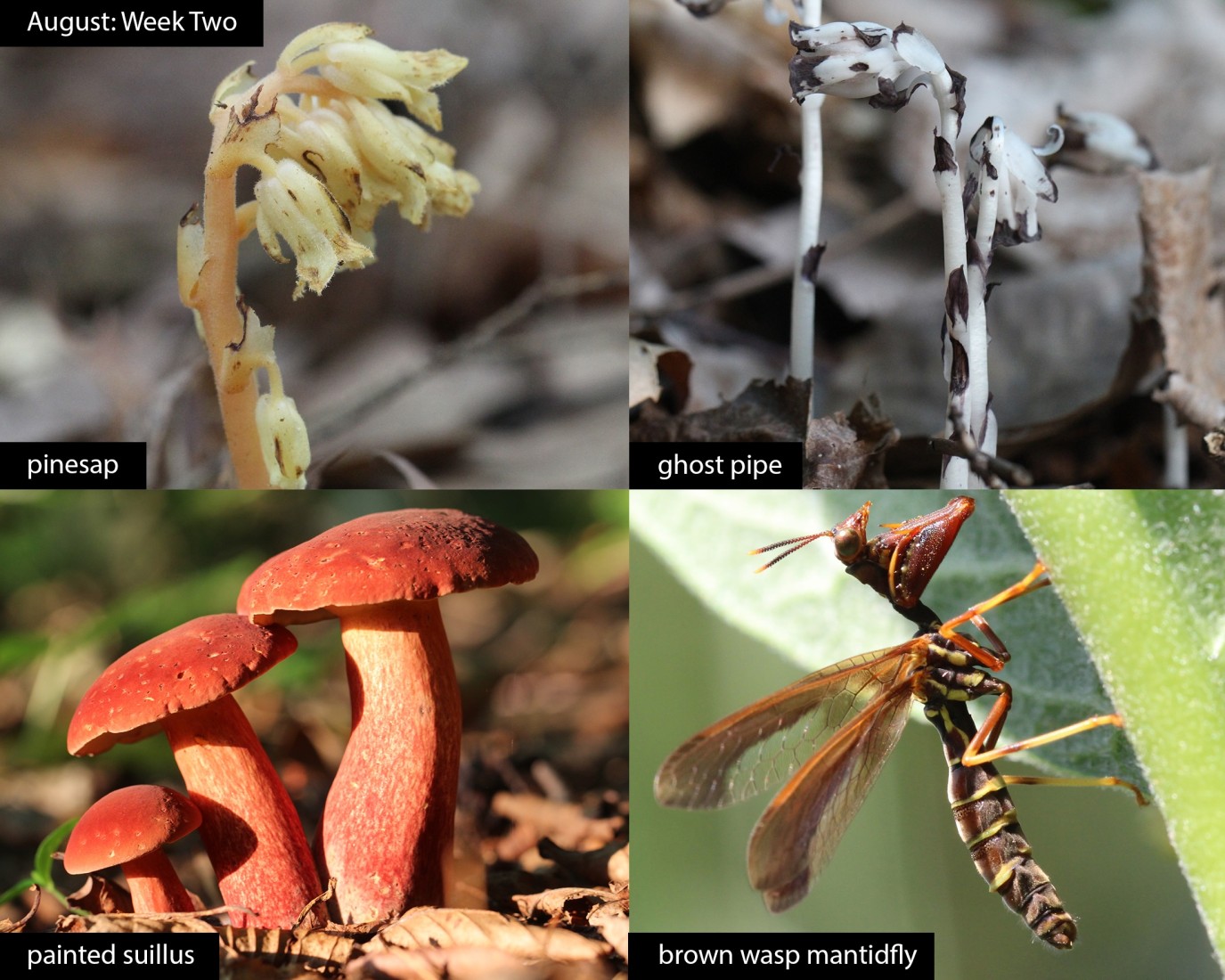
This week in the woods, pinesap and ghost pipe unfurled from the forest floor. These waxy lookalikes are not fungi but rather chlorophyll-free plants that parasitize mycorrhizal fungi, which have in turn drawn nutrients from tree roots. Pinesap more typically has clusters of flowers, fuzzier stems, and more variable color than ghost pipe. Both species suggest relatively long forest continuity, given their dependence on undisturbed soils and intact ectomycorrhizal networks.
One such mycorrhizal fungus, painted suillus, fruited near the pinesap, which – as its name suggests – prefers coniferous forests, especially ones dominated by pine. This burgundy bolete, too, tends to associate with eastern white pines. As Northern Woodlands columnist Alexandra Kosiba writes in our Autumn 2025 issue, a single pine may join with more than a dozen different ectomycorrhizal species at once.
Out from the shade of the pines, this brown wasp mantidfly (photographed by Ann Little) lay in wait for prey on a milkweed leaf. In a 2024 Outside Story essay, Rachel Sargent Mirus describes the unusual insect as having “the body of a wasp, the face and forelegs of a praying mantis, and the wings of a fly.” Like the pinesap and ghost pipe described above, these animals also resemble one organism (a wasp) and parasitize another: in its newly hatched larval form, this mantidfly climbs onto a passing spider, subsists on the spider’s blood until it lays an egg sac, and moves into the egg sac to eat eggs until it pupates. Adults keep a more generalist diet and use their forelegs to grasp prey much like a praying mantis.
What have you noticed in the woods this week? Submit a recent photo for possible inclusion in our monthly online Reader Photo Gallery.
Discussion *