
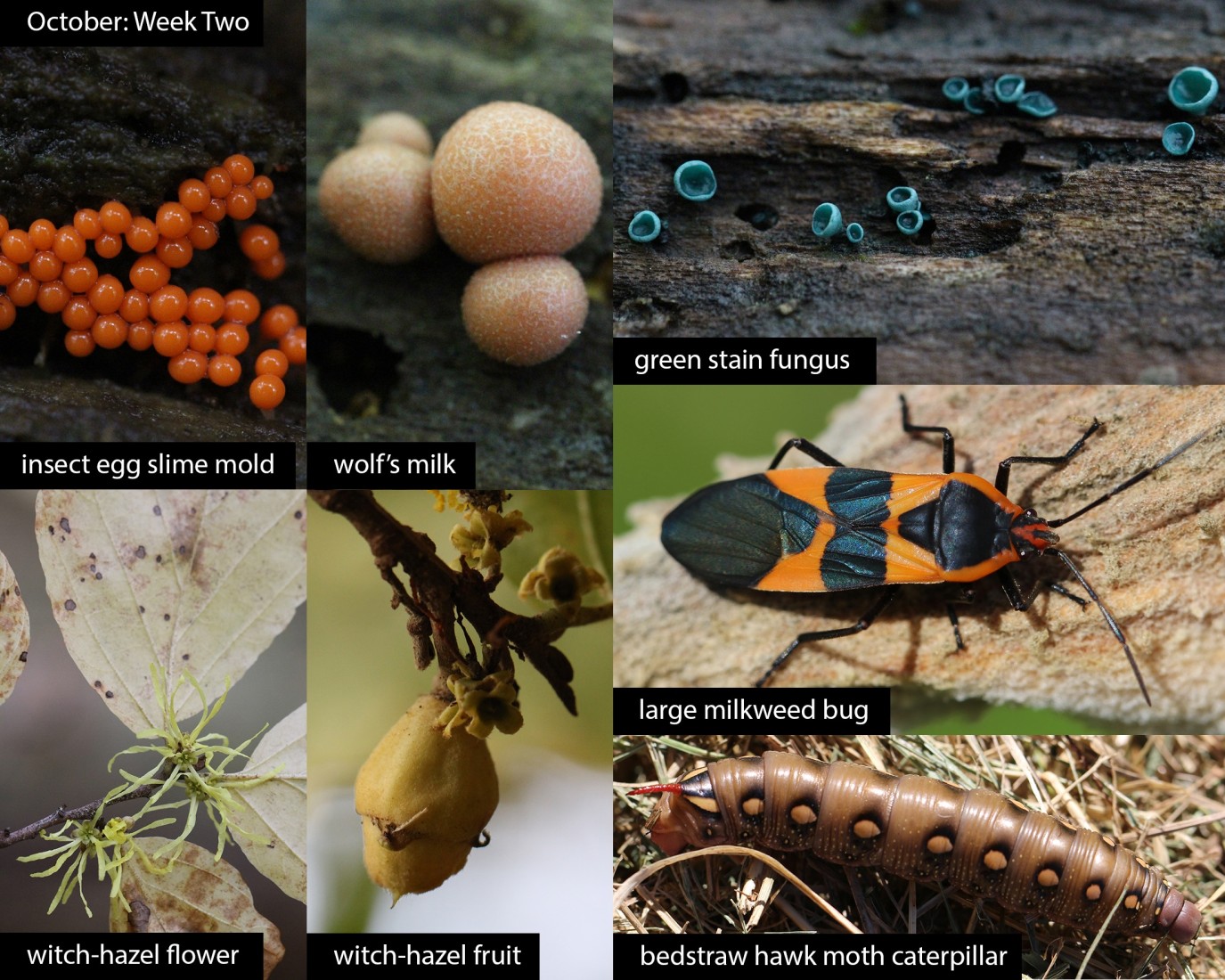
This week in the woods, the days after rain yielded many forms of slime mold fruiting on decaying logs, including this insect egg slime mold. This species appears on every continent but Antarctica and forms little, round, glistening orange or yellow spore-bearing sporangia. When the spores mature, writes Mary Holland, these bodies open up, creating globe-shaped cups filled with yellowish, fuzzy threads that help spores disperse.
Wolf’s milk slime mold invites comparison to bubblegum but earns its common name from the pink or orange goo that will ooze (or shoot) out of the cushiony, bulbous fruiting body when popped. This paste, which contains the slime mold’s spores, will darken as it dries out and turn into a wind-dispersed powder.
Also adding colorful decoration to dead wood in damp, autumnal forests is green stain fungus, also known as green elfcup or green wood cup – one of two closely related and, by eye, indistinguishable fungus species, Chlorociboria aeruginascens and C. aeruginosa. These fungi do not actively break down the wood’s components, and woodworkers use hardwood they have discolored in decorative inlays. As Kateri Kosek writes in The Forest Revealed, its blue-green pigment endures even more than 500 years after Italian Renaissance artisans used the wood in intricate intarsia designs. The brilliant, centimeter-wide, sometimes hard-to-find clusters of fruiting bodies peak in September and October.
American witch-hazel produces an unusual flower at an unusual time – a bloom between September and December, on the ends of branches, with long, narrow, wrinkly yellow petals. Its woody, capsular, two-beaked fruit remains on the tree for a year after pollination, splits open when mature, and ejects a pair of shiny black seeds tens of feet from the parent plant. Perhaps no other native North American shrub will have its ripe fruit, flowers, and the next year’s leaf buds on its branches all at once.
Milkweed continues to host the large milkweed bug and provides almost all its food in the form of sap and seeds. Like monarchs, red milkweed beetles, swamp milkweed leaf beetles, and other milkweed specialists, these insects accumulate toxins from the plant and signal their toxicity to would-be predators with their redness. We see this species in greater abundance and later in the autumn than its smaller, distinctly patterned counterpart, the small milkweed bug, most often feeding in groups on milkweed seedpods.
This caterpillar of a bedstraw hawk moth (also known as a gallium sphinx) found ambling along a woodland edge will overwinter as a pupa if it survives its larvahood. The hawk moths, or sphinx moths, in our area include such species as the tomato horn worm, hummingbird clear wing, and snowberry clear wing.
What have you noticed in the woods this week? Submit a recent photo for possible inclusion in our monthly online Reader Photo Gallery.