
Sometimes botanizing can feel like a scavenger hunt. Find a successive set of clues, and you may be rewarded with something rare and beautiful. The clues in these scavenger hunts are the associates, or indicator plants: those found growing in the same habitat as the “prize” plant. Once you start seeing these associates, anticipation builds – and the search is on.
One of my favorite botanical scavenger hunts involves twinflower (Linnaea borealis), which often grows with or near a very specific set of associates. Discovering each associate plant is an affirmation of “getting warmer” and closing in on finding the “prize” of twinflower.
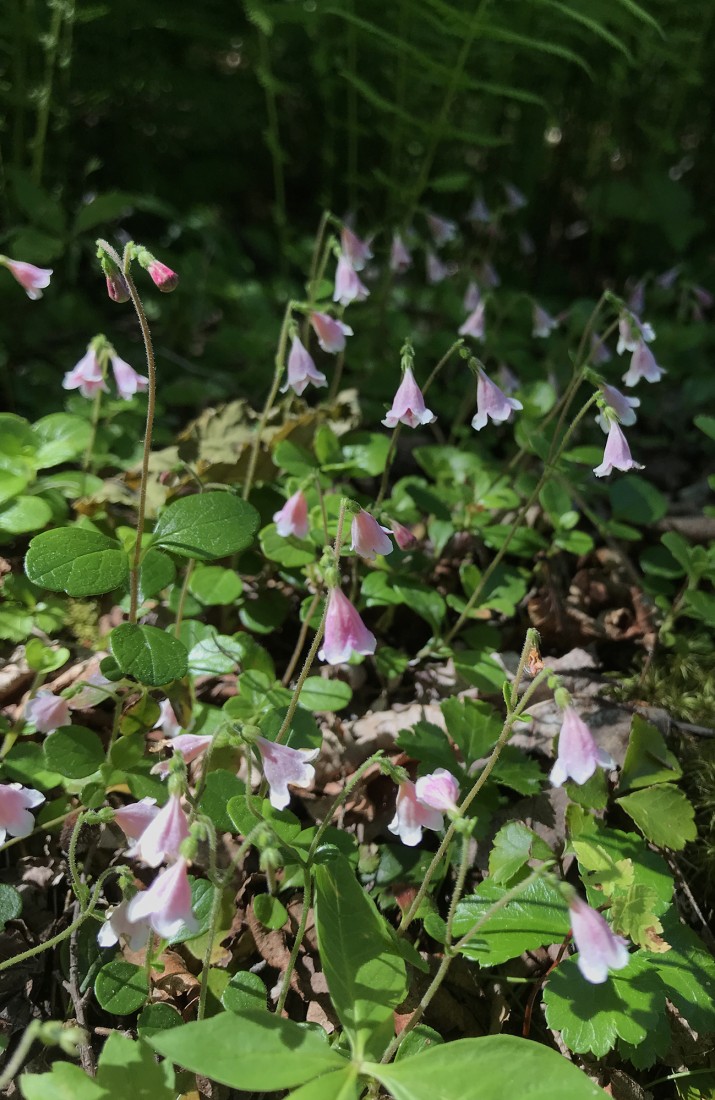
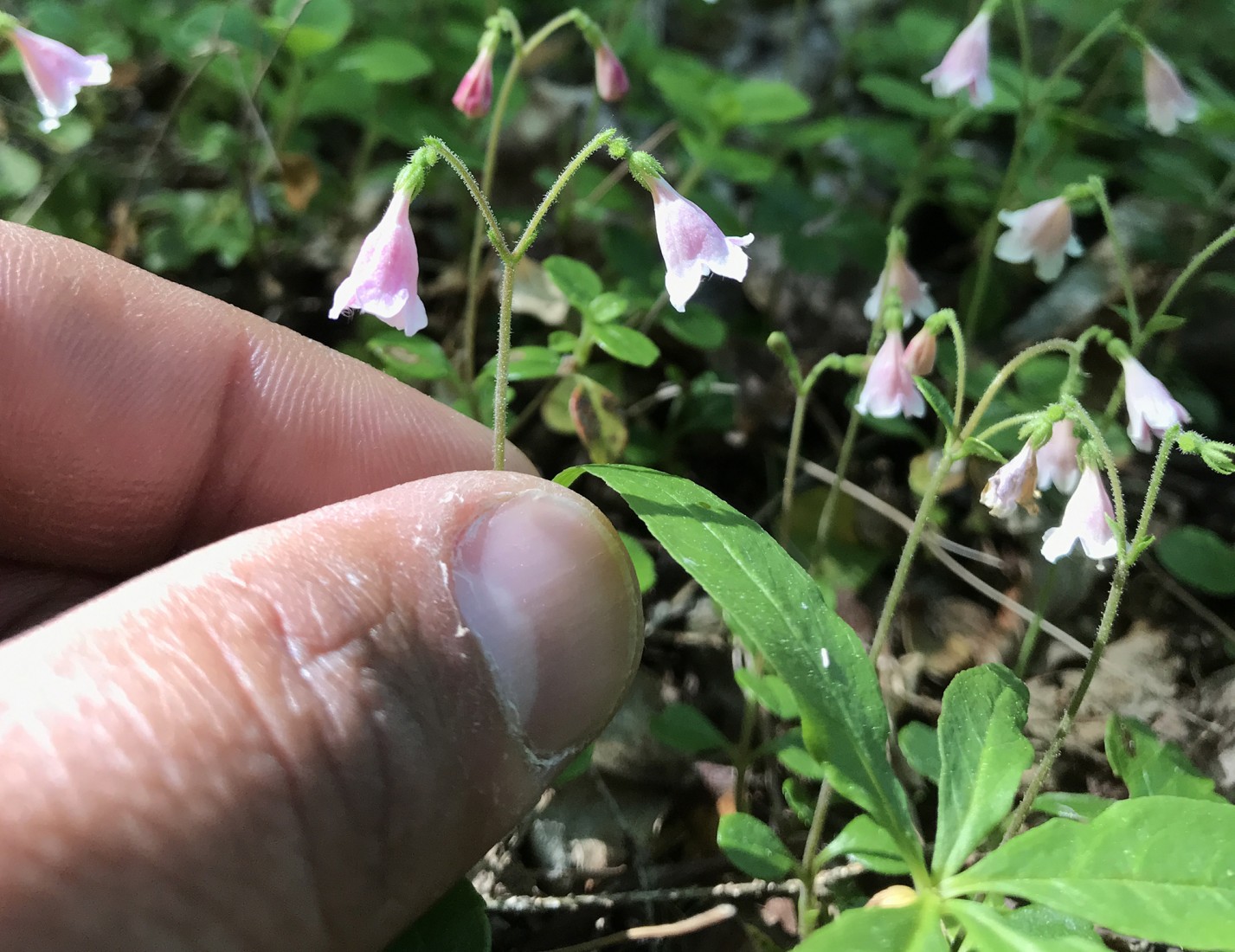
A boreal groundcover in the honeysuckle family (Caprifoliaceae), twinflower grows in cool, shady conifer forests across the northern hemisphere. True to its name, pairs of nodding pink-and-white, bell-shaped flowers appear in June, held just an inch or two above the plant’s low, evergreen, trailing stems. Flowers can be numerous, lending a glow to the dark forest floor – as if it is lit by hundreds (or thousands!) of tiny lanterns. Like all members of the honeysuckle family, twinflower leaves grow in pairs (opposite-leaved). They are small, about ½ inch long, and rounded to egg-shaped. The leaf has impressed veins on its upper surface and toothed margins toward the tip of the leaf. The flowers are also highly fragrant, like its honeysuckle relatives.
Across its very wide range, from Newfoundland and New England west to Alaska and northern California, twinflower is a habitat generalist. But within the Northeast, it most often grows in damp to wet conifer forests, such as on hummocks in swamps or the forested edges of beaver ponds and bogs. I most often find twinflower growing near red spruce, balsam fir, and hemlock trees in various parts of New England. Conifer forests supporting twinflower tend to be relatively stable communities. Local microclimates and a lack of highly disruptive land uses can support a consistent mix of shade-tolerant conifers over many centuries. This consistent overstory composition also creates a consistent understory community, and I think of twinflower as the pinnacle of that community.
Some of twinflower’s associates may be familiar from other habitats. Three-leaved goldthread (Coptis trifolia) grows in many different types of cool, damp forest. It has shiny, trifoliate leaves scattered along prostrate stems and subterranean runners. It flowers in very early spring with solitary white flowers, long before twinflower blooms.
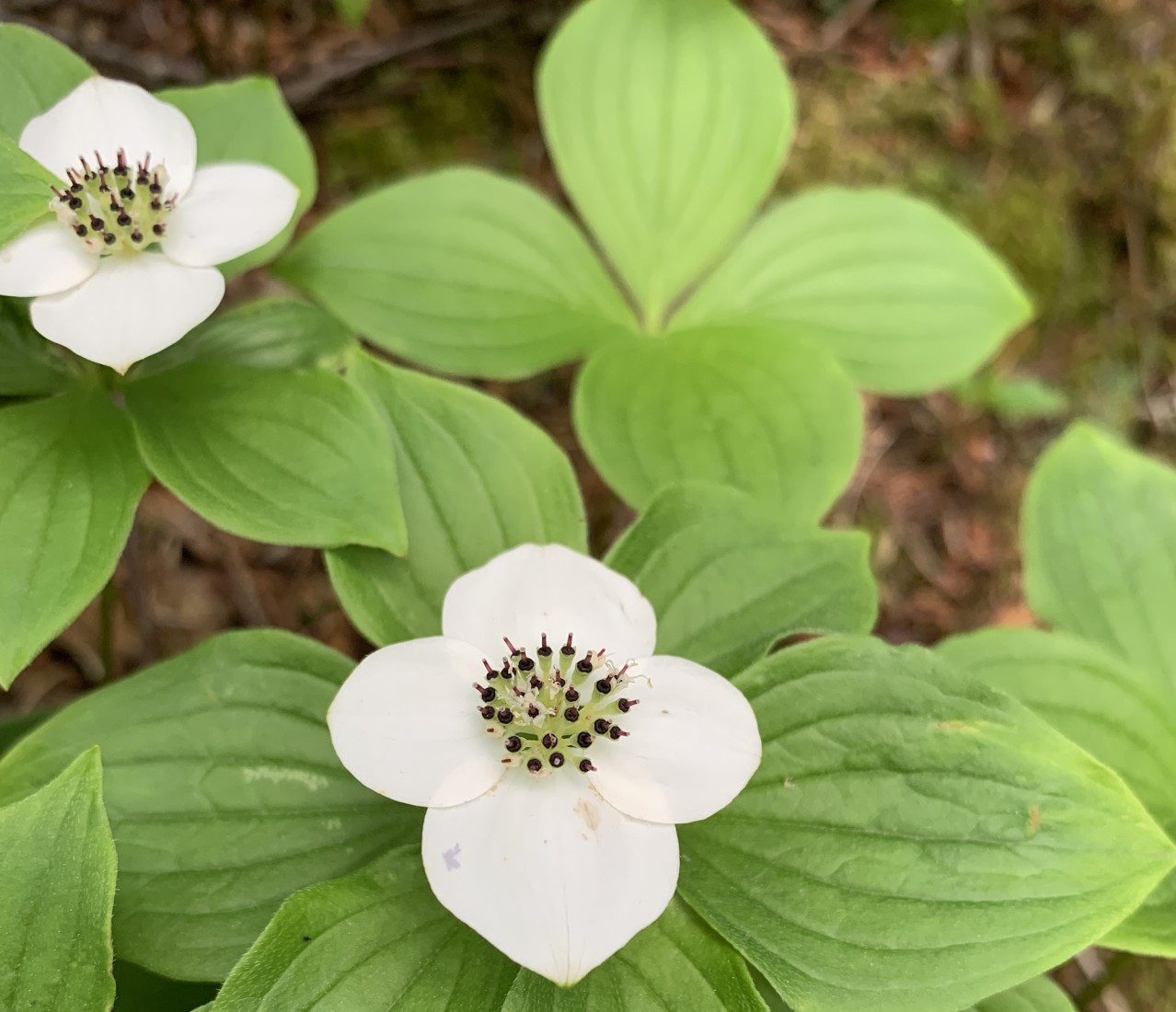
Bunchberry, or dwarf dogwood (Chamaepericlymenum canadense), is another common species that shows up with frequency in twinflower habitat. Like its tree and shrub relatives, the dwarf dogwood has parallel leaf veins from base to tip. The “flowers” are also quite similar to the flowering dogwood tree (Cornus florida). The four white “petals” are actually colored leafy bracts, and the true flowers are small and inconspicuous, arranged in a dense head at the center of the bracts. Bunchberry flowers from mid-May through mid-June, and fertilized flowers turn into bright red fruits by late summer, similar to the fruits of flowering dogwood trees.
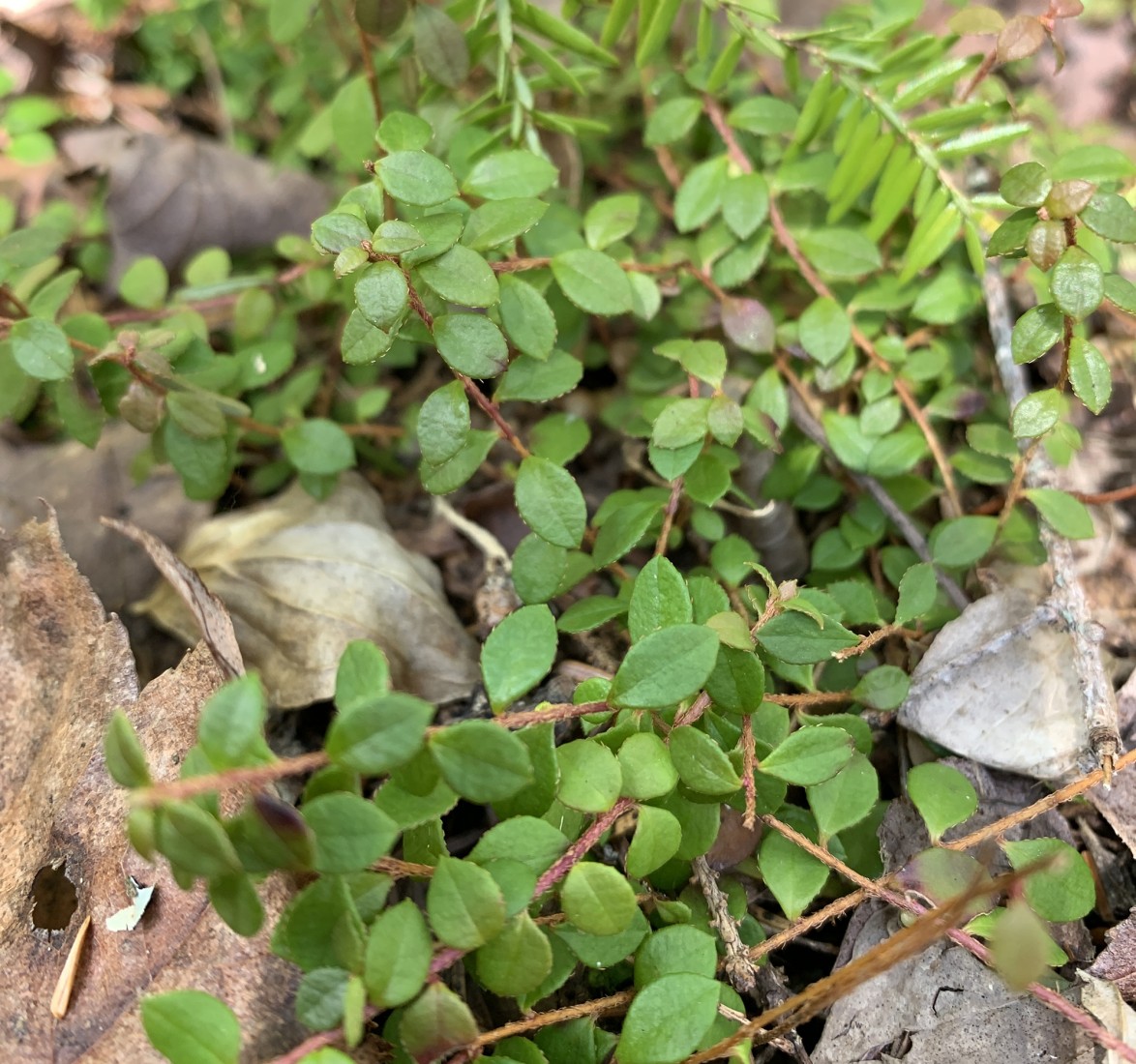
Creeping snowberry (Gaultheria hispidula) might be the closest thing to a twinflower lookalike. It forms dense mats of creeping evergreen leaves in cool, damp conifer forests. Even from a distance, a swathe of snowberry will draw one’s attention for its novel texture, carpeting hummocks and even climbing up and over rotting stumps and branches. But on closer inspection, snowberry’s leaves are alternate along the stem, unlike twinflower’s opposite leaves. All parts of the snowberry plant – even the fruits – are beset with bristly, brownish hairs. As the name suggests, snowberry produces tiny white berries, playfully called “nature’s tictac” due to their refreshingly minty flavor. This minty attribute is no surprise because snowberry is in the same genus as the familiar wintergreen or checkerberry (Gaultheria procumbens). Snowberry is not rare, but it does seem to be restricted to higher-quality conifer forest habitats. So, finding snowberry means you might be hot on the trail of twinflower.
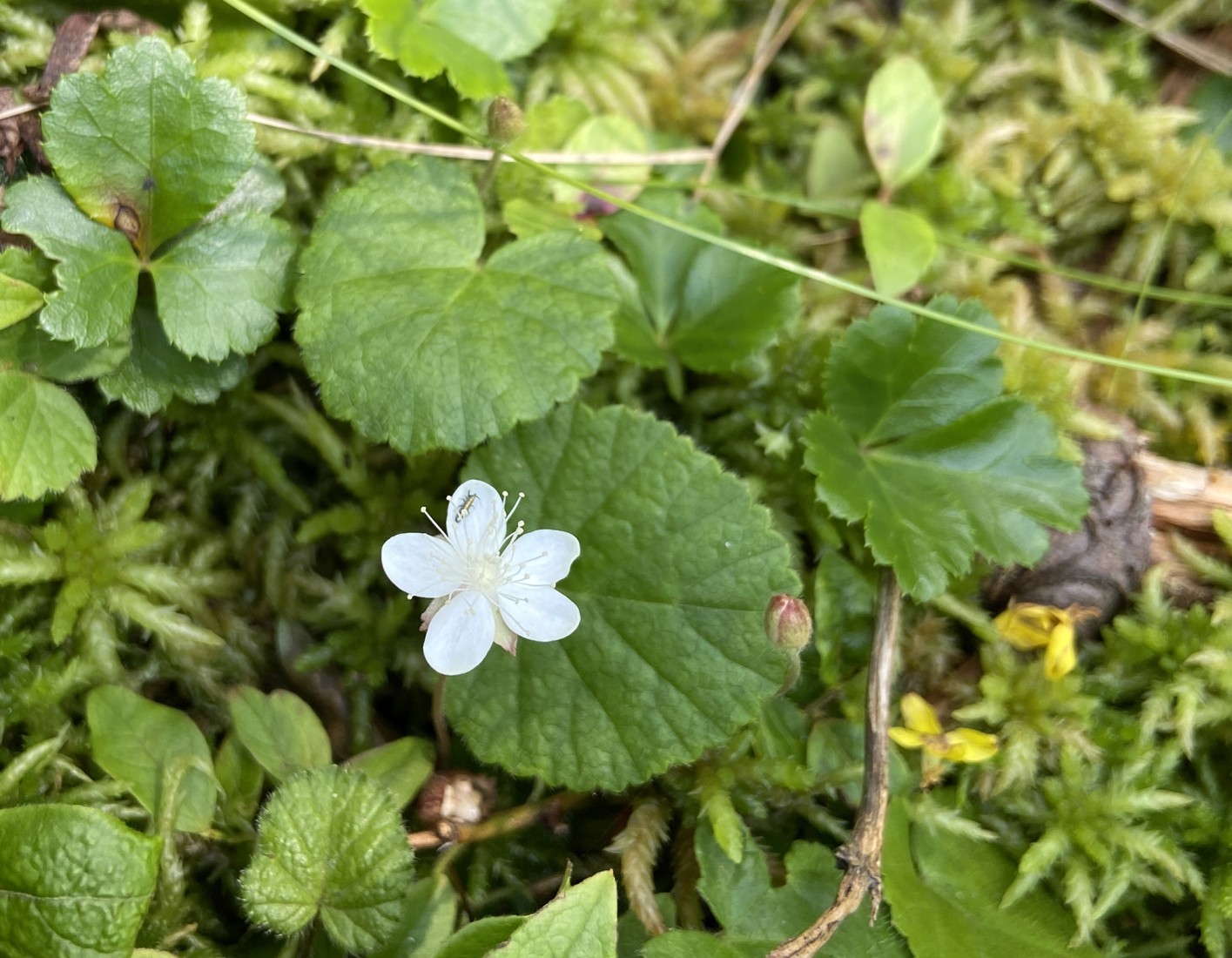
If I’ve spotted all these twinflower associates, one more plant puts me on high alert: dewdrop (Rubus dalibarda). Although placed in the genus Rubus, dewdrop does not produce an edible fruit like its cousins, raspberries and blackberries. Its leaves are simple, heart-shaped, and evergreen, quite unlike its relatives. But the pure white flowers are indisputably raspberry-like, and they shine up from the ground like bright stars in their deeply shady habitats. Although dewdrop is not rare, it is very conservative about the quality of habitat where it grows, much as twinflower is.
Finding all these plants in one place does not automatically mean twinflower is present, but it is certainly worth looking very closely for it. Sometimes I think to myself, This seems like a good spot for twinflower, and sure enough, I stumble across it. But, with increasing frequency here in southern New England, I am not finding twinflower. Populations at the southern edge of twinflower’s range, including in Massachusetts, are shrinking or vanishing altogether. Even though patches of twinflower can be large, the plant is clonal, which means that even a large patch may comprise just a single genetic individual, limiting opportunities for cross-pollination and fruit set. Small populations that are climate-stressed also are less resilient to disturbances, such as logging or windthrow, which can contribute to range contraction as these outliers blip out of existence.
Such precious rarity makes this scavenger hunt all the more meaningful. Finding twinflower in bloom is the ultimate reward, but there’s no need to limit your search to late June. Twinflower, like all the associates described here, is evergreen, so you can scout for the plant in any snowless month of the year and make a return trip to see – and smell – the flowers.