
Imagine being around when lumbering mammoths, giant ground sloths, and fearsome saber-toothed cats roamed the North American continent. Imagine living when ancient Egyptians were constructing their towering pyramids or when the Bering Land Bridge between Siberia and Alaska disappeared. Imagine a time when Shakespeare was writing his comedies or when the American Civil War was ripping the country apart. Imagine being alive for 13,000 years!
Well, there’s a relatively unknown and undistinguished shrub growing throughout about 100 acres in rural Perry County, Pennsylvania; it’s an organism estimated to have germinated between 8,000 and 13,000 years ago. This is the Losh Run box huckleberry, and it is sequestered on what is now private property. Unfortunately, before scientists could determine the longevity of this expansive colony, construction of state routes 322 and 22 during the 1970s destroyed a significant section of it. Since then, the Pennsylvania Department of Conservation and Natural Resources (DCNR) has classified the box huckleberry as threatened.
Although it is not possible to visit this Ice Age survivor, there is a younger (1,300 years old) and smaller (9 acres) colony of box huckleberry nearby. This unique specimen is protected within the Hoverter & Sholl Box Huckleberry Natural Area in Tuscarora State Forest and has been living since long before the invention of moveable type, the trans-Atlantic explorations of Leif Erikson, or the crowning of Charlemagne as emperor of the Romans.
Box huckleberry (Gaylussacia brachycera) has a somewhat limited range, primarily within the boundaries of Appalachia. As such, it is extant in Pennsylvania, Maryland, Virginia, West Virginia, North Carolina, and Tennessee. In his book Native Trees, Shrubs & Vines, author and native plant expert William Cullina notes that the scattered distribution of box huckleberry suggests the species once spread more broadly across North America, but it was almost eradicated by glacial advances, surviving only where it escaped the ice in protected refugia. Typically preferring dry, acidic soil, it grows in areas dominated by stony inclines or open woodlands.
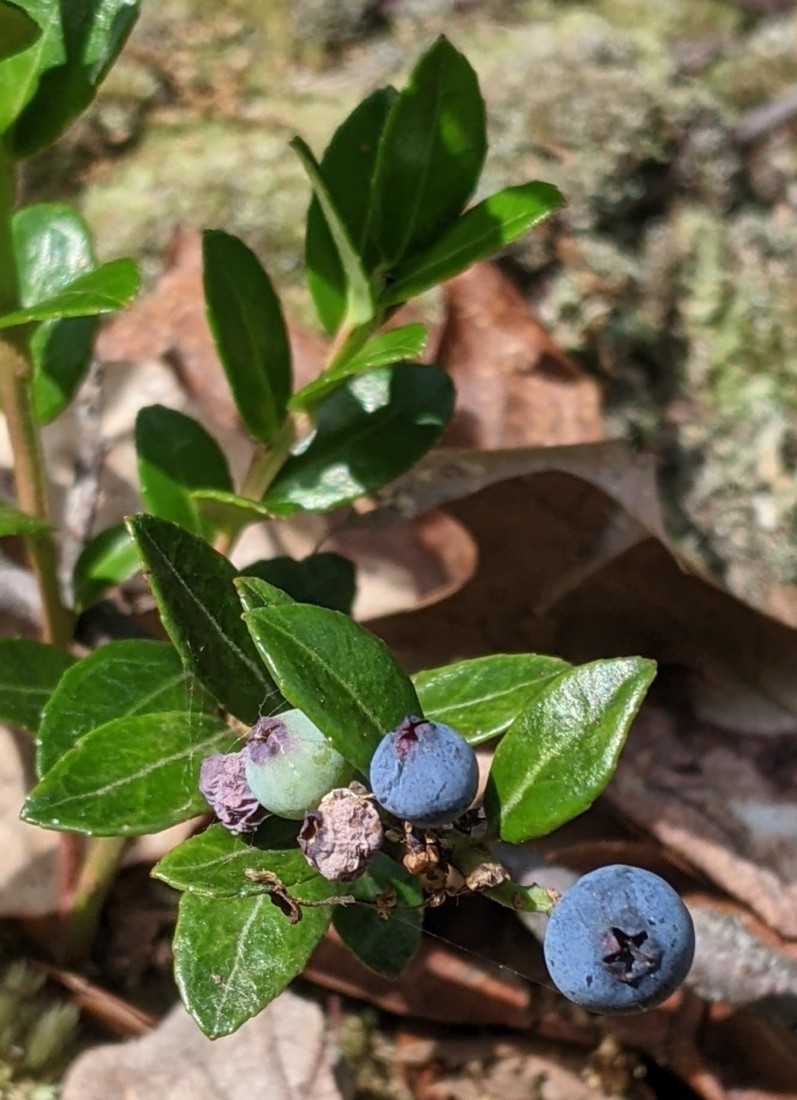
The species is a member of the Ericaceae family, an enormous botanical assembly that includes 4,250 known species such as blueberries, cranberries, and rhododendrons. Box huckleberry is an evergreen woody shrub with creeping stems that rise a mere 6 to 12 inches above the substrate. Unlike other huckleberries (which are deciduous), it maintains its leathery, oval-shaped leaves throughout the year. Even in late autumn, most leaves are green, with a few fading into deepening shades of yellow. In late spring, the plant produces white, bell-shaped flowers with occasional touches of pink. In late summer, light blue berries (similar to small ripe blueberries) appear. Several kinds of wildlife, including grouse and turkeys, eat these berries.
Most amazing is that each population of box huckleberry is a single enormous plant – a botanical Goliath. Box huckleberry does not reproduce sexually. Instead, it constantly clones itself, sending out runners (rhizomes) across its territory. Although it looks like a random assortment of diverse plants, it is a single genetic individual. For most of the year, the plant resembles a sprawling and ubiquitous groundcover, in some places completely dominating the forest floor.
Over time, aboveground stems die and regenerate. New stems sprout from the underground rhizomes to replace older, dying branches in a continuous cycle of vegetative reproduction. The root system, however, survives for millennia. Its evolutionary creep is slow and methodical: a persistent transit through time.
Unlike large trees, whose ages are determined by counting annual growth rings, shrubs such as box huckleberry require an alternate dating procedure. Scientists – over a period of multiple years – calculate the growth rate of the rhizomes in concert with the plant’s overall size. Careful observations over the decades have revealed an average growth rate (or expansion) of approximately 6 inches per year. Using this method, researchers have determined that the Losh Run sector is roughly 13,000 years old, while the Hoverter & Sholl sector is about 1,300 years old. Conserving these longstanding colonies is essential to box huckleberry’s survival.
The box huckleberry colony at the Hoverter & Sholl site provides visitors with a rare opportunity to saunter along one of the most picturesque and delightful nature trails anywhere in the state. The well-marked (27 stations) and easy-to-traverse path meanders through thick woods far removed from the cacophony of urban life. Seemingly everywhere, box huckleberry spreads across the forest floor, like a gigantic tapestry woven among the trees. Eastern hemlocks, oaks, white pines, and hickories dominate the site, in concert with shrubs such as witch-hazel, poison ivy, mountain laurels, and smooth sumacs. All these species offer the filtered sunlight box huckleberry prefers.
Along the ascending trail, meandering swatches of box huckleberry grip the hillside. Concentrated carpets of moss cover exposed boulders, and mountain laurel – the state flower of Pennsylvania – forms thickets all around. It is a world diverse – a clearly distinctive ecosystem.
At the top of the ridge, the path bends to the left and begins its descent. Here, the trees are thicker, the shadows longer. The carpet of box huckleberry thins considerably. As the trail descends, the colony again becomes profuse, denser. Its expanse, measured in centuries rather than feet, is commanding. At the end of the trail, a stone monument with a bronze plaque reminds us that this site “possesses exceptional value in illustrating the natural history of the United States.”