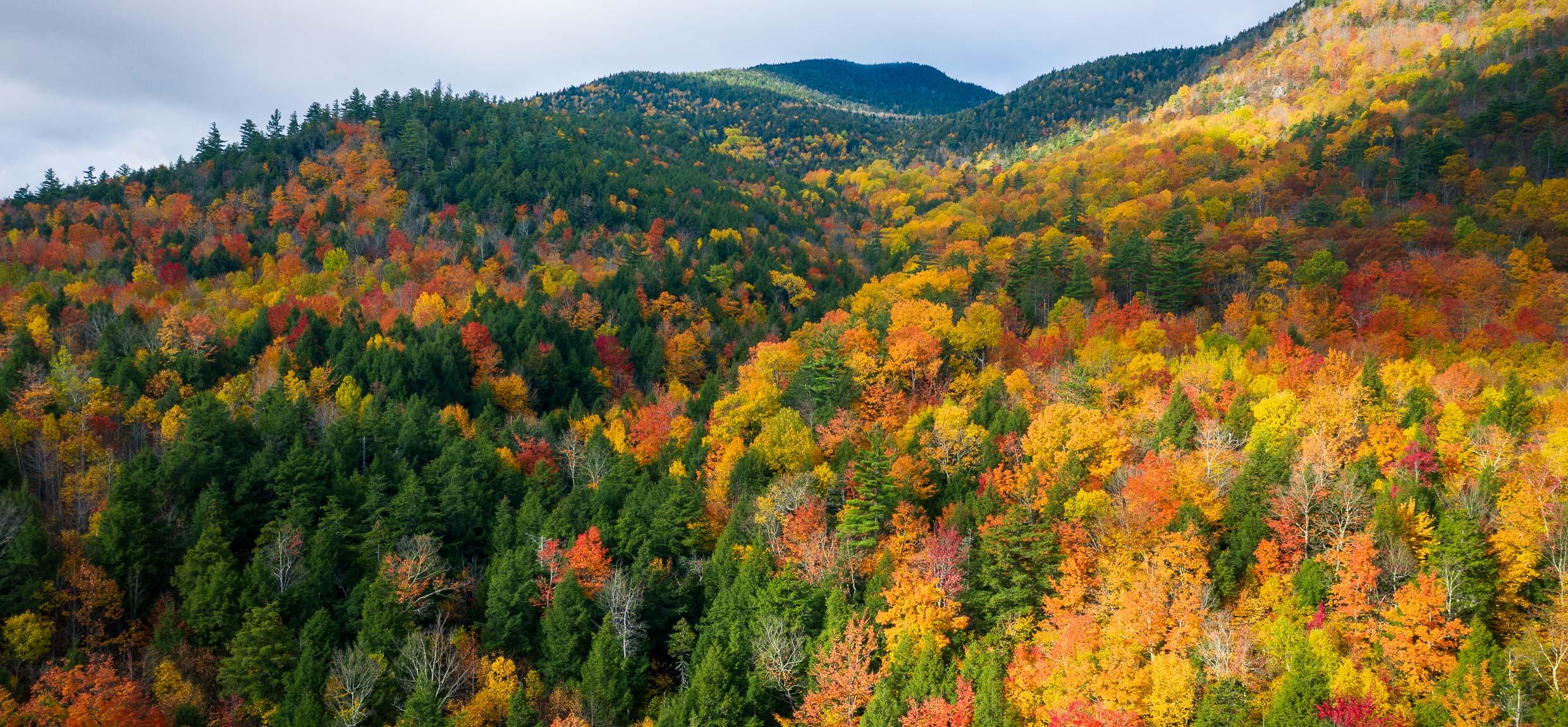


Worldwide, biodiversity is in crisis. Species are disappearing at an estimated 100 to 1,000 times the historical rate, driven primarily by habitat destruction and climate change. According to the biodiversity conservation organization NatureServe, about one-third of plants and animals in the United States now face extinction risk. In the forests of the Northeast, these trends have profound effects on the plants, animals, and ecological services we depend on. To understand what this means for the region and its forests, it helps to ask: What is biodiversity and how do we measure it? What is the status of biodiversity in the Northeast? What steps can we take to support it?
Defining Biodiversity
Biodiversity – short for “biological diversity” – is the variety of life on Earth. It includes everything from microscopic bacteria and fungi to plants, animals, and the ecosystems they form, as well as genetic differences within species and their interactions with the environment.
Because it is impossible to observe every species directly, scientists often track indicator species, whose presence or absence reflects specific habitat conditions. Birds are especially useful indicators because they are easy to observe and closely tied to forest conditions and food availability. For example, the black-throated blue warbler depends on mature forest with a dense, diverse understory that supports abundant insects. This warbler’s absence can indicate a simplified forest community, with such characteristics as low tree diversity, uniform tree ages, or a sparse understory. Tracking indicator species over time helps researchers assess how management actions influence biodiversity.
Biodiversity in the Northeast
In the Northeast, biodiversity has been shaped by dramatic land-use changes since European colonization, including widespread forest clearing and loss of old-growth forests. Today, most forests in the region are relatively young and simplified. About 75 percent of forests in New England and New York are between 40 and 100 years old. Many are even-aged stands that established after intensive clearing or that were high-graded to remove only the most valuable lumber. These forests often lack the variety of tree species, large trees, canopy openings, dense understories, and decaying wood that many wildlife species need.
This simplification has reduced habitat diversity across the landscape, disproportionately affecting species tied to the extremes of forest development: very young forests and very old forests. Old-growth forests, which once covered more than 70 percent of the region’s landscape, now occupy less than 1 percent. Young, or early-successional, forests arise after major disturbances kill mature trees and create open conditions for new growth, but their extent has changed dramatically over time. The precolonial landscape contained roughly 5 percent early-successional forests. By the 1970s, farmland abandonment and subsequent forest regrowth increased that number to about 30 percent. Since then, early-successional forests have declined to just 2 percent of the landscape as forests have matured and natural disturbances – such as beaver flooding and periodic fire – have become less frequent, and as overall forest cover has been reduced. As a result, most young forest habitat today is created through active forest management.
These structural shifts are mirrored in long-term species trends. According to the North American Bird Conservation Initiative’s 2025 State of the Birds report, eastern forest birds have declined by 27 percent since 1970, including species such as the prairie warbler and field sparrow that rely on young forests. Birds requiring complex old forests with diverse understories have also declined.
Native plant species show similar patterns, with more than 20 percent of those in our region identified as extinct, rare, or in decline. Wild pink, a native wildflower that grows in forest openings, has become imperiled, or even lost, from parts of the region as early‑successional habitats have faded. At the other end of the forest age spectrum, lichens reveal the effects of old-growth forest loss on biodiversity. Lungwort lichen, for example, depends on forests with large, old trees; it is now rare or absent across much of the region.
The Importance of Biodiversity in Forests
A forest’s resilience is rooted in its biodiversity. Diverse species, genetic variation, and forest structure all influence how forests respond to pests, disease, and climate stress. Functional redundancy – when multiple species perform similar ecological roles – helps maintain ecosystem stability when individual species decline. For example, forests dominated by American beech, a species important as a wildlife food source and threatened by both beech bark disease and beech leaf disease, will be less resilient than forests with a variety of mast trees. If beech declines in a more diverse forest, species such as red oak can help sustain bears and other wildlife.
Biodiversity supports essential services humans depend on, including pollination, clean water, food, and climate regulation. About one-third of the region’s more than 450 bee species rely on forests, and early blooming trees such as red maple provide essential food for pollinators emerging in spring. Species‑rich forests also tend to retain more water and slow runoff, as diverse tree canopies and leaf litter can improve rainfall interception and soil water storage.
The forests of the Northeast also form a critical wildlife migration corridor between the southern Appalachians and Canada and serve as the breeding grounds for thousands of neotropical migratory songbirds – further underscoring the need for intentional stewardship.
Current Threats to Biodiversity
Today, the region loses about 30,000 acres of forest per year to development and other land uses. This conversion fragments formerly continuous forest blocks into smaller, unconnected patches, limiting wildlife movement, reducing available habitat, and increasing vulnerability to invasive species and climate stress.
Invasive insects such as emerald ash borer and hemlock woolly adelgid threaten keystone tree species and the many organisms that rely on them. Ash trees alone support hundreds of insect species, including about 40 that feed exclusively on ash. Invasive plants, including Japanese barberry, honeysuckle, and European buckthorn, crowd out native wildflowers and tree seedlings, alter soil and light conditions, and offer poor-quality food for wildlife. Buckthorn berries, for example, have a laxative effect, making them an inefficient and harmful food source for migrating birds.
Threats can also come from native species. High browsing pressure from white-tailed deer reduces regeneration of tree seedlings and wildflowers, leading to simplified forests dominated by a few unpalatable plants. This lowers habitat quality for birds and pollinators and reduces resilience.
Climate change adds additional stress. Warming temperatures, shifting precipitation patterns, and more frequent storms challenge species already under pressure. Cold-adapted species, such as balsam fir and moose, as well as species with limited dispersal abilities, including many forest flowers, are particularly vulnerable.
Actions to Support Forest Biodiversity
Supporting biodiversity requires thoughtful forest management, maintaining connectivity, and long-term stewardship. Because managing for every species individually is impractical, ecologists often focus on conserving representative habitat types across the landscape. For example, broad conservation goals such as “30 by 30,” which endeavors to conserve 30 percent of every ecosystem type by 2030, reflect this approach.
Key forest stewardship practices include protecting remaining old-growth forests, managing forests to increase complexity, and creating patches of young forests to support declining early-successional species. Taken together, these efforts promote a mosaic of forest conditions – from young to old.
Forests become more complex over time as small-scale disturbances, such as insect outbreaks and ice storms, kill scattered trees and open gaps in the canopy. These events are relatively infrequent, occurring naturally only every 50 to 200 years in a given location. Where landowners hope to accelerate the development of these features, active forest management can mimic natural disturbance patterns. And where trees or branches fall on their own, embracing the forest’s natural “messiness,” rather than tidying up dead wood and downed limbs, helps support a wide range of organisms.
Another way to diversify forest conditions is by creating larger forest openings that encourage the growth of young trees and other sun-loving species, such as raspberries, cherries, and asters. Because early-successional habitats are short-lived – typically persisting for only about 20 years before growing trees close the canopy and shade out the understory – maintaining young forest habitat requires regularly creating new patches. Yet the stand-replacing natural disturbances that form these habitats, such as hurricanes or microbursts, are very rare, occurring once every several centuries in any one location. As a result, landowners who wish to support early-successional forest habitat often need to rely on intentional management.
Last, conserving biodiversity depends on maintaining connectivity across the landscape. Connectivity allows individuals to move, reproduce, and shift their ranges as climate and habitat conditions change. Protecting natural corridors – such as wetlands, ridgelines, and riparian zones – and avoiding development that restricts movement helps sustain viable populations over time. Together, these strategies support and bolster biodiversity and resilient forests into the future.
Discussion *