
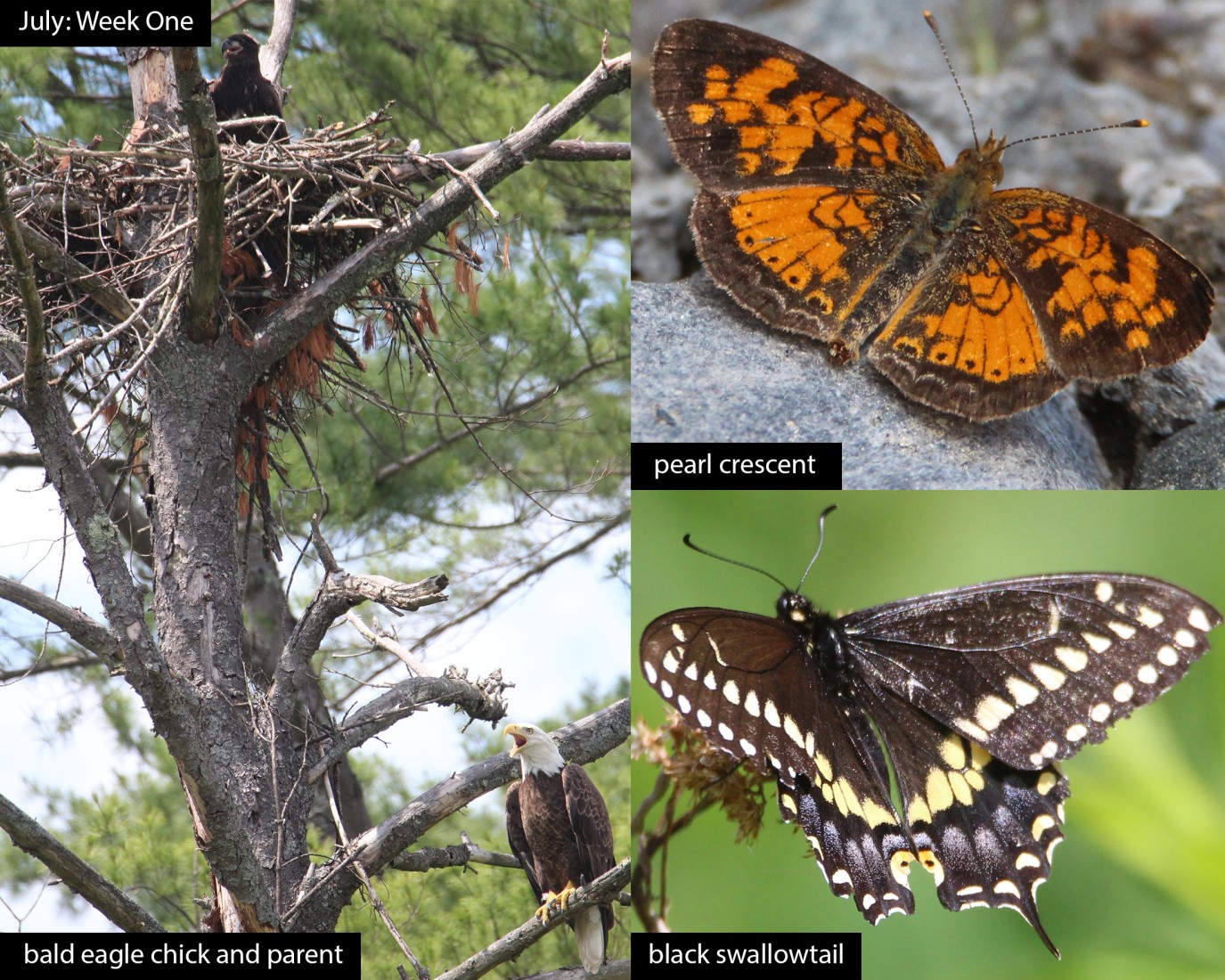
This week in the woods, in time for the Declaration of Independence’s semiquincentennial, we checked up on the United States’ national symbol. Sure enough, the pair of bald eagles whose nest in Lyme, New Hampshire, we wrote about previously has raised a chick now large enough for us to spot from the ground. The eaglet has shed its light-gray hatchling feathers, taken on a darker plumage, and begun to approach adult size but remains in the nest, brought prey by the hunting parents. Our neighbors in Quechee, Vermont, at Vermont Institute of Natural Science also have a live video feed of bald eagle parents and their chick. If the Lyme eaglet hatched at approximately the same time as the Quechee one (April 24), we can expect it to fledge in late July or early August.
Two butterflies we saw recently – pearl crescent and black swallowtail – have peak abundance this month. Common in open, sunny habitats, both species fly from mid-May to early September and have two broods per year, in June and between mid-July and mid-August. The broods overlap this month, hence the peak. The long flight season means that they must nectar on numerous flower species as adults. Meghan McCarthy McPhaul wrote about the black swallowtail’s caterpillar for The Outside Story in 2015 and described its numerous defense mechanisms: spikes, resemblance to a bird dropping during its first two instars, a set of yellow stripes that suggest toxicity, and an osmeterium (an organ resembling a snake’s tongue and releasing a foul smell).
What have you noticed in the woods this week? Submit a recent photo for possible inclusion in our monthly online Reader Photo Gallery.