
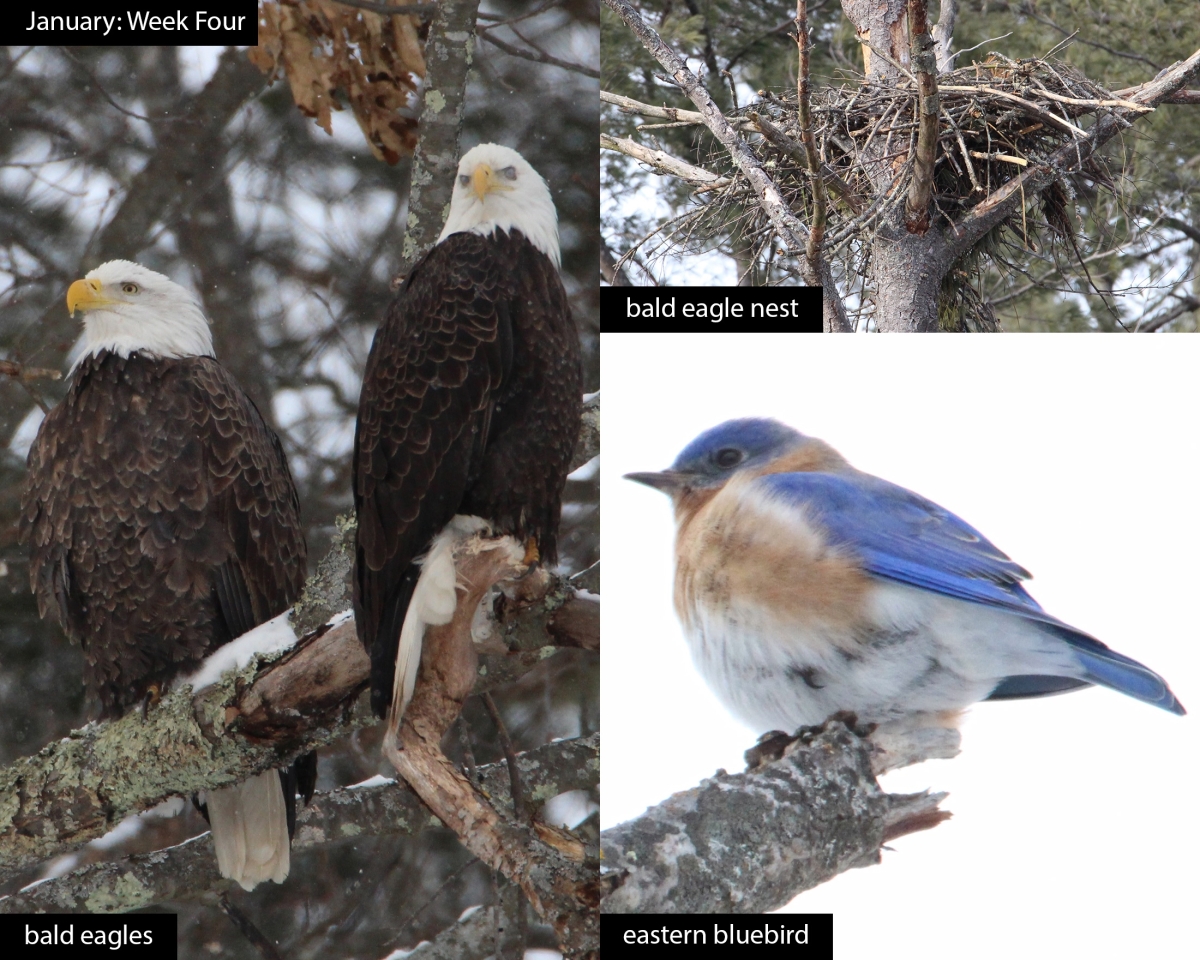
This week in the woods, we encountered a pair of bald eagles that had begun rebuilding a nest in Lyme, New Hampshire. Many overwintering birds, like the bald eagle to the left, fluff up their feathers to trap warm air closer to their bodies. The mid-blink eyes of the bird on the right show their glaucous third eyelids, or nictitating membranes. All birds (and many other animals, such as housecats) have these semi-transparent lids, which move front to back, clear debris, and moisten the eyes. They enable some diving birds to see underwater and close protectively when woodpeckers’ bills hit wood.
Massive, inelegant bald eagle nests exceed any other North American species’ nest in size, reach up 9 feet wide and 4 feet deep, weigh up to a ton, and can support the weight of a full-grown human being. The initial construction process can take an entire season to complete, with both male and female collecting sticks. Pairs might not use a nest to raise chicks for a full year, but once they establish it, they can repair and refurbish it annually for years, and nests can even last decades, with successive pairs occupying and maintaining them.
Bald eagle population recovery is a classic, familiar environmental success story. Once common (estimated in the hundreds of thousands continentwide in the 1700s), fewer than 100 nested in the entire Northeast by the 1960s. Hunting and habitat loss drove the decline in part, but DDT (dichloro-diphenyl-trichloroethane) did most of all – and affected numerous other birds; the synthetic pesticide killed smaller bird species outright and caused larger birds like the eagle and osprey to lay thinner-shelled eggs that incubating parents broke and stunted these birds’ embryonic development. Conservation efforts in the 1970s – the Environmental Protection Agency’s ban on DDT, passage of the Clean Water Act and Endangered Species Act, and state agencies and nonprofit organizations placing captive-bred chicks in wild adult eagle nests – largely succeeded, and the bald eagle was removed from the Endangered Species List in 2007. New Hampshire Audubon’s 2025 Breeding Season Count tallied 128 pairs statewide, and Audubon Vermont counted at least 45 pairs in 2024. Despite the recovery, bald eagles still face threats from collisions with cars and trains, mercury poisoning, lead contamination from fishing tackle and hunting ammunition, and electrocution from power lines.
The eastern bluebird also has a recovery story to tell. Loss of habitat and nesting sites saw the bird decline across the continent in the 20th century, but populations rebounded with the installation of bespoke nest boxes and with many of the same efforts that aided the bald eagle, including the ban on DDT. Bluebirds sometimes combat low temperatures by huddling together in tree cavities at night and, like other songbirds that overwinter in the north, they forage prodigiously, shiver while at rest, and fluff up their feathers. If you look closely at this individual’s belly, you can see the protruding claw of a leg tucked against its body. While long-legged species like herons and egrets stand on one leg most conspicuously, all birds do so. In the winter, this behavioral adaptation halves the heat lost through unfeathered limbs.
What have you noticed in the woods this week? Submit a recent photo for possible inclusion in our monthly online Reader Photo Gallery.