
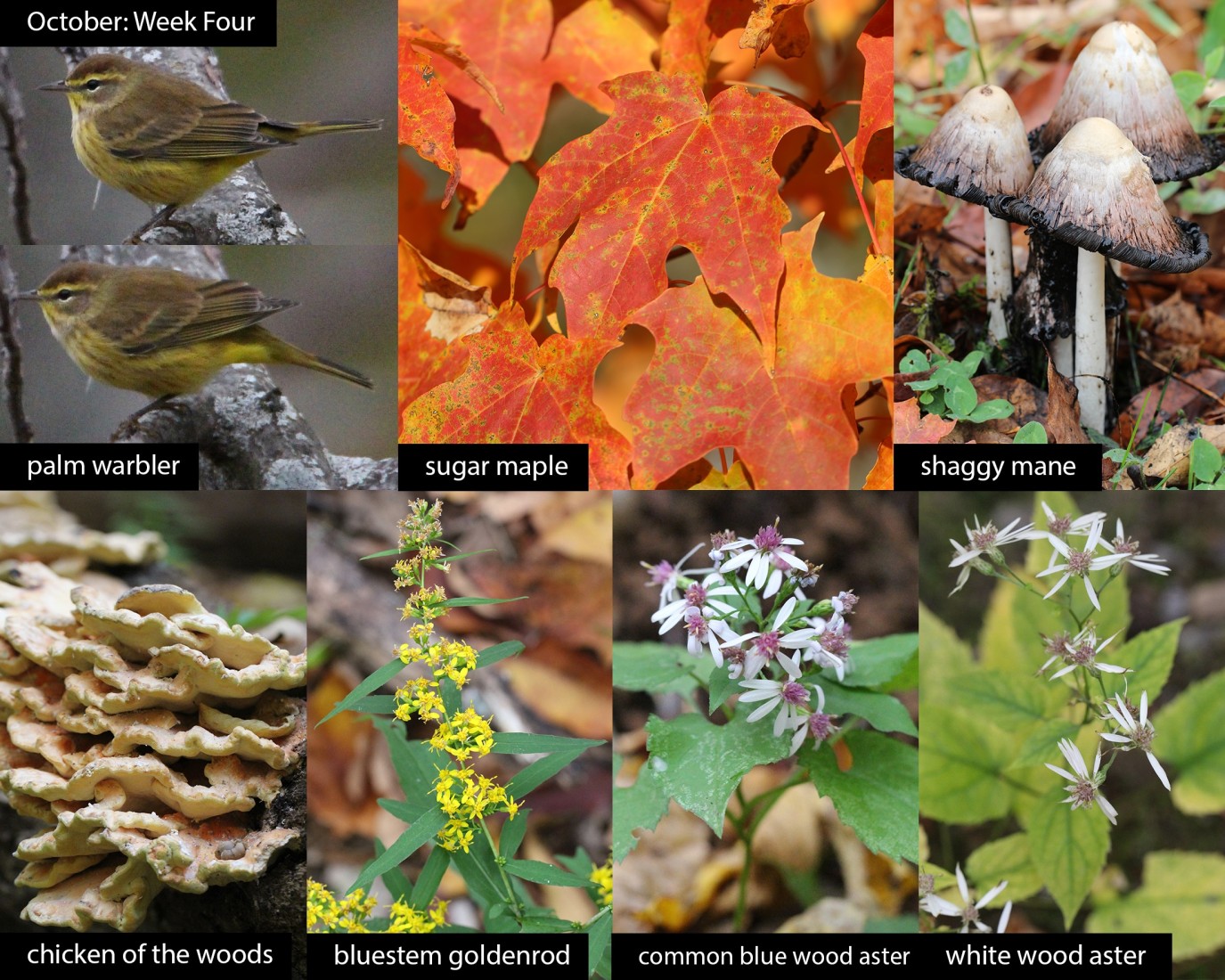
This week in the woods, a palm warbler gave its telltale tail wag during a pit stop on its way south. Despite its tropical name, this bird breeds in the coniferous boreal expanse to our north, and the majority of New World warblers nest exclusively or mostly in Canada and the extreme northern United States. Perhaps ironically, the Canada warbler stays with us through the summer, as do many other breeding species, but we get the bay-breasted, orange-crowned, Cape May, blackpoll, and Wilson’s warblers only in passing in spring and fall. Almost all our warblers travel under cover of darkness, but we can occasionally see some shorter-distance migrants – including the palm and yellow-rumped – moving by the thousands during the day.
Yellow pigments have been present in deciduous trees’ leaves throughout the year, but green chlorophyll masks it until it breaks down. More trees – like birches, hickories, and aspens – show yellow pigments, and fewer (like red maples) show red pigments, which they synthesize shortly before dropping leaves and often on brighter days. Sugar maples can show red on their outermost leaves and blend to orange and pale yellow at the cores of their canopies. Even before they fall, leaves serve as a platform for fungal spores dispersed by the wind and deposited from the atmosphere.
By autumn, the deposition of spores has grown especially heavy, and a single leaf may host several thousand spores per square inch. Saprophytic fungi (which get their energy and nutrients from dead and decaying organic matter) feed on the metabolites leaking from the leaf’s aging epidermal cells and on pollen, which has also increasingly collected on its surface. As Peter J. Marchand writes in Nature Guide to the Northern Forest, “the inevitable fate of the leaf is foretold high in the forest canopy,” and with fungal succession, the community on the autumnal leaf shifts toward saprophytes. The colony rides the leaf to the ground, and the fungi on the leaf may play a role in the initial decomposition of that very leaf: “The task of recycling the bulk of this organic windfall now belongs primarily to the class of litter-dwelling fungi known as Basidiomycetes that form many familiar gilled mushrooms,” writes Marchand. “These are the real heavy hitters, equipped with the enzymes necessary to break down the tough lignins, cellulose, and strong defense compounds of the plant leaf.”
One such member of the Basidiomycota phylum, the shaggy mane (also known as shaggy ink cap or lawyer’s wig) fruits most commonly at about this time. Like others in the inky cap group, as these mushrooms mature, the edges of their caps flare and turn upward in order to release their spores, and their gills dissolve and turn into an inky black fluid. Shaggy mane are edible and asparagus-like in their taste as long as their gills remain white, and they do some eating themselves: they catch and consume nematodes, or round worms.
Chicken of the woods has had its final flush of the year by now and has passed the point of edibility, but we can still easily spot the thick, bright-orange remnants of its fruiting bodies persisting on dead or dying trees. The raggedy remains of some last woodland flowers have stuck around as well, sometimes weeks after they first blossomed.
Bluestem goldenrod – also called blue-stemmed or axillary goldenrod – grows in the shade or edges of rich, moist forests. Both this habitat and its appearance differ from other goldenrods’ typical field settings and steepled structures. Its flower heads sprout in compact clusters from the axillary parts of the plant, in the “armpits” beneath the leaves. The stems reach their deepest purplish-green as the season progresses.
Like its fellow late-bloomers the goldenrods, the American-asters have many species in their genus (about 250). You likely won’t see other daisy-like flowers in autumn. The common blue wood aster boasts 10 to 20 pale blue or violet rays with a center that turns pinkish or purplish this time of year, and the white wood aster has flower heads with white rays arranged in open, flattish panicles. Both species’ basal leaves have the cordate shape that earn them their other common names (heart-leaved American-aster and common white heart-leaved aster respectively), but the latter’s will have withered by flowering time.
What have you noticed in the woods this week? Submit a recent photo for possible inclusion in our monthly online Reader Photo Gallery.