
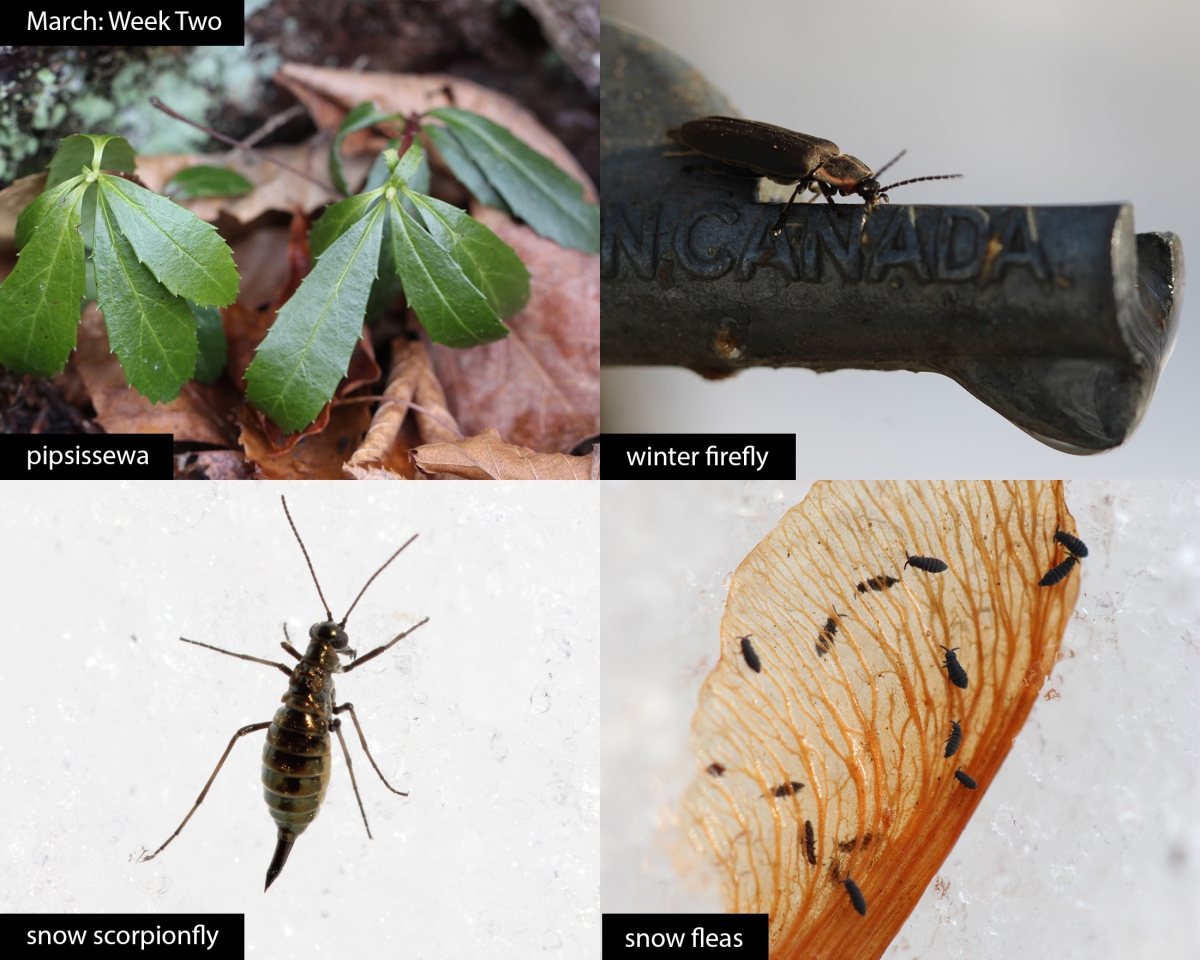
This week in the woods, snowmelt revealed what has remained green all winter: wall scalewort reaching toward the blue sky from around tree bases, Christmas ferns flattened against the leaf litter, and other ground cover, like our wild-growing strawberry species, partridgeberry, clubmosses, and three-leaved goldthread. The evergreen woodland subshrub pipsissewa – also known as prince’s pine, waxflower, and bitter wintergreen – has the scientific name Chimapila umbellata. Chimapila comes from the Greek cheima, meaning “winter weather.” The plant’s slender woody stems retain whorls of lance-shaped, glossy, sharp-toothed leaves through the seasons. It puts on a few new branches of growth each year and spreads in mats across the forest floor. Come July, it will produce loose clusters of nodding, waxy pink-white flowers.
Ann Little photographed three snow-crawling invertebrates this week with misnomered common names. While its larvae have faint bioluminescence, the adult winter firefly has no lantern, does not use illumination to attract a mate but instead employs pheromones and good old-fashioned sight during its daytime active hours; like all fireflies or “lightning bugs,” it is also neither a fly nor a true bug but rather a soft-bodied beetle. The snow scorpionfly (of which we have two species) qualifies as neither a true fly nor, as you might guess, a scorpion; it belongs to the order Mecoptera, with the hangflies. Snow fleas are not fleas or, in fact, even insects; the miniscule things we see scattered like ashes or black pepper on snow in New Hampshire and Vermont are one of thousands of species of springtails, the six-legged hexapods that belong to their own class, Collembola.
Having overwintered as adults in deeply grooved tree bark and survived on energy reserves, winter fireflies emerge in early spring, sometimes as early as late February, sooner than nighttime temperatures rise high enough for other insects’ muscles. They often appear on the sunlit side of tree trunks and find their ways to sap flows from freeze cracks and taps, like here, earning them the nickname sap bucket beetle. Otherwise, the carnivorous insects eat a range of other invertebrates. “As is always the case with predators and prey,” writes Declan McCabe in his Winter 2023 Invertebrates Bestiary column, “winter fireflies are scarce as compared to the creatures they hunt,” and they represent the midpoint of a healthy food web.
Female snow scorpionflies have stubby wings, and males have slightly larger ones with which they cradle the females during mating. Despite the wings, snow scorpionflies do not fly and instead walk and hop across the snow in search of food and mates. A number of adaptations allow them to stay up to six degrees warmer than the air around them: their dark cuticles absorb solar radiation, their long legs keep their contact with the cold snow minimal, and they remain close to the boundary layer, with slowest convective airflow, least wind chill, and reflected solar heat.
When snow begins to thaw, snow fleas make their way to the surface as well. As Bill Amos explains in an Outside Story article from our archives, snow fleas consume a varied diet of soil bacteria, fungi, pollen, and other organic material; during their time on the snow, they favor wind-blown plant matter like pollen grains and seeds, as shown here, and spores and algal cells.
What have you noticed in the woods this week? Submit a recent photo for possible inclusion in our monthly online Reader Photo Gallery.
Discussion *