
As summer ticks towards autumn, the flow of birds heading south for the winter grows in volume until it becomes a rushing torrent of migrants in September and into October. Millions of birds – hundreds of millions, in fact – will pass through the Northeast’s airspace during this time, as species that bred up north head to warmer locations. But this southbound river of migrating birds all began with a few drops as far back as early July, when a handful of shorebirds from northern arctic and subarctic regions started heading south.
One of those early migrants, and one of the most frequently encountered shorebirds in interior parts of the Northeast, is the solitary sandpiper (Tringa solitaria). Aptly named, the solitary sandpiper generally travels and forages by itself, unlike most other shorebirds, which tend to congregate in large flocks during migration and on their wintering grounds. The exception for the solitary sandpiper is during the breeding season, when males and females form monogamous pair bonds and remain together for a few weeks.
In addition to being a bit of an outlier with regard to its social life, the solitary sandpiper stands alone among North American sandpipers in its nesting behavior; it uses abandoned songbird nests in Canadian and Alaskan boreal forests, typically in muskeg bogs. Because these birds breed in remote areas that are difficult for people to access, we know very little about their breeding ecology. The avian ecologist Lewis W. Oring was one of the few to study these birds on their breeding grounds, and his accounts from the 1960s and 1970s (along with those of a few others from the 1920s and 1980s) provide glimpses into this world. Oring found that shortly after arriving on their breeding grounds in May, solitary sandpipers begin looking for appropriate nests. Males do the nest-searching, and when a possible nest is located, the male calls to the female to inspect the nest for suitability. Oring noted that the sandpipers most frequently used nests of the American robin, rusty blackbird, cedar waxwing, Canada jay, and eastern kingbird.
Once the female selects a nest, she does a little neatening up of the nest cup, and then lays, on average, four speckled eggs. Both the male and female incubate the eggs, but what happens after hatching is mostly a mystery. The young, which are downy and precocial (born alert and mobile, with their eyes open) abandon the nest soon after hatching and likely remain with one or both parents for some period of time before becoming independent. There is no information on the duration of parental care (if any) nor on what happens during the fledgling period. Adults begin migrating first, especially those that lost their eggs or young to predators or inclement weather. These adults are the ones to first arrive in the Northeast in early to mid-July, appearing at almost any source of freshwater, including flooded fields, drainage ditches, and other temporary water bodies in addition to ponds, wetlands, and riverine systems.
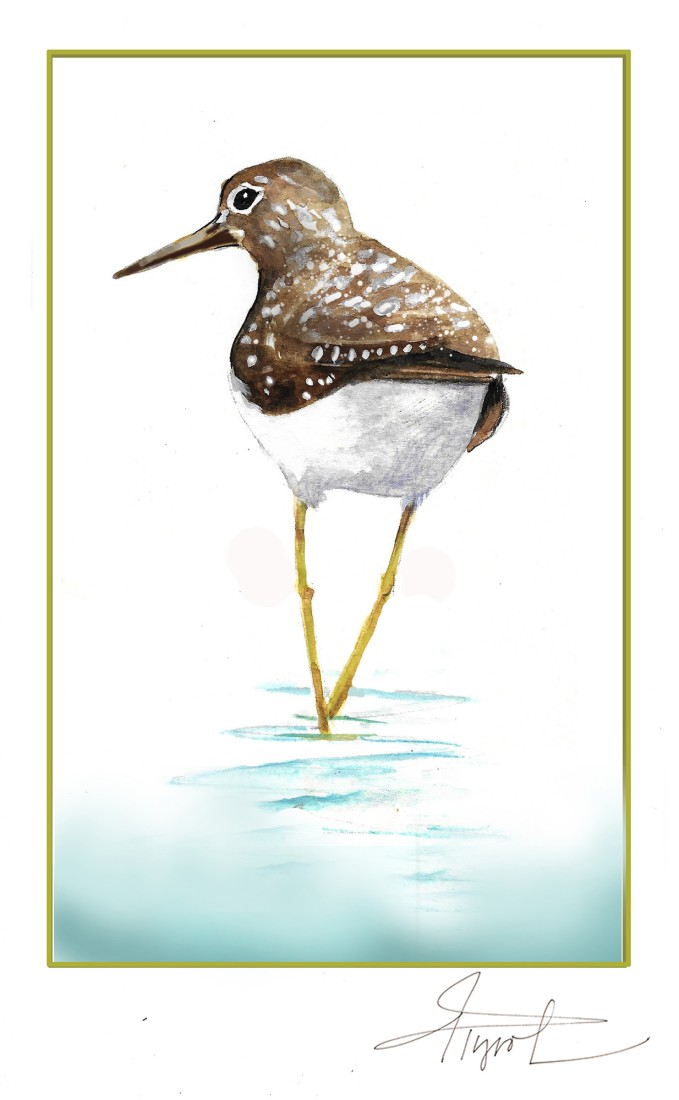
The timing of peak solitary sandpiper autumn (or more accurately, “post-breeding”) migration varies a bit across the region but generally occurs in August. Venture into quiet backwaters of streams, rivers, ponds, and wetlands during this time, and you are likely to come across this robin-sized shorebird with long greenish-yellow legs, a clean white belly, brown back flecked with white, and a bold white eye-ring. One of the characteristic behavioral traits of the solitary sandpiper is that it often bobs its upper body when standing in one spot or as it walks along the edge of the water looking for invertebrates, small fish, and tadpoles. When flushed, it often utters a sharp wheet-wheet-wheet as it flutters to a new location. Upon landing, solitary sandpipers have the distinctive habit of keeping their wings raised above the body for a few beats before dropping them to their sides.
By late September, most of these birds will have moved further south, and many will already have reached their wintering destinations in Central and South America. For the next few weeks, however, we get to enjoy these long-legged loners as they patrol our inland waters.