
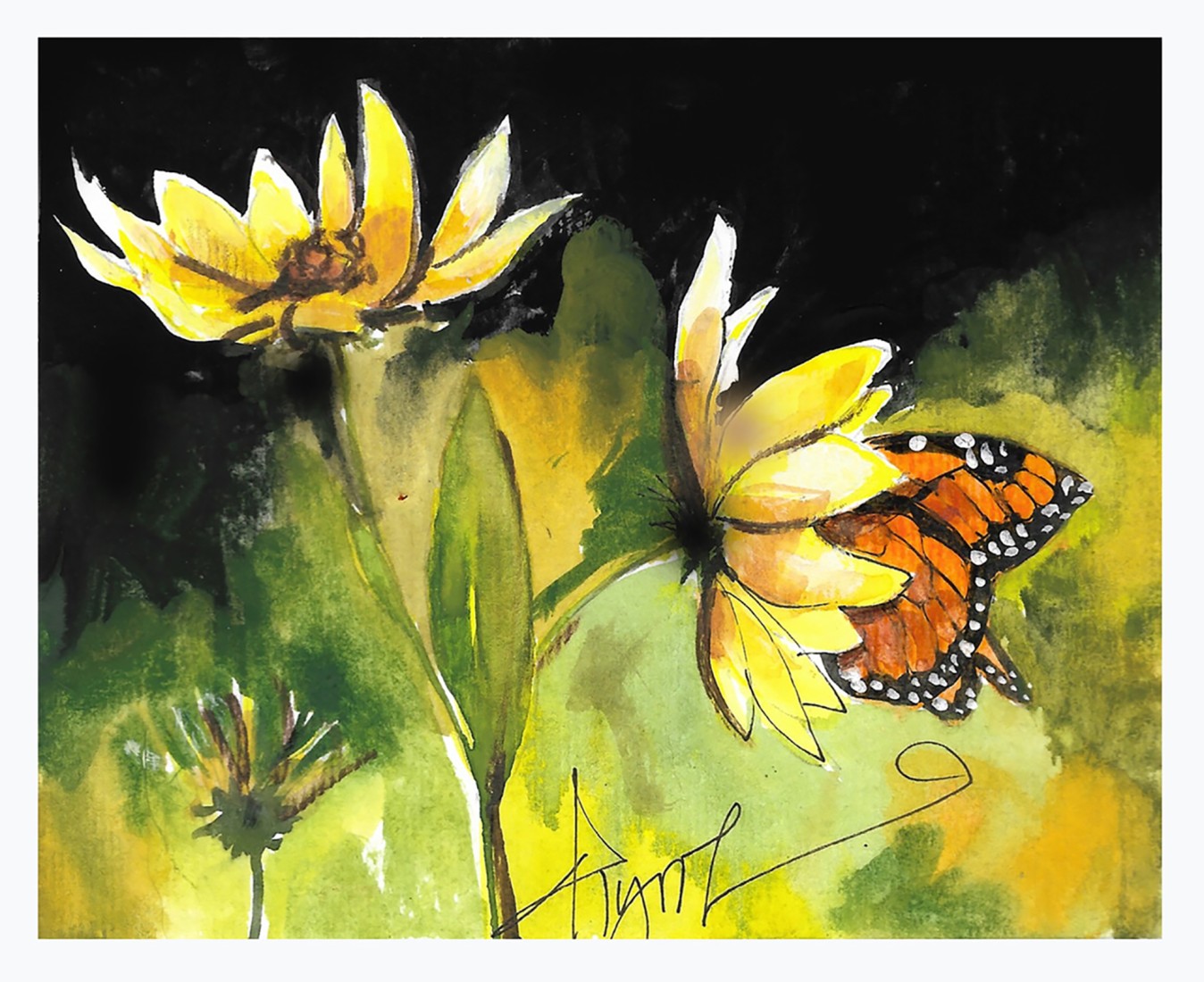
Among the most widely cultivated and recognizable plants growing in gardens this time of year are sunflowers, members of the genus Helianthus. The showiest species and hybrid varieties within this cheery botanical club, such as common sunflower, often steal the limelight for their size and color. But it’s worth getting to know northern New England’s three native Helianthus species: woodland, pale-leaved, and thin-leaved sunflower.
Etymologically speaking, Helianthus is a blissfully straightforward genus. The name is derived from two Greek words: Helios, for sun, and anthos, for flower. There are 56 Helianthus species within the genus. Many of these originate in North America, largely in the Midwest, and can now be found around the world as crops and, in some cases, invasive plants.
The native sunflowers of northern New England all inhabit woodlands and their edges. Woodland sunflower (Helianthus divaricatus) and pale-leaved sunflower (H. strumosus) do well in fields and meadows, while thin-leaved sunflower (H. decapetalus) may also be found in floodplains and other wet areas. Pale-leaved sunflower is classified as rare to uncommon in Vermont.
The botanically curious may want to hone their plant identification skills with a different genus. All three native sunflowers sport the circular yellow flowers characteristic of the genus at large, but The Native Plant Trust warns that to tell Helianthus species apart, “observation of small flower and fruit parts are necessary. You will need a good hand lens and a ruler with millimeter divisions.” Eastward range expansion by Midwestern species and the spread of cultivars from gardens into natural landscapes have allowed many non-native species to hybridize with our three native ones, making positive identification in the field all the more difficult. Distinctions are often found only among each species’ bracts, stems, and rhizomes.
While most species of sunflower provide some amount of wildlife value, our three natives have co-evolved over millennia with the assemblage of species found in our region. This makes them the best choice for supporting native insects and wildlife. All three native sunflowers are a boon for many stripes of pollinators. Bees, from tiny sweat bees to swaggering bumblebees, frequent them, often in the company of butterflies, syrphid flies, and wasps. Several species of mining bees, genus Andrena, specialize on them, along with a handful of mason bees, leafcutter bees, and resin bees. The nectar of woodland sunflower, in particular, is reportedly a favorite of the endangered Karner blue butterfly.
Our native sunflowers’ wildlife value extends beyond the sustenance they offer pollinators. All three are larval host plants for the silvery checkerspot, a small butterfly considered extirpated in New Hampshire and very rare in Vermont. Another butterfly, the painted lady, also uses woodland sunflower as a host. Sunflowers’ hollow stems provide overwintering sites for wild bees, while muskrats incorporate the stems of thin-leaved sunflower into their lodges. In fall, songbirds and game birds, as well as small mammals, feast on the ripe seeds. A favorite childhood memory of mine is watching goldfinches pluck the seeds from sunflower heads in my mother’s garden at the close of summer, the black-and-yellow color schemes of the birds’ feathers and the flowerheads a near-perfect match.
These plants offer other curiosities. Sunflowers exhibit heliotropism, a behavior whereby the flower buds of seedlings rotate to follow the sun’s daily east-west parabola. After sunset, the seedlings will reorient their buds toward the east in preparation for sunrise. Blooming flowers become fixed in their eastward direction, perhaps to take advantage of the warmth of the sun’s early rays at a time when pollinator activity is at its morning height.
The disc florets within the larger sunflower head, meanwhile, are arranged according to the Fibonacci sequence, a pattern of numbers that, when represented in nature, forms the “golden spiral,” showing up in everything from gecko tails to galaxies to – yes – sunflowers. Add mathematical marvel to sunflowers’ list of enchantments.
The sweeping selection of sunflower varieties available at commercial nurseries is evidence of our longstanding infatuation with this genus. But as with so many other plant genera, there are delightful species native to our region that deserve just as much attention and reverence, if not more, for how they support local ecosystems. Keep an eye out for them these next few weeks as you stroll in or around your favorite woodland.