

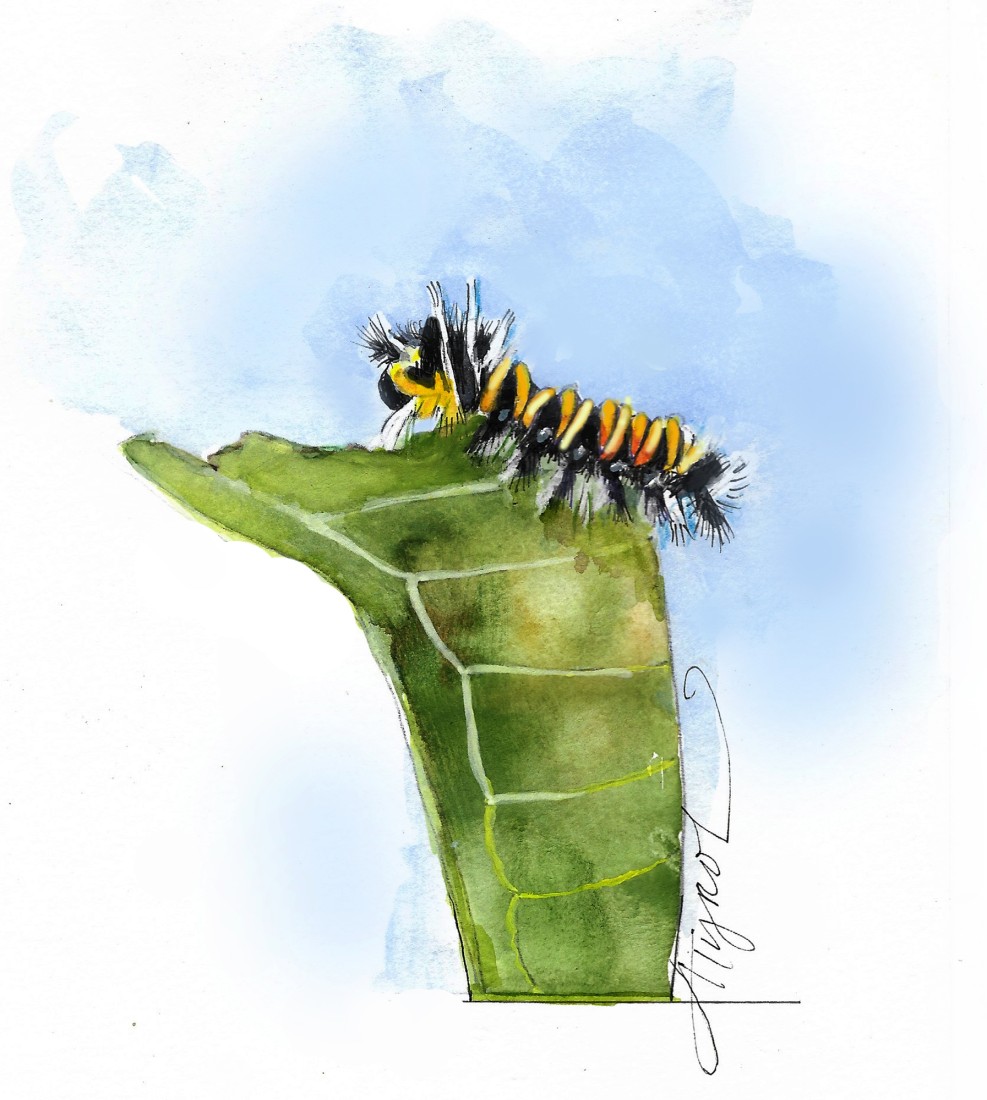
The black and orange stripes catch my eye as I swing the scythe through dew-laden grass. My eyes typically follow the tip of the 28-inch blade as I mow, trying to keep it level with the ground, but the contrasting color pattern pulls my attention to milkweed plants just a few feet to my right. A group of seven very hairy caterpillars, sporting alternating tufts of black, white, and orange hairs, are nibbling away at a leaf. They have already reduced nearby leaves to just limp central veins. These gregarious feeders are the larval form of the milkweed tussock moth (Euchaetes egle).
This August morning, I mow around my apple trees from the trunks to a few feet beyond the edges of their canopies in preparation for the coming harvest. The milkweed grows in an unmown alley between the tree rows, and I am delighted to see these caterpillars here now. Based on the presence of their colorful hairs, these caterpillars have already passed through a few instars, or larval stages. Weeks earlier, a female moth deposited dozens of eggs on the underside of a leaf. At first, the tiny larvae feed together in one large mass, but by the third instar they disperse and feed in smaller groups, like the one I admire now.
Milkweed tussock moths are native and common throughout much of the eastern United States, and are abundant in Vermont, New Hampshire, and Maine. The hairs of these caterpillars are not venomous, but they are barbed and serve as a defense against birds and other predators. Hairs come out from everywhere on the caterpillar’s body, with longer tufts of black and white on either end, and more tightly bundled and shorter tufts of black, white, and orange in the middle. The striping pattern is visually stunning and communicates to would-be predators that they are not a pleasant meal.
Milkweed plants produce toxic compounds in their sap that make them unpalatable to most insects. Milkweed tussock moth caterpillars have developed a specialized metabolism that allows them to ingest these toxins and then store them in their skin. If this strategy sounds familiar, that is because it is the same approach monarch caterpillars use. Both species feed exclusively on milkweed, capitalizing on its defensive strategy and turning it into their own. Even more amazing is that these toxic compounds are carried through metamorphosis and into their adult forms.
Monarch butterflies advertise their toxicity through their brilliant orange and black wings. The milkweed tussock moth, on the other hand, has dull gray-brown wings that mask an orange and black abdomen. So why has the moth reduced its brilliant larval colors into cloaked undergarments? Monarchs fly by day, and milkweed tussock moths by night. The moth no longer needs a visual cue.
Bats, which use sound rather than sight to hunt their prey, are the primary nighttime predators of milkweed tussock moths. Incredibly, the moths have developed a way to communicate to bats that they are distasteful: using a pair of specialized organs called tymbals, they produce high-frequency clicks. When moths detect ultrasonic pulses from an attacking bat, they respond with clicks of their own that match the frequency of the bats’ sonar. Scientists have tested this evasion strategy and shown that the auditory clicks need to be paired with actual toxic compounds to deter the bats’ behavior. Other species of tiger moths, the family group to which milkweed tussock moths belong, use a jamming technique to distort the sonar to evade bat capture. The moth produces an extremely high rate of clicks, which scrambles the returning signals to the bat, causing it to misjudge the exact location of the moth right before capture. It amazes me to think of this species interaction that is beyond our human perception.
What I can perceive is that these fuzzy caterpillars are doing well on this milkweed patch in my orchard. In a few weeks, they’ll crawl down under some leaf litter or duff, spin a cocoon, and overwinter as pupae. Next spring, they will emerge as adult moths to start another generation, and I will keep leaving milkweed to grow in the orchard for them and the monarchs to feed on.