

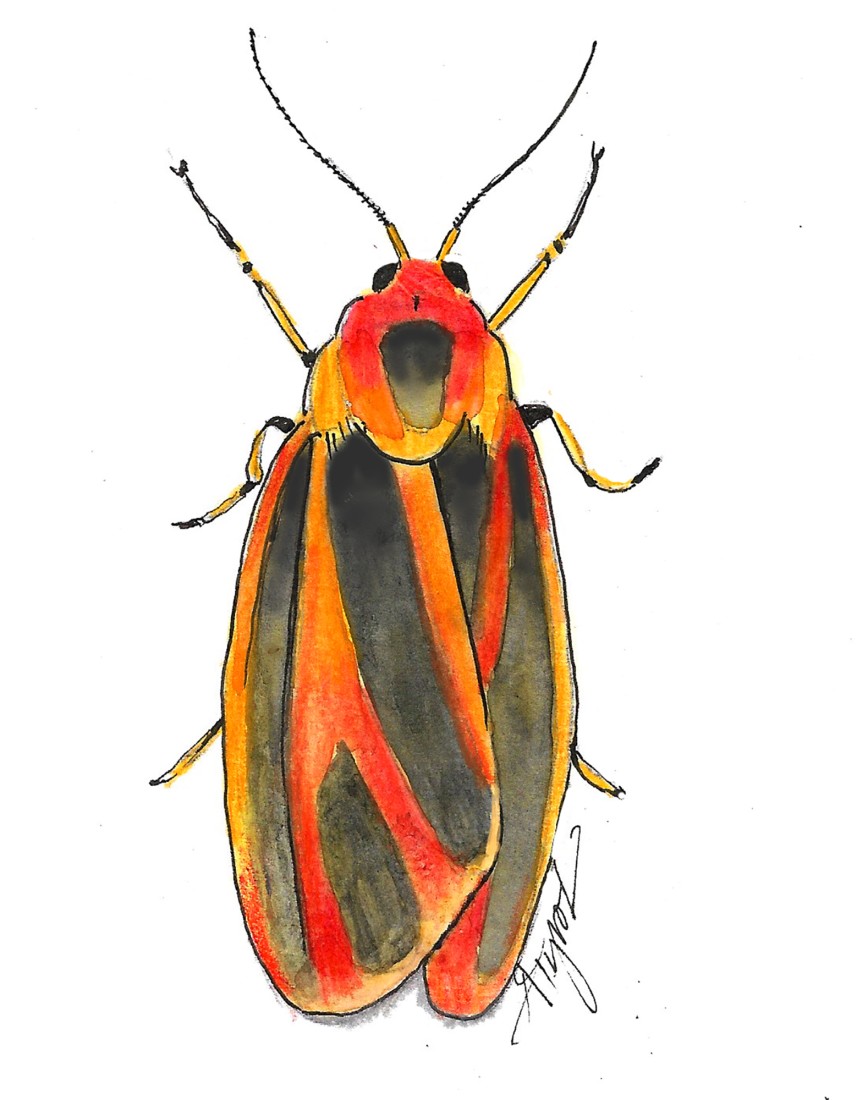
A stunning moth visits my deck in late summer. At an inch long, it doesn’t have the stature of a luna or cecropia moth, but the brilliant gradient of vermilion to gold across its wings and body, offset with contrasting black bars, is eye-catching. It’s a painted lichen moth, a member of a group of small moths whose caterpillars are known for feeding on lichens.
Most lichen moths are nocturnal, but a few, like the painted lichen moth, are day-flying. The day-flyers tend to be brightly colored, often with orange, red, and black markings. Getting to know lichen moths is tricky: they are small, and most are nocturnal and drably colored. Their caterpillars are even smaller and often disguised to look like part of the lichen they feed on. Lichen moths are a diverse group with many species, only some of which are well known, like the painted lichen moth. Painted lichen moths are widely distributed in North America and live east of the Rocky Mountains. In the wild, their caterpillars are found on tree trunks, eating foliose lichens, but they have been successfully reared in captivity on algae, suggesting that they aren’t picky eaters.
Timothey McCabe, curator of entomology at the New York State Museum, studies lichen moths and related species by attracting adult moths to a light, capturing them and keeping them until they lay eggs. He then rears the caterpillars that come out of those eggs. By offering the caterpillars a selection of foods and tracking their preferences, he narrows down which microhabitats are worth investigating for more caterpillars. Newly hatched lichen moth caterpillars are around 1 millimeter long, much too small to hunt for in the woods without a few clues for where to look.
Information on lichen moth caterpillar dietary preferences is limited, in part because they are hard to find and monitor. McCabe sometimes offers caterpillars leaves from documented host trees, only to find they aren’t interested. Instead, they eat lichens or algae that grow on those tree species. Entomologists often collect caterpillars by holding a cloth platform, called a beating sheet, beneath a tree while they vigorously shake branches above to gather any dislodged insects. While this strategy can make discovering tiny caterpillars easier, it also removes them from their ecological context. Entomologists record the tree species, assuming the caterpillars were eating the tree, but instead they were feeding off something growing on the bark.
McCabe uses a microscope to see what exactly lichen moths and other lichen-eating caterpillars are consuming. Some eat algae, some like fungi (including lichenized fungi), and others prefer decaying plant material. Some species are very picky while others eat anything on the menu.
Any given species of lichen-eating caterpillar can be very choosy about which lichens it will accept. Caterpillars of the gray Zanclognatha theralis moth are suspected to feed only on beard lichens (Usnea species). However, there are few lichens that don’t have somebody willing to eat them. McCabe noted that crustose lichens, those that form a flat crust tightly attached to their substrate, are less likely to host caterpillars.
McCabe suspects that if he could closely observe more lichen moth caterpillars, many would turn out to rely on algae as the bulk of their diet, especially when they are young. However, the lichens they eat might still be important for providing the caterpillars with critical chemical compounds. Each kind of lichen produces a signature cocktail of chemicals, any one of which could be useful for growing caterpillars to ingest. Monarch butterflies and milkweed tussock moths sequester milkweed toxins; lichen moths might similarly be absorbing toxins from lichens that contribute to success in courtship, protect them from predators, or increase their parasitoid resistance. While more research is needed, it could explain why some lichen moths have eye-catching, high-contrast colors.
If you keep an eye out, the day-flying lichen moths aren’t difficult to spot, but finding a tiny, cryptic lichen moth caterpillar, if you aren’t a professional, might take a hefty dose of luck. If you do find one, McCabe recommends watching their feeding and behavior closely. “Get a microscope or a hand lens and see what it’s actually doing,” he said. It might surprise you.