
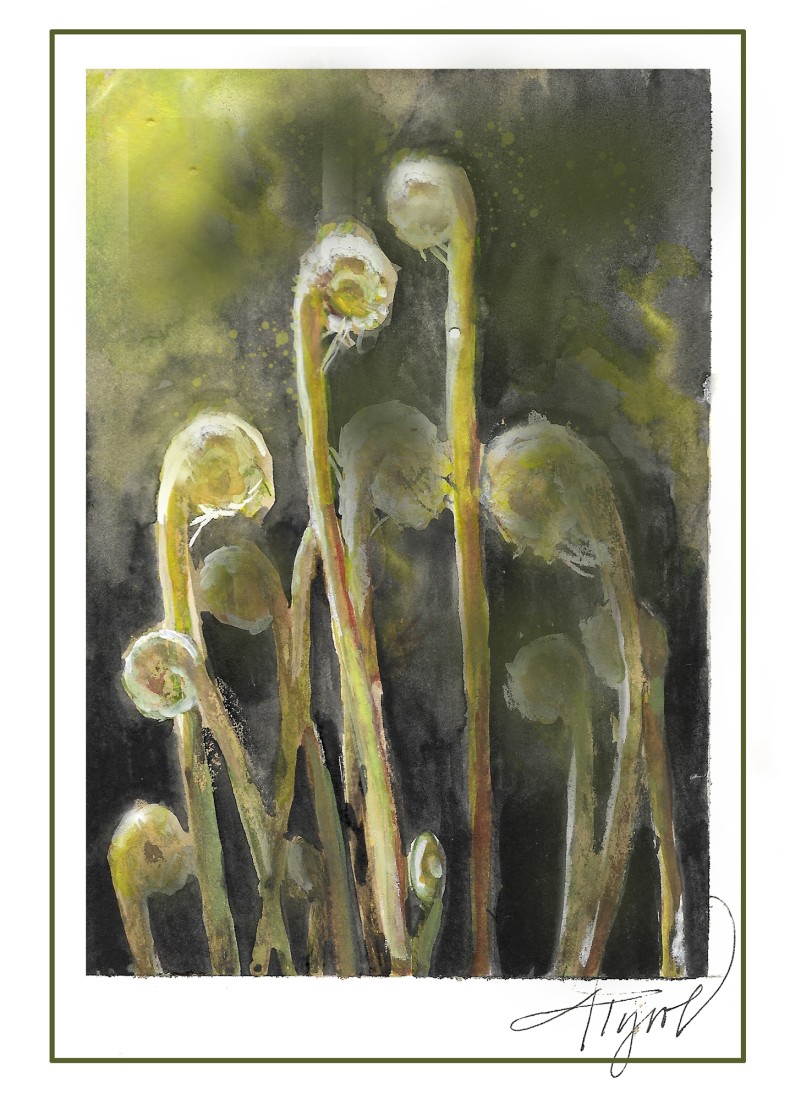
Near my home in Vermont, at the bottom of a hillside, there is a shelf just above a roadcut where the soil is moist from the groundwater seeping out of the hill. Back in April the first coiled cinnamon fern (Osmundastrum cinnamomeum) fiddleheads pushed up through the ground. Huddled with heads bowed in a tight group, clad in shaggy off-white wool as if anticipating the chill, their forms glinted in the morning light as they caught the dew. During the first days of May, the fiddleheads began to unfurl, opening into what looked like leaflets at first, but which then thickened into bright green, bead-like sporangia, the cases for the spores.
These fertile fronds grew stiff and erect in the center of the clump, surrounded by the leafy sterile fronds, which are photosynthetic. Through May and into early June, the spores, which are filled with active chloroplasts, were dispersed, leaving the sporangia behind, which turn from lime-green to a darker forest-green, then tan, and finally the cinnamon color, which gives the species its name. By July, the plant has released its spores, and now spent, the spikes have darkened and withered at the center of each clump of arching green, waist-high foliage.
In the Northeast, cinnamon fern is one of the easiest ferns to recognize when its cinnamon-colored spikes are still present. It looks similar to its close cousin, the interrupted fern (Osmunda claytoniana), which often occupies the same moist woodlands, but the sporangia of interrupted fern grow on a band of modified leaflets in the middle of a leafy frond instead of a separate leafless stalk in the center of the clump.
By late summer the spike of cinnamon fern has crumbled away, and the fertile leaflets of interrupted fern have dropped off, leaving similar-looking vase-shaped ferns. This time of year, turn a frond over to look at where the base of the leaflet meets the stalk: cinnamon fern has a persistent tuft of tan hairs, while interrupted fern is smooth. (Even as fiddleheads, cinnamon fern’s wool is denser and slower to shed than interrupted fern’s.) A second clue is in the leaflet tips; whereas cinnamon fern's leaflets taper to a point, those of interrupted fern are blunter and more rounded. A final tell is that cinnamon fern prefers wet soils, while interrupted fern is a generalist that will also grow in well-drained uplands.
Remarkably, the cinnamon fern has changed very little over time, appearing in the fossil record in late-Cretaceous rocks, and its lineage has remained stable even longer. In 2014, researchers described a 180-million-year-old fossil rhizome of a close relative from a volcanic mudflow in Sweden, where mineralization was so rapid that nuclei and even chromosomes were preserved. These matched those of the modern cinnamon fern almost exactly in size and number. Why have cinnamon ferns changed so little from the times that the last dinosaurs were walking among them? The answers are not definitive, but possibly because the wet, acidic, low-nutrient ground that suits cinnamon fern has existed continuously on the planet since the Mesozoic, and because traits like tough rhizomes and quick-germinating green spores work so well in those wetlands that there has been little pressure to change.
Closer to home, cinnamon fern thrives in the low-disturbance margins of bogs and in swamps, where the fronds can grow as large as five feet. In these locations, the soil has been wet and acidic for centuries and many trees and shrubs struggle to take hold. Ruffed grouse nibble the fiddleheads; yellow warblers and hummingbirds line their nests with the silver-tan wool covering the unfurling fronds.
Weston Testo, a fern biologist at University of Vermont, told me that each clump of ferns grows from a slowly branching underground stem that can keep producing new fronds for centuries. In West Virginia, interrupted fern has been documented in colonies estimated to be over 400 years old, making it among the longest-lived organisms in the Appalachians. Cinnamon fern's rhizomes spread the same way, and where conditions are right, a single clump can broaden into a circular patch of genetically identical plants, all stems of the same individual.
Contemplating the cinnamon fern in our woods, I see in one glance the spores ripening over spring and summer, the creep of a rhizome over centuries, and the hundreds of millions of years of a lineage that has watched the dinosaurs come and go.