
Choosing the right trees to plant – in a yard, park, or other planned space – can be a daunting task. Options include native and non-native species, as well as cultivars bred for traits such as drought tolerance or pest resistance. Some horticulturalists select cultivars and non-native species, arguing that ornamentals fulfill a similar ecological niche as their native relatives.
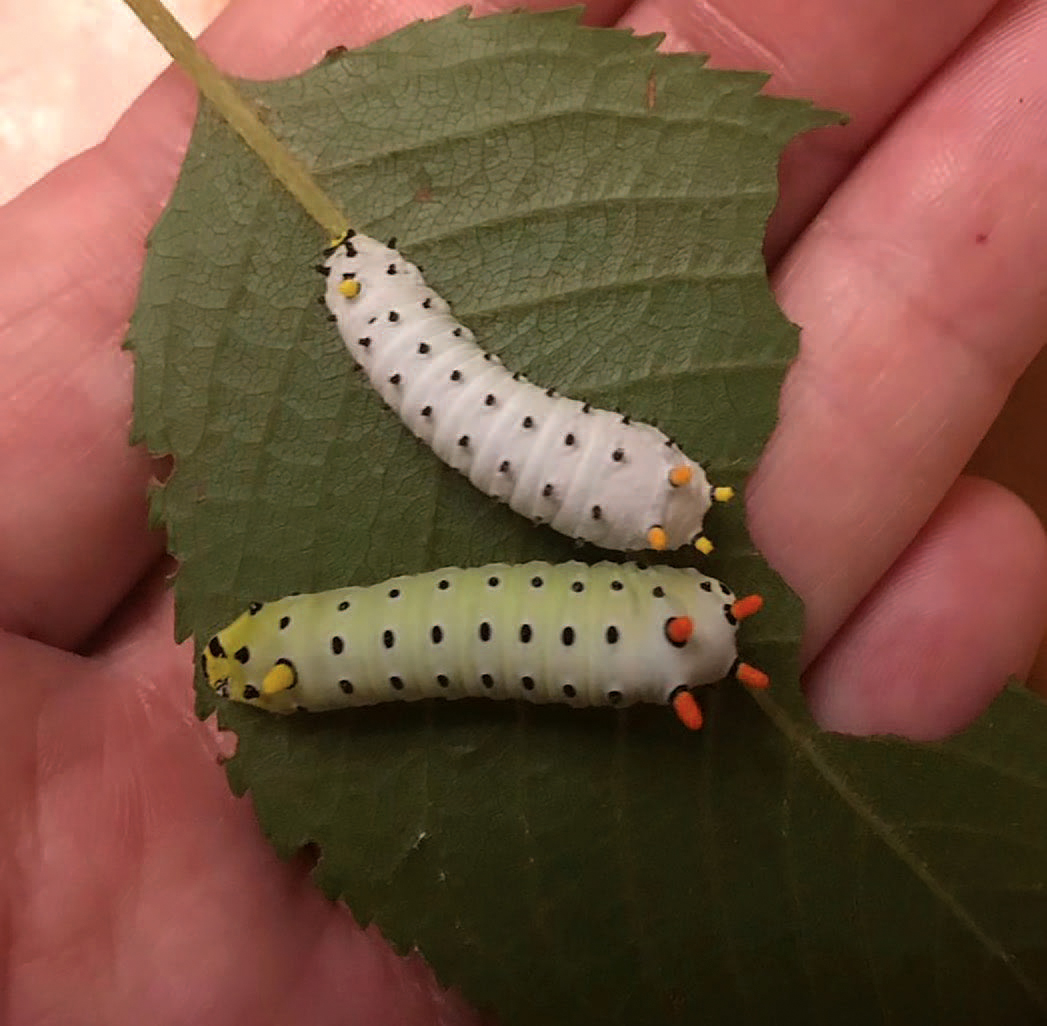
In a study published last year in Ecosphere, Desirée Narango, a conservation biologist at Vermont Center for Ecostudies, and Katherine Straley, a University of Massachusetts PhD candidate during the study, sought to test the idea that non-native trees with close genetic ties to natives are as beneficial to wildlife. To do so, they examined how 14 trees in the Prunus genus (which includes cherry, plum, and other fruit trees) and two control species performed as host plants for Promethea moth caterpillars.
During June and July of 2021, Narango and Straley reared nearly 1,000 Promethea moth caterpillars from eggs to when they prepared to pupate. The researchers chose this giant silk moth species because they tolerate egg-laying in captivity and, in their Northeast range, prefer Prunus host plants.
In a lab, the scientists divided caterpillars among plastic containers, each containing 8 to 10 hatchlings, and fed them leaves from one of 16 tree or shrub species. Fourteen of those were native and non-native Prunus species, including black cherry (P. serotina), a preferred host plant for the Promethea moth caterpillar. Black cherry is native to western Massachusetts, where the experiment took place.
Promethea moth caterpillars also pupate on other Prunus species, and the researchers wanted to test how these native and non-native congeners – or close relatives – stacked up as host plants. To that end, Narango and Straley fed some caterpillars leaves from two other Prunus species that grow wild in western Massachusetts: fire cherry (P. pensylvanica) and choke cherry (P. virginiana). In the study, they referred to these species as locally native. The study included three Prunus species native to other areas in Massachusetts but not growing wild in western Massachusetts: Canada plum (P. nigra), sand cherry (P. pumila), and maritime plum (P. maritima). Researchers also used eight Prunus species not native to the Northeast. Last, they tested two non-Prunus control species: black aronia (Aronia melanocarpa), which is not a Promethea caterpillar host plant, and sweet birch (Betula lenta), which had been marked in some databases as a possible host plant.
Narango and Straley analyzed three metrics. They monitored caterpillar survival for 21 days, during which time most caterpillars died. They also assessed growth rate until caterpillars died, successfully pupated, or lived 60 days after hatching. To evaluate host-plant quality, researchers measured caterpillar biomass, individually weighing surviving insects once the first caterpillar in that brood reached the fifth instar, the developmental stage when they prepare to pupate. To have the best outcomes, caterpillars must reach the fifth instar quickly and achieve a high biomass before pupating; faster-growing caterpillars are less likely to end up as bird food, and bigger caterpillars tend to mature into more fecund moths.
Of the 993 caterpillars hatched, 180 lived for 21 days, 131 developed to the fifth instar, and 94 successfully pupated. The results confirmed black cherry as the highest-quality host plant and indicated that native plants are more beneficial to wildlife than non-natives. Caterpillars fed black cherry had the highest survival rates, developed more quickly, and had higher biomasses than caterpillars fed any other species. They reached their fifth instar roughly eight days faster than caterpillars fed other species.
“What stood out to me the most was just the sheer magnitude of the differences that we were seeing,” Narango said.
Caterpillars pupated when fed the locally native species – black cherry, fire cherry, and choke cherry – as well as sand cherry and maritime plum, both natives that are not locally wild, and the non-native Higan weeping cherry, sweet cherry, and Okame cherry.
Caterpillars fed both local and non-local natives had higher biomasses than caterpillars fed non-natives, indicating that native species were uniquely beneficial for caterpillar longevity and robustness.
Non-native Prunus species, however, were suboptimal hosts. They produced caterpillars that developed more slowly, recorded lower biomasses, and were less likely to survive. Narango suggested that caterpillars pupating on three of the non-natives tested could be an example of an ecological trap – when a species favors a resource that ultimately worsens their survival or fertility.
To bolster wildlife, Narango encourages gardeners and landscape planners to plant native species and to select plants that foster interactions between species, such as caterpillars eating leaves, birds feasting on caterpillars, and butterflies sipping nectar from flowers.
“There’s no perfect plant,” Narango said. “But there are right plants for particular backyards.”