
Jack Collins spent his earliest years as a free-range kid in Trumbull, Connecticut, while it was still quite rural. He loved fishing and exploring creeks, playing in fields overgrown with red cedar, and finding stone walls in the woods. “We could go anywhere, do anything, as long as we were home by supper,” he said.
His family moved to a suburb of Hartford when he was 8, and he quickly realized he preferred rural living to this new subdivided setting. His parents, who ran a business insulating houses, purchased the long-abandoned Amidon sawmill manufacturing plant in Willington, Connecticut. After high school, Collins started working in carpentry and took on the job of restoring the building. The mill was built almost entirely of American chestnut harvested right after the blight, and it inspired an interest in wood recycling.
Collins met his wife Jane on the Amidon project, where she was working as a subcontractor. “It was the ’70s, and she was one of the few women in construction, but she fit right in with our guys,” Collins said. “She dealt with a lot of crap from the macho builder dudes on other jobs, but she was very cool. We hit it off and the rest is history.”
In 1980, Jack and Jane bought a small farmhouse, a falling-down barn and chicken coop, and 3 acres of hayfield along a quiet dirt road in “The Quiet Corner” of northeastern Connecticut. The land felt precious in this stretch of unfragmented hardwood forest – an area known as The Last Green Valley – as development began expanding across the state. The farmer also owned an adjacent 160 acres, and the Collinses were able to purchase 32 acres behind the house in 1992 and an additional 120 acres across the road in 1994.
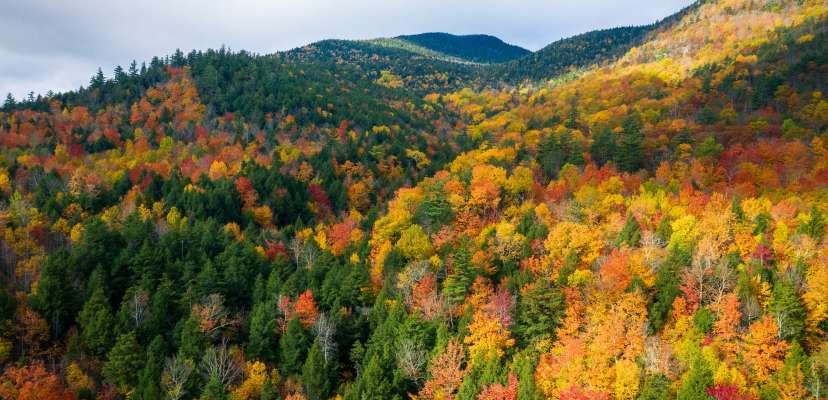
The land had been a dairy farm until the 1970s, when much of it was left to regrow into forest. “Of course, they logged the heck out of it before they sold it to us, as was typical of that time, so it was freshly cut with mostly junk left when we bought it,” Collins said of the parcel across the road. In addition to the original 3-acre lot around the house, there were 15 acres kept as hayfield, which Collins has maintained as early successional habitat for wildlife. The rest of the property is mostly mixed hardwood forest dominated by oak, hickory, and black birch, although there is a 2-acre red pine plantation as well. A chain of ponds along the road drains into Stonehouse Brook, which flows into the Natchaug River and then into the Willimantic Reservoir.
Collins recognized the value of this parcel for preserving clean drinking water downstream and for maintaining the region’s rural, forested character. The property is adjacent to state forestland, and Collins prioritizes wildlife connectivity and carbon sequestration in managing the property. As a woodworker, he also manages for timber to use in his projects, while keeping the next generation in mind.
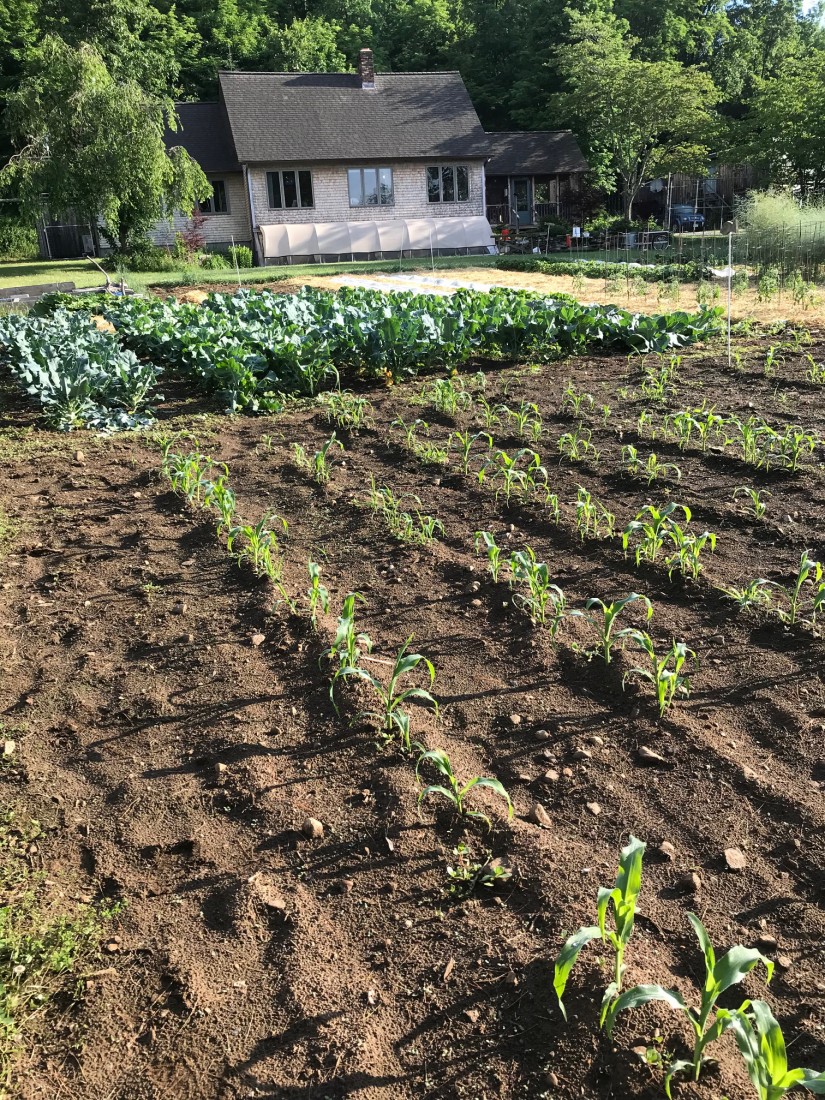
When the couple first moved to the property, they established a large organic vegetable garden and planted a fruit orchard on their original 3-acre parcel. They quickly found that the farmhouse was unrestorable; while gutting the interior to begin renovations, they discovered it had been built with charred wood, salvaged from a house that had burned down on the property in 1917.
As an alternative, they built a new passive solar house and converted the farmhouse into a woodshop. Collins began taking on custom woodworking projects, mainly cabinetry. At the time, the area had no retail hardwood lumber dealers, so he had to procure material from large wholesalers and quickly found his profits were tied up in the excess inventory of pine, oak, cherry, maple, and butternut, which accumulated after each custom job he did.
Working with local loggers and small sawmills, he began to stock and sell high-quality wood to other builders and makers. As his business grew, Collins built connections across the region; he knew where to go for good cherry in Pennsylvania and New York and who had the best pine nearby. Mills started to put wood aside for him, knowing what he’d want. When he and Jane bought the land across the road in 1994, it came with a barn, which allowed him to expand his storage.
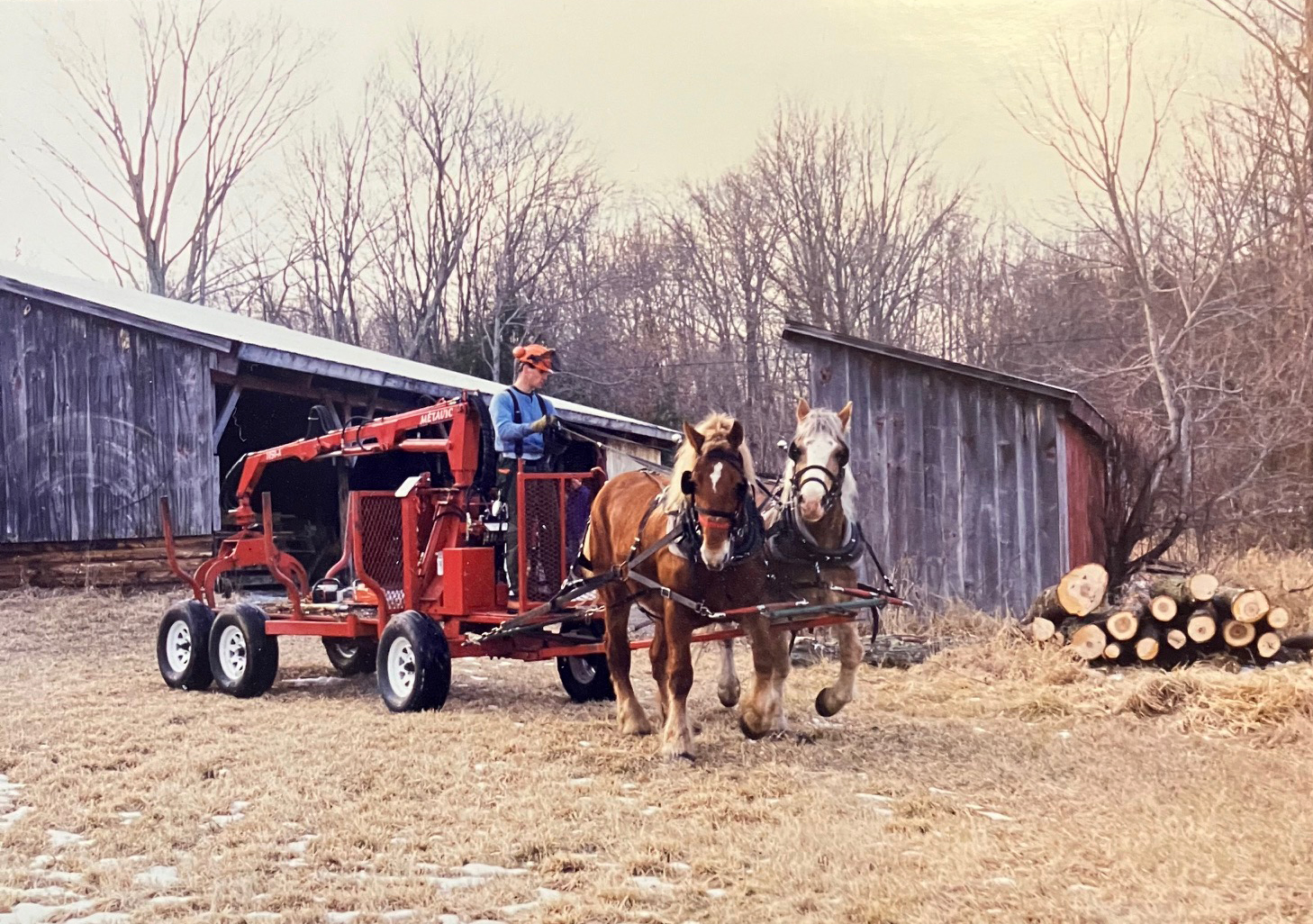
He occasionally harvested timber from his own property for projects. In the mid-1990s, he received funding from the USDA Natural Resources Conservation Service (NRCS) to release some oak trees and to do some thinning, and he hired a logger who worked with horses. “It was a beautiful thing to see horse logging,” Collins said. “It was just so quiet.” He also planted a couple hundred trees: mostly red cedar but also larch, catalpa, and walnut, all favorites for his woodworking.
In the late 1990s, Jane was diagnosed with cancer, and for two and a half years Jack’s time revolved around trips to a hospital in Boston and helping to care for her until she entered remission. By then, he was worn down and had become increasingly allergic to sawdust.
“There was another recession, the doggone markets were different, and my niche was gone with it,” Collins said. He sold most of his lumber inventory in an auction. “I wanted to be done with it, and we wanted to just be thinking about protecting the land,” he said.
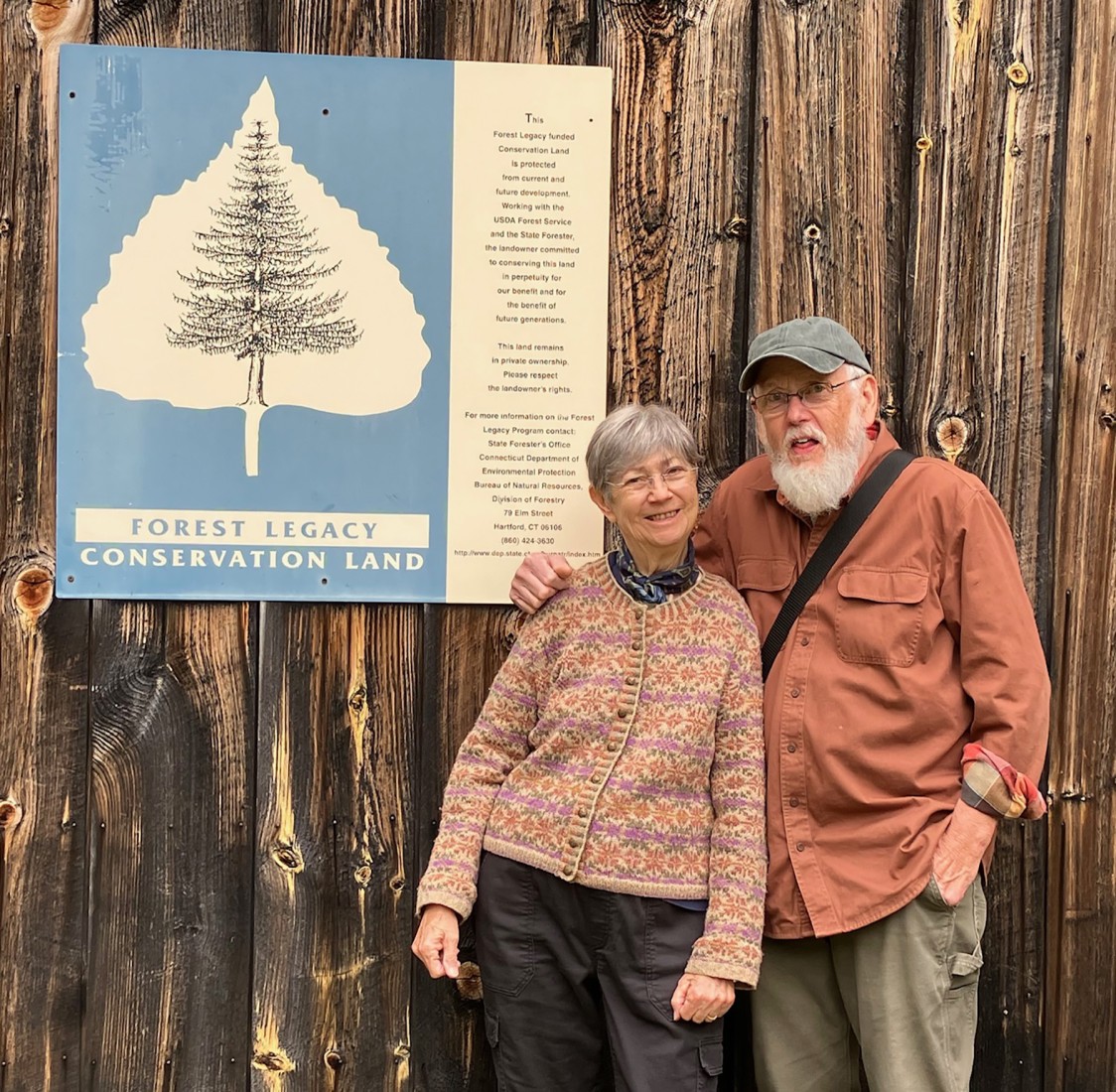
On a walk in his woods in 2000, Collins told Dick Ramond, a Connecticut service forester, about the couple’s focus on protecting their woods forever. Ramond brought up another neighbor’s interest in doing so through the Forest Legacy Program (FLP), a conservation easement program administered by the U.S. Forest Service. FLP was designed to protect large tracts of forest, but Ramond thought if enough neighbors were interested, they might be able to put together the first-ever group application. Collins spearheaded the formation of the Stonehouse Brook Watershed Preservation Circle, a group of neighboring landowners looking to conserve their woods.
“It took five years and an awful lot of planning; everyone had their own puzzles to work out – surveys to do and family to consult,” Collins said. But in 2005, FLP accepted the Stonehouse Brook Watershed Preservation Circle’s application, which included seven landowners holding a total of 700 acres. The landowners still manage their woods; several of them harvest occasionally, extract gravel and cut firewood as needed, tap maples, and hunt deer.
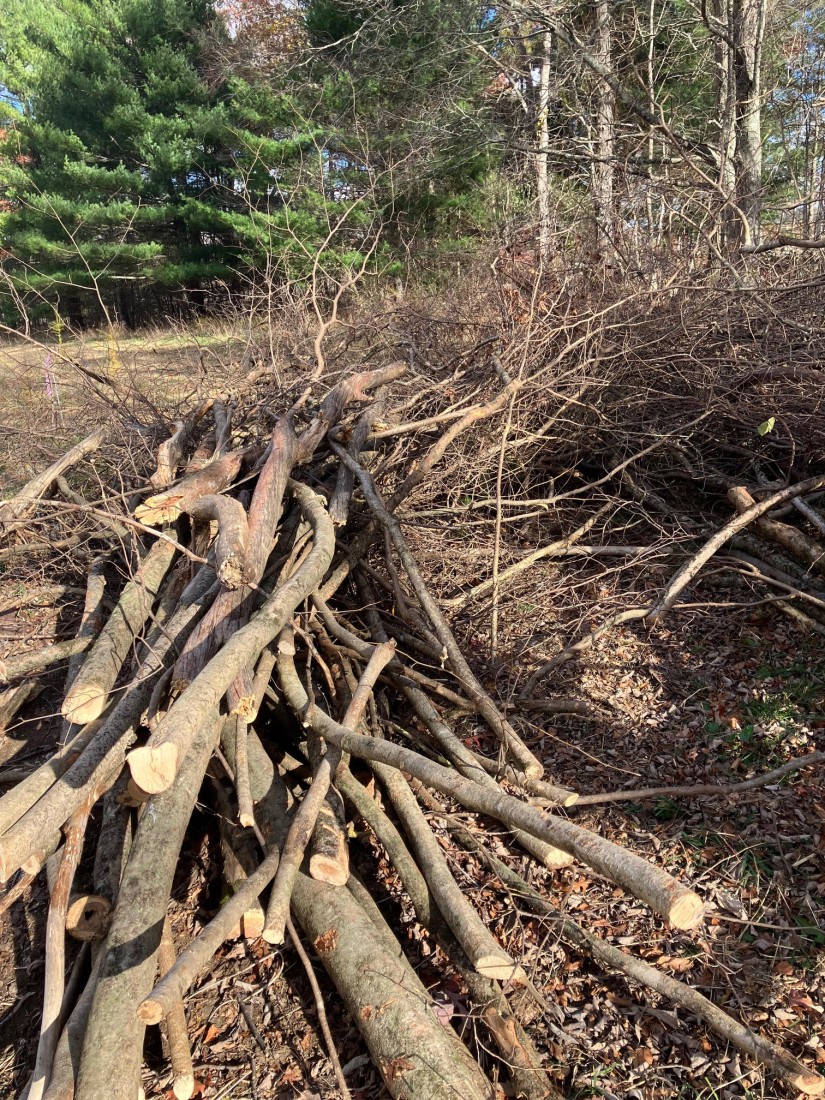
In his most recent round of NRCS funding, Collins completed two patch cuts to release oak from an overgrowth of black birch – which comes in thick because deer avoid eating it – and a timber stand improvement project, which released some white pine coming into the old red pine plantation and increased efforts to combat the Japanese barberry that’s taken hold in the understory. “The NRCS money really helps get things going that a landowner might not be able to do normally,” Collins said. “But now, everything is stalled. When the government shut down last fall, there was nobody [from the USDA] talking to me because there was nobody there to talk to.” He still hopes to complete a project to thin about 20,000 feet of hardwoods this autumn, removing low-grade pine and releasing oaks, but the status of the funding to cover some of the expenses remains uncertain.
Collins has also returned to an idea first introduced to him 25 years ago: harvesting witch-hazel. One of the first foresters Collins had out to the property remarked on the size of his witch-hazel shrubs, but harvesting it wasn’t a priority for Collins then. However, the planned harvest for this autumn would likely damage the shrub layer and so Collins decided to harvest it ahead of time. In autumn 2025, he hired Seth Frink of Frink Landworks to chip the witch-hazel and send it to American Distilling, a Connecticut company that creates an extract for use in cosmetic products. Collins is already seeing some witch-hazel regeneration.
Collins has also worked to regenerate chestnut on the property, harvesting nuts from three mature specimens growing since the couple bought the property. The previous landowner worked in the University of Connecticut greenhouses, and Collins thinks the trees may be hybrids developed in the 1950s. “I sure wish I had asked him more questions before he was gone,” Collins said. “One tree must be 70 feet now, with a good 2-foot trunk on it, and it puts out nuts like crazy.” A few years ago, he collected around 150 nuts, stored them in the fridge over winter, and put them at the bottom of an air-pruning box. The box was 4-by-8 inches with about 18 inches of depth, and the bottom was chicken wire and hardware cloth. Collins covered the nuts with soil and put the whole box on cinderblocks to allow for air movement, which allows roots to develop but not any big taproots. After a year, Collins planted the seedlings around the property, using tree tubes to protect them from deer and rodent browse; he looks forward to using the chestnut wood in projects in the future. “It’s just beautiful wood to work with,” he said.
Collins enjoys tending to the land and seeing it change over the years. “The beavers have finally gotten into one of the streams and turned it into a marshy area,” he said. “I’m hoping they’ll fill it up even more.” He expects the beavers will make about 20 acres of the woods that abut the state forest inaccessible, but he doesn’t mind. “We’re calling it our old-growth place because there’s no way to get to it now,” Collins said. “It’ll be good to have a spot that’ll not be touched for a long time.”
The couple’s children are grown and no longer live in Connecticut, but as Jack and Jane are starting to slow down, the topic of what to do with the land comes up often. “We hope [the kids] will want to keep it, and if they want to get out of the city someday, they’ll have a place to come back to,” Collins said. “I would like to see the land continue to be managed well into the future, especially with all the climate issues we are facing. Change is happening. I guess we can get kind of spiritual about it, but being here and just watching everything – that connection is very meaningful.”