
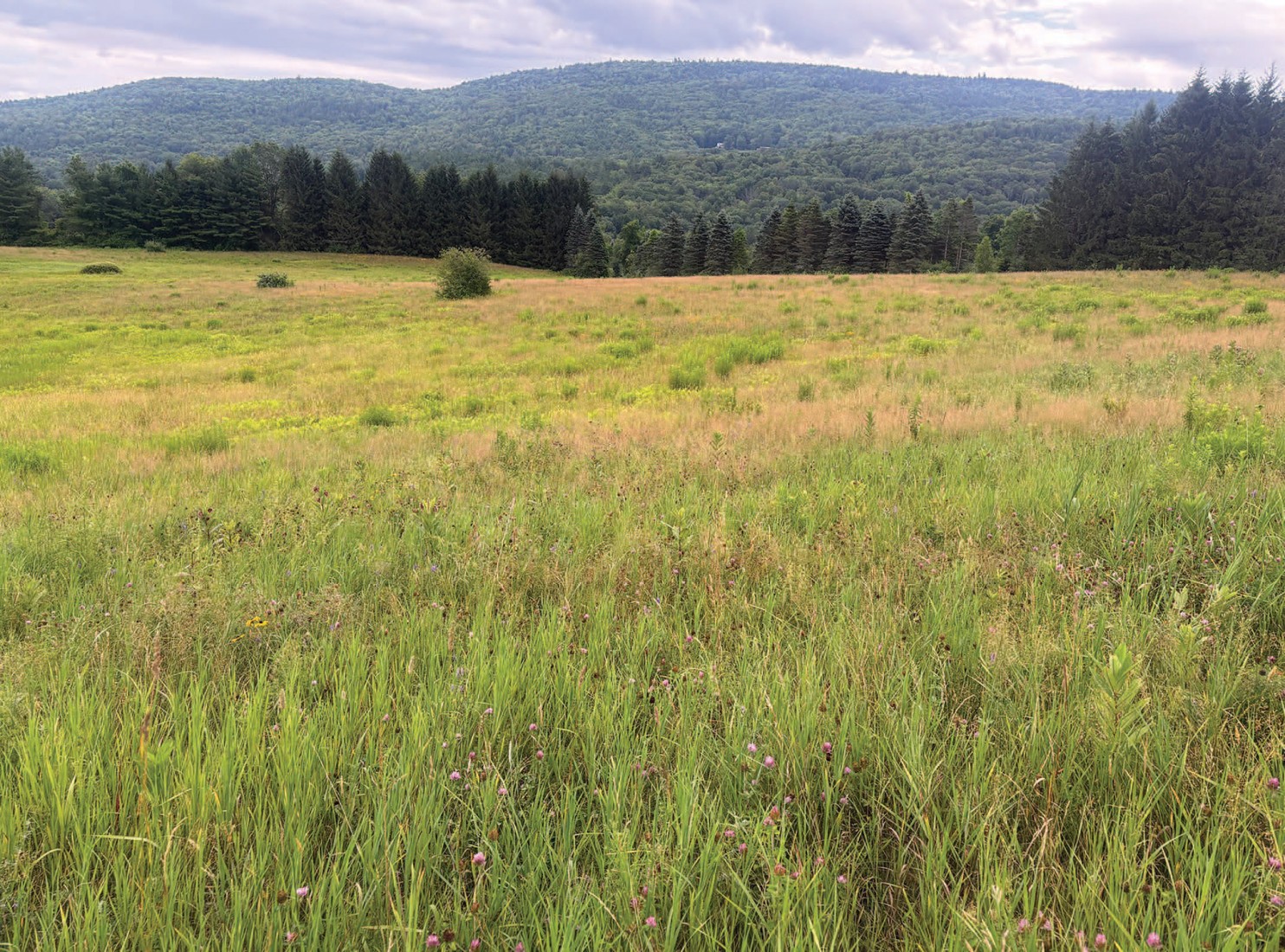
Grasslands are rare in the Northeast and are either transient or rely on regular disturbance to persist over time. In the heavily forested, pre-colonial landscape, beavers contributed to a limited, shifting patchwork of temporary grasslands when their dams flooded surrounding forests and initiated ecosystem succession, and fire replenished soils and kept fields from reverting to forest. While European settlers extirpated beavers from much of the Northeast and suppressed fire, they also cleared land for agricultural use, which drastically expanded grassland habitat and boosted previously minimal populations of grassland birds such as eastern meadowlark, bobolink, and savannah sparrow. However, farming advances such as mechanization and earlier, more frequent haying beginning in the mid-twentieth century, along with reforestation as agriculture shifted west, eventually rendered many former hayfields inhospitable to grassland-breeding birds. As a result, over the past 50 years, grassland birds in the Northeast – and across the country – have disappeared faster than any other avian group.
Faced with plummeting grassland bird populations even on available habitat, conservationists introduced the concept of delayed mowing in the early 2000s in an effort to accommodate the breeding cycles of these birds, which nest on the ground in hayfields. Conservation groups, including The Bobolink Project, and the federal Natural Resources Conservation Service developed programs to pay private landowners who follow delayed-mowing guidelines as a way to offset income lost to forgone cuts or poor hay quality. While a typical modern haying schedule in the Northeast might involve a first cut in late May or early June – which is the middle of breeding season for many grassland birds – landowners participating in delayed-mowing programs generally postpone their first cut to midsummer or opt for an early first cut in spring followed by a delayed second cut later in the season.
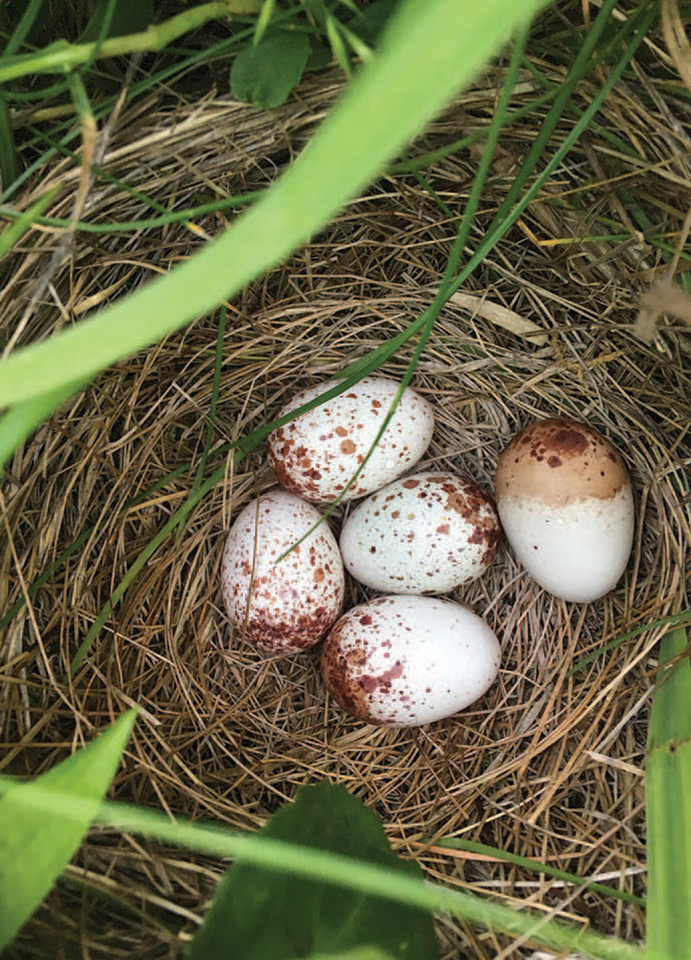
The strategy is predicated on a robust body of research that demonstrates the outsized impact haying schedules have on grassland bird breeding success. A study by Noah G. Perlut and colleagues published in Ecological Applications in 2006, for example, found that on hayfields in Vermont’s Champlain Valley, haying before June 11 resulted in failures in 99 percent of savannah sparrow nests and in 100 percent of bobolink nests, while reproductive success was significantly higher for both species on fields hayed in either mid- or late summer.
The compelling data, as well as a lack of viable alternative interventions, has solidified delayed mowing as a cornerstone of grassland bird conservation in the Northeast. “It’s a simplistic message: ‘Don’t cut during breeding season,’” said Kevin Tolan, a staff biologist at Vermont Center for Ecostudies whose specialties include grassland bird conservation. “There’s beauty in that simplicity.”
Recently, however, conservationists have discovered that delayed mowing has an unintended beneficiary: invasive plant species. As much as they help breeding birds, infrequent cuts also allow invasives to spread and set seed.
“We didn’t know that delayed mowing would affect the quality of the habitat as significantly as it has,” said Margaret Fowle, a senior conservation biologist at Audubon Vermont who works with The Bobolink Project, a collaboration between Audubon chapters in Vermont, Massachusetts, and Connecticut aimed at incorporating bird-friendly practices into agriculture. “The thinking was that a first cut around August 1 was enough to limit the invasives from moving in. Just how quickly they could set seed and change the fields was unexpected.”
How enrolled landowners manage – or do not manage – their fields can compound the issue. Most who participate in The Bobolink Project are not farmers and so do not amend the soil in their fields to support hay production. Some landowners lease their fields to farmers, but as the number of farmers has dwindled, landowners have struggled to find willing farmers to do the haying. This lack of man-made soil inputs to sustain healthy habitat, as well as the continued absence of fire from the landscape, can lead in many enrolled fields to nutrient-poor conditions on which invasive plants can capitalize.
“You need to have farms and farmers around to work on these fields, to maintain the agricultural presence in the long term,” said Toby Alexander, state biologist in the Vermont office of the Natural Resources Conservation Service. “They keep the fields healthy.”
As grassland health diminishes, invasives such as chervil, bedstraw, spotted knapweed, and poison parsnip can outcompete desired grasses. Meanwhile, studies from other regions, including the Great Plains and parts of Europe, suggest that reductions in invertebrate diversity in grasslands colonized by invasives drive out birds by shrinking their food supply. Tolan and Fowle also pointed to shifts in the vegetative structure of unmown fields, namely the predominance of forbs, which can be harder for birds to nest in and fledglings to navigate, as possible reasons birds may abandon fields in which they bred for years.
“We’re seeing population numbers dropping in fields overtaken by invasives. It’s affecting how the birds use the habitat,” said Fowle. The pattern threatens the rationale behind delayed mowing – and has forced conservationists to accept that it may not be as simple a solution as once hoped.
“Standard delayed-mowing management was developed without consideration of invasive species,” said Tolan. “Our recommendations don’t account for them. The name of the game now is to figure out how we integrate them into the guidance.”
In 2025, for the first time in its nearly two-decade history, The Bobolink Project shifted its mowing dates. Enrolled landowners previously could pick from two cutting schedules: a delayed haying on August 1, or an early one on or before May 31 followed by a second one after August 15. Now, The Bobolink Project has adjusted those dates to one cut on or after July 15, or an early cut on or before May 20 and a second cut after July 24.
“We have to shift our mindset from saving all the bobolinks in a field to maintaining the health of that field to keep it in use by the birds,” Fowle said. “The July 15 date could mean that not all bobolinks in a field fledge their chicks, or that not all those chicks survive. Waiting until August 1 or later for the first cut, however, was allowing invasives to go to seed and fields to become overrun.”
Updating the cutting dates is only part of the equation. Because the single delayed cut has been the regime of choice for most fields enrolled in delayed-mowing management, many of those fields already have a formidable invasives problem that needs remedying. Tolan recently received a $100,000 grant from the National Fish and Wildlife Foundation to support his research and outreach on managing and, when possible, preempting invasives. One of the grant’s goals, he said, is to “get to a point where we as managers can say to a landowner, ‘If 50 percent of your field is overtaken by invasives, do this. If it doesn’t have a problem yet, do this.’”
To salvage fields where invasives are already established, other tactics might be in order. Some landowners, Fowle said, may need to hay intensively for a summer. Others may be encouraged to put some of the money they receive from The Bobolink Project toward reseeding their fields or amending the soil.
These novel approaches all point to a real-time rethinking of the conventional wisdom surrounding delayed mowing. The hope is that these new tactics can keep pace with the increasingly complex challenges landowners, grasslands, and grassland birds face in the modern Northeast.