
As spring arrives, we revel in the budding out of plants and trees and the emergence of insects, birds, and animals. The lengthening days awaken many species, and added warmth contributes to their activity. All life on Earth evolved to operate on a 24-hour schedule – with bright blue-rich illumination during the day, fading into red/orange light at dusk, and darkness at night.
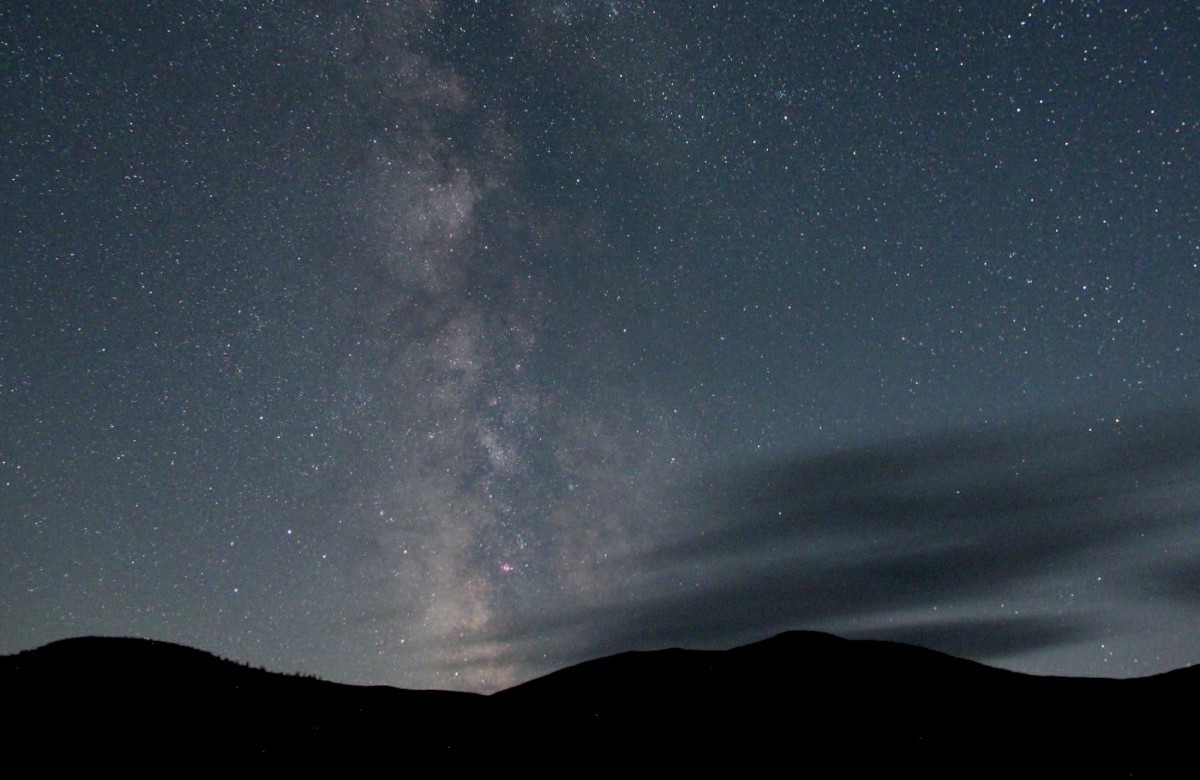
But artificial light at night (sometimes shortened to ALAN) threatens this natural balance. Nighttime artificial light creates light pollution, which has far-reaching effects on human health and safety, bird migration, pollination, insect species, and energy use. Good lighting principles can reduce or eliminate these effects – and ensure we can continue to see the stars shining in the night sky.
Sources of light pollution include fixtures that allow light to shine above the horizontal (indeed, many shine primarily upward), are brighter than necessary for their intended purpose, and whose light is too blue-rich. While we often think of light pollution as an urban problem, artificial lighting in rural and remote areas, even on small scales, can have outsized effects on both humans and the natural world.
A shift to LED lighting has contributed to increased light pollution. While LED lights are more energy efficient than other sources, many also emit more blue-rich light, and LED illumination often results in brighter, over-lit areas.
The Globe at Night program is a community science effort urging participants around the world to track and report the brightness of the night sky. Christopher Kyba of the German Research Center for Geoscience analyzed data from Globe at Night and found that average sky brightness around the world is increasing by more than 9.6 percent each year – and by more than 10.4 percent annually in the United States.
Artificial light at night has numerous consequences:
- Poorly shielded fixtures create glare and deep shadows, which impede vision and makes driving more dangerous.
- According to the American Medical Association Council on Science & Public Health, blue-rich light at night contributes to sleep deprivation, increases risks of hormonally driven diseases such as breast and prostate cancer, and may contribute to mood disorders in adolescents by breaking circadian rhythms.
- Migrating birds are attracted to light and may collide with buildings or become exhausted by flying around lit structures. According to Cornell Lab of Ornithology, more than 1 billion birds die each year in the United States due to window strikes, and many of those could be avoided with changes to lighting. Light pollution also impacts birds’ ability to use stars to help navigate during migration.
- Artificial light at night affects pollinators. Research comparing pollination and plant success by Eva Knop at University of Bern in Switzerland showed a drop of as much as 62 percent in pollinator efficacy under artificial illumination.
- The number of moth caterpillars, an important food source for birds and other wildlife species, can decrease by 30 percent or more in lit areas.
- Artificial light mimics daylight, causing plants to bloom too early and to hold on to leaves too late in the season Changes in plant phenology can cause mismatches with the emergence of insects and the migrating birds that rely on them. Plants that leaf out or flower early may be damaged or killed by frosts.
- Excess and misdirected lighting demands additional electricity production.
A 2021 study analyzed satellite data to determine that some 35 percent of light at night is directed upward; in the United States alone, that translates to more than 130 billion kW-hours of electricity at a cost of $4.5 billion and generating 21 million tons of atmospheric carbon.
DarkSky International, the leading organization addressing light pollution, works with individuals, municipalities, and other groups to promote good lighting practices. DarkSky has a worldwide group of advocates as well as DarkSky chapters in many U.S. states and countries around the world who work to address light pollution through advocacy and public education. The organization also offers the International Dark Sky Places (IDSP) program, which provides certifications and designations to regions, organizations, and municipalities that have reduced or eliminated light pollution and offer light pollution education.
More than 250 places around the world now have protected night skies, benefitting the people and wildlife that live in or near them. These include AMC Maine Woods International Dark Sky Park and Katahdin Woods and Waters Dark Sky Sanctuary in northern Maine, which together protect the night sky over hundreds of thousands of acres of woodland. IDSP designations require that an area have a natural, dark sky; conduct lighting improvement projects in their region; offer night sky education programs; and enact regulations and ordinances that control lighting to protect the sky quality in perpetuity.
DarkSky International also offers certifications for communities and lodging facilities that meet night sky standards, and it maintains a database of approved light fixtures to help find and purchase lighting for both commercial and residential applications that reduce or eliminate light pollution effects.
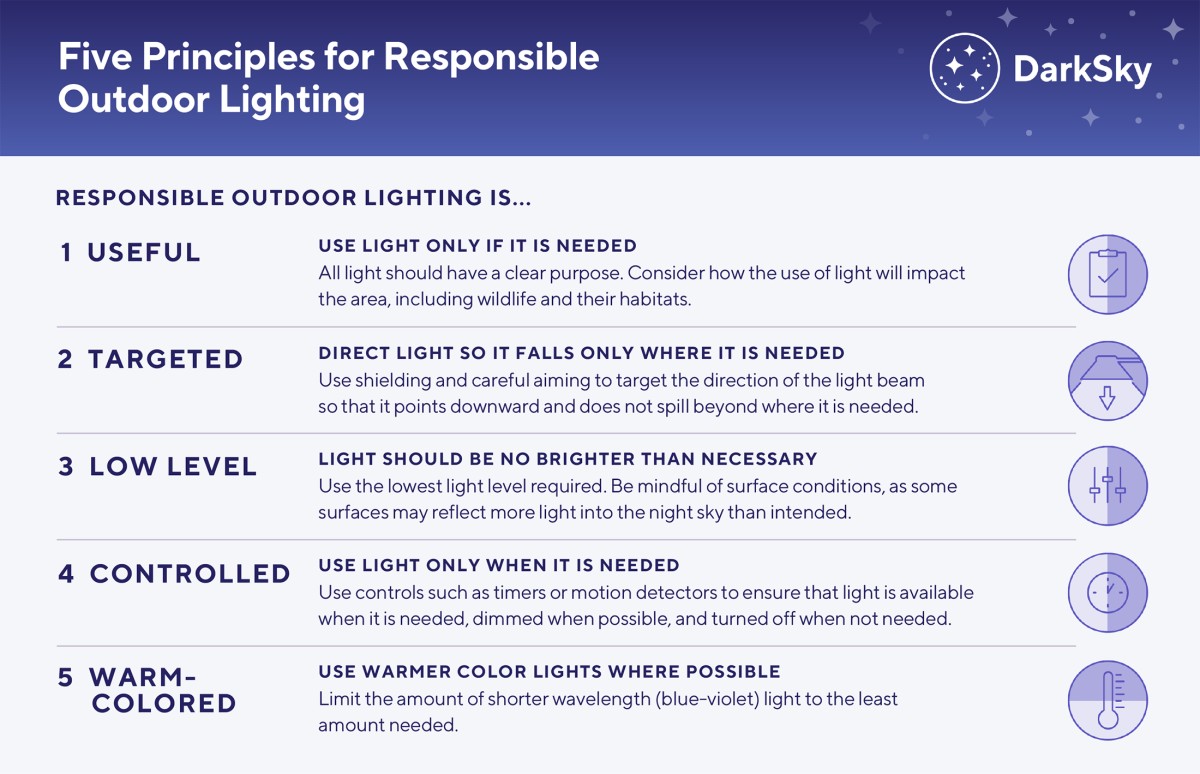
The Illuminating Engineering Society and DarkSky have developed five simple guidelines for reducing light pollution. These Five Principles for Responsible Outdoor Lighting guide the implementation of good lighting to minimize effects on the environment, safety, and health. (See chart.)
One community that illustrates the effectiveness of these guidelines is Shelburne, Massachusetts, which replaced its street lighting with fixtures that are fully shielded – meaning their light is targeted strictly to the roadway – and are of low color temperature, delivering very little blue light. Other examples, involving the sky glow often created by lighting at sports arenas, include improved lighting at facilities such as the National Tennis Center in Queens, New York, the University of Michigan football stadium, Wrigley Field in Chicago, and even the Formula 1 motor racing circuit in Jeddah, Saudi Arabia.
Each light, however small, contributes to overall sky glow. It may seem like that little light by the front door isn’t a problem, but it’s the cumulative effect – of each house light, each business marquee, each parking lot light, each streetlight, each lit sign – that together create sky glow and glare.
Each of us can make changes to reduce light pollution. An inventory of the lighting at a home or business can identify fixtures that don’t meet the “five guidelines.” Replacing them with luminaires that minimize the impact on the environment – those that are fully shielded, provide only enough light for their purpose, are on only when needed, and that minimize blue light – can reduce light pollution.