

“It just looks like grass.” I’ve heard this many times from non-botanists after I’ve pointed out some subtle plant. Indeed, many flowering plants blend in readily with grasses and sedges, becoming conspicuous only when they display a convenient flower. Some plants even carry this confusion in their common names, including yellow star-grass (Hypoxis hirsuta), grass-pink orchid (Calopogon tuberosus), and all the species of blue-eyed grasses (genus Sisyrinchium), even though none of these are in the grass family (Poaceae).
The blue-eyed grasses are worthy of closer attention because they not only prove themselves as other-than-grasses, they can also tell us a little bit about the site characteristics where they grow. Blue-eyed grasses are in the iris family (Iridaceae). Look closely at one of these plants and this kinship will make sense. Their dull, blue-green stems are flattened and winged, like miniature versions of the common blue iris (Iris versicolor, also called northern blue flag iris). The purple (or blue, lavender, violet, and sometimes white) flowers share a similar hue with the blue iris, and they flower about the same time of year: late May to early June. The six-parted flowers are actually composed of tepals: three sepals and three petals of similar color and texture. Blue-eyed grasses grow in sunny, often damp habitats such as meadows, mowed roadsides, powerline corridors, and grassy shorelines.
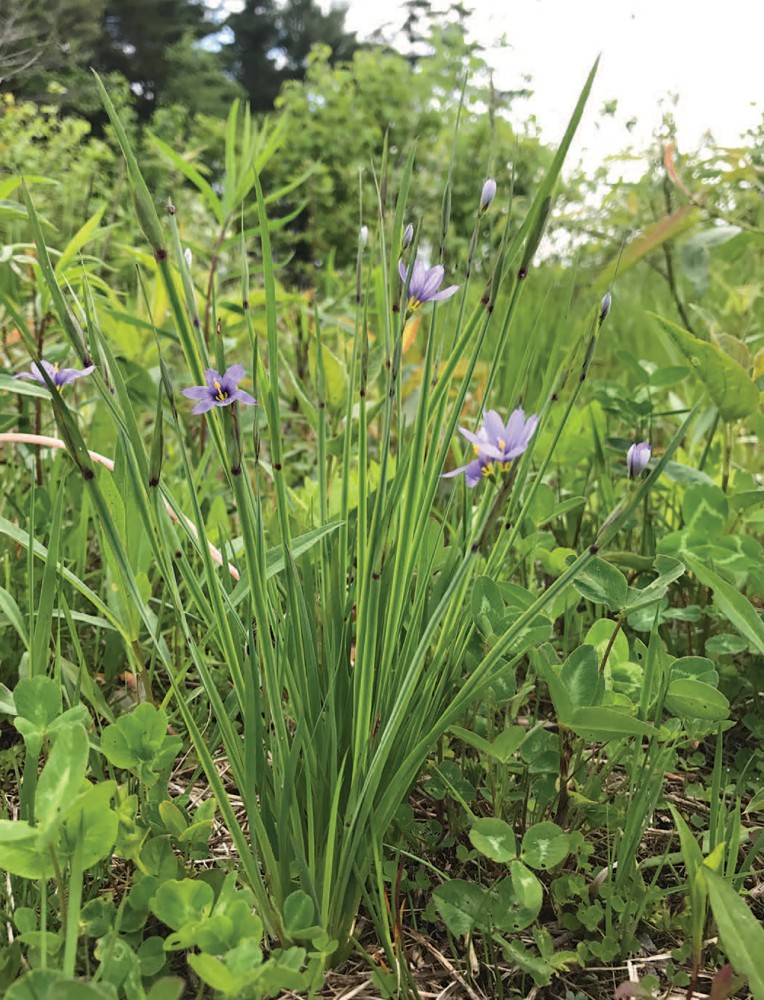
There are four widespread species of blue-eyed grass in the northeastern United States and southeastern Canada. Two questions can help distinguish these four species: 1) Is the inflorescence branched? and 2) How wide are the stems? Although this approach sounds straightforward, the old saying “the plants don’t read the manuals” applies particularly well to blue-eyed grasses. Individual plants can produce aberrant traits, so it is advisable to look at several plants across a population before drawing a conclusion about which species you’ve found.
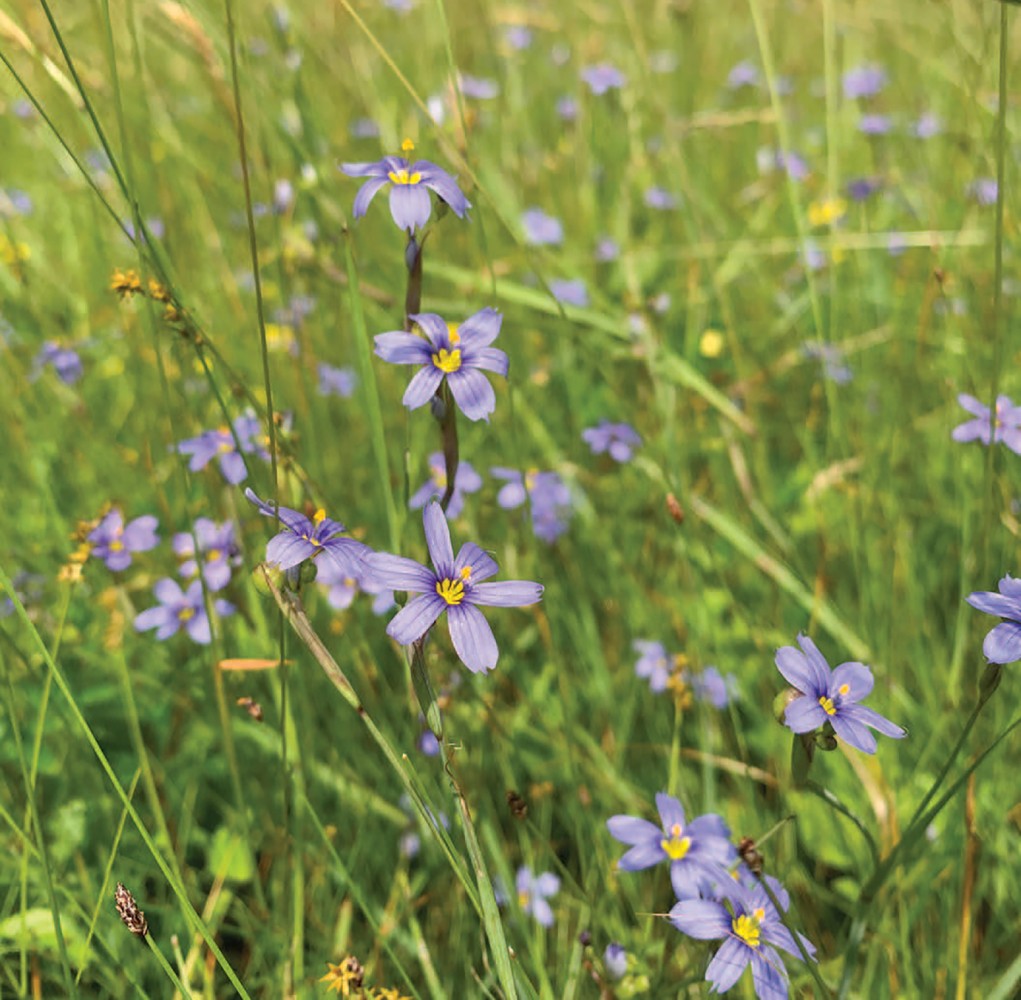
Narrow-leaved blue-eyed grass (Sisyrinchium angustifolium) is an unfortunate misnomer. Despite its common name, this plant has rather wide winged stems, measuring about 2.5 to 5mm. The stem branches into one or more elongate pedicels, similar in shape and color to the main stems, each terminating in one to several flowers. The flowers of this species are often pale blue, almost cornflower blue, rather than purple. It is a generalist of sunny, damp habitats, but it is the blue-eyed grass species most likely to grow on strongly acidic sites. Although it is common in much of the eastern United States, it is considered vulnerable in Vermont and quite rare in several eastern Canadian provinces.
Strict blue-eyed grass (Sisyrinchium montanum) looks most similar to narrow-leaved blue-eyed grass. However, the flowers are not held on extended branches, but are instead tucked close at the top of the stem, protruding from the “spathe” – two leaflike bracts shaped like a green lobster claw, gripping the flowers like a tiny bouquet. There are two recognized varieties of this species, although separating them is a bit tedious. Variety montanum is more frequent on calcium-rich sites, where I find it has especially vibrant purple flowers, whereas variety crebrum is less discerning about pH. Strict blue-eyed grass is the most widespread and common species across our region.
Eastern blue-eyed grass (Sisyrinchium atlanticum) is very similar to its “narrow-leaved” cousin, except it actually has very narrow “leaves” (that is, stems). Stems measure less than 2mm wide with slight wings along a wiry green axis. The inflorescence is branched, and the slender stems give the whole plant an airy, elegant appearance. The flowers also seem a bit more delicate, although not overtly different from other species. I see this species most often in what I call “rich-acidic” habitats; the soils may be acidic, but some form of nutrient enrichment influences the site, usually from bedrock, such as limestone, or a clay hardpan underlying the topsoil. “Rich-acidic” meadows are often quite diverse, and the presence of this species suggests there also may be more interesting plants to find throughout the growing season. Although not exactly a southern species, eastern blue-eyed grass becomes rare in northern New England, as well as in Nova Scotia, the only Canadian province where it is found.
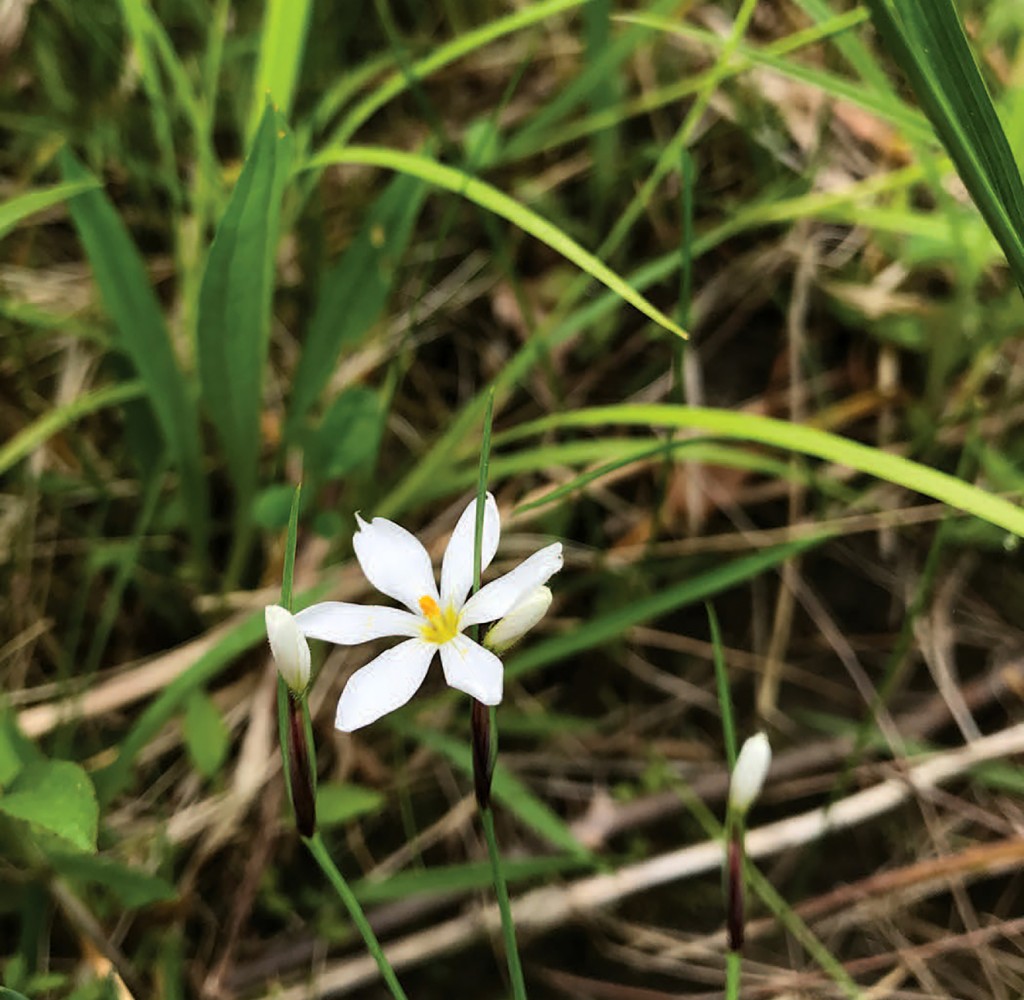
Needle-tipped blue-eyed grass (Sisyrinchium mucronatum) is a rare and delicate species of limestone meadows and similar nutrient-rich habitats. It has extremely slender, wirelike stems similar to eastern blue-eyed grass, but it has sessile, unbranched inflorescences like strict blue-eyed grass. Most strikingly, the spathes that clasp the flowers are deeply tinged with wine-purple pigments, giving a second touch of color to these diminutive plants. This species is rare, or even locally extirpated, throughout much of its range, mainly due to the limited extent of its nutrient-rich meadow habitat. The plants require both an enriching substrate and some kind of ecological disturbance – such as by fire, grazing, mowing, or beaver pond abandonment – to keep their habitats open.
True for all the species described here, succession to trees and shrubs will shade out blue-eyed grasses. However, they remain dormant in the seed bank, waiting for some new disturbance to let in the sunshine, stirring them into aboveground life again.