
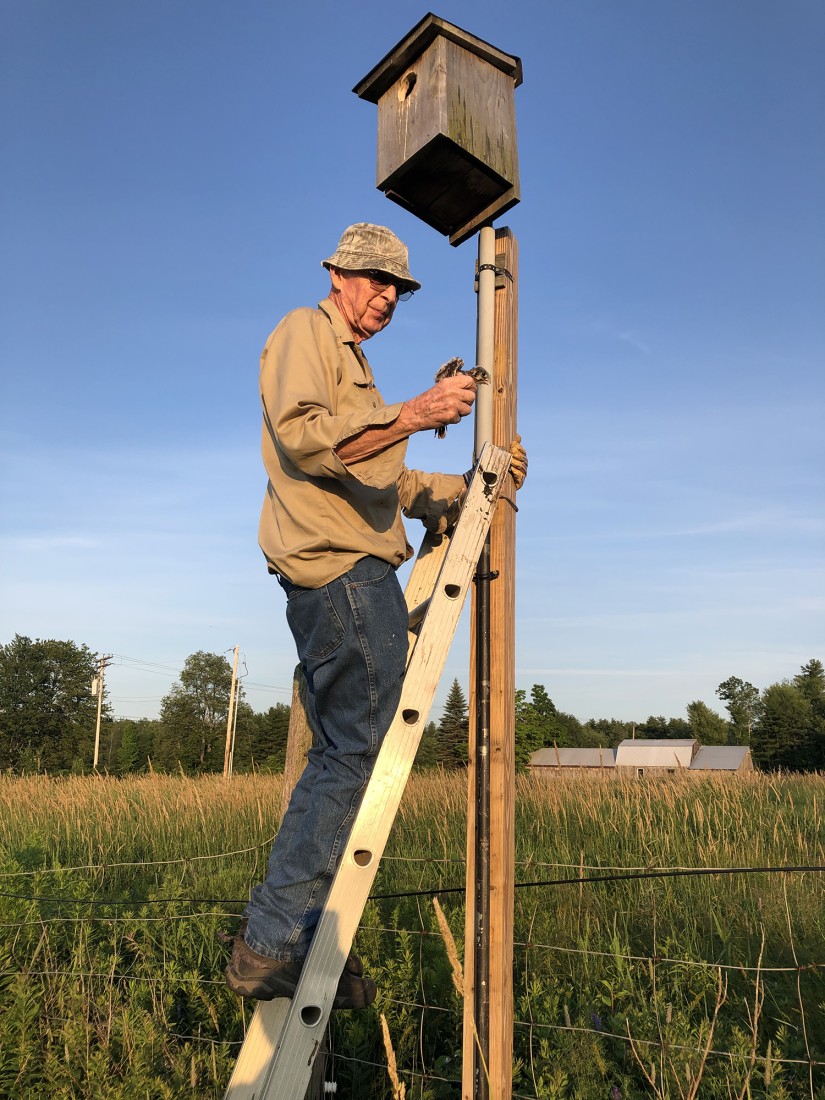
In one year, Steve Wheeler put 35,000 miles on his new Chevy pickup. You might think Wheeler has a punishing commute, or perhaps family members scattered across the country. But he racked up most of those miles monitoring the 241 American kestrel nest boxes he has installed around New Hampshire. From late May to mid-July, he visits each box, often multiple times, to record nesting data and to band the adult birds and fledglings within them.
No one pays Wheeler, who turned 80 this past winter, to erect and monitor the nest boxes. Beyond the massive investment of time, he covers gas, construction materials, and other costs that crop up as part of the project, which he has run for more than 50 years. He does it all for North America’s smallest raptor species, which is disappearing faster in northern New England than in other parts of its range.
Wheeler is part of an informal network of kestrel devotees, spanning Maine to Virginia, whose nest box programs are at once a treasure trove of scientific data and a lifeline for the species.
A Declining Mainstay of Open Spaces
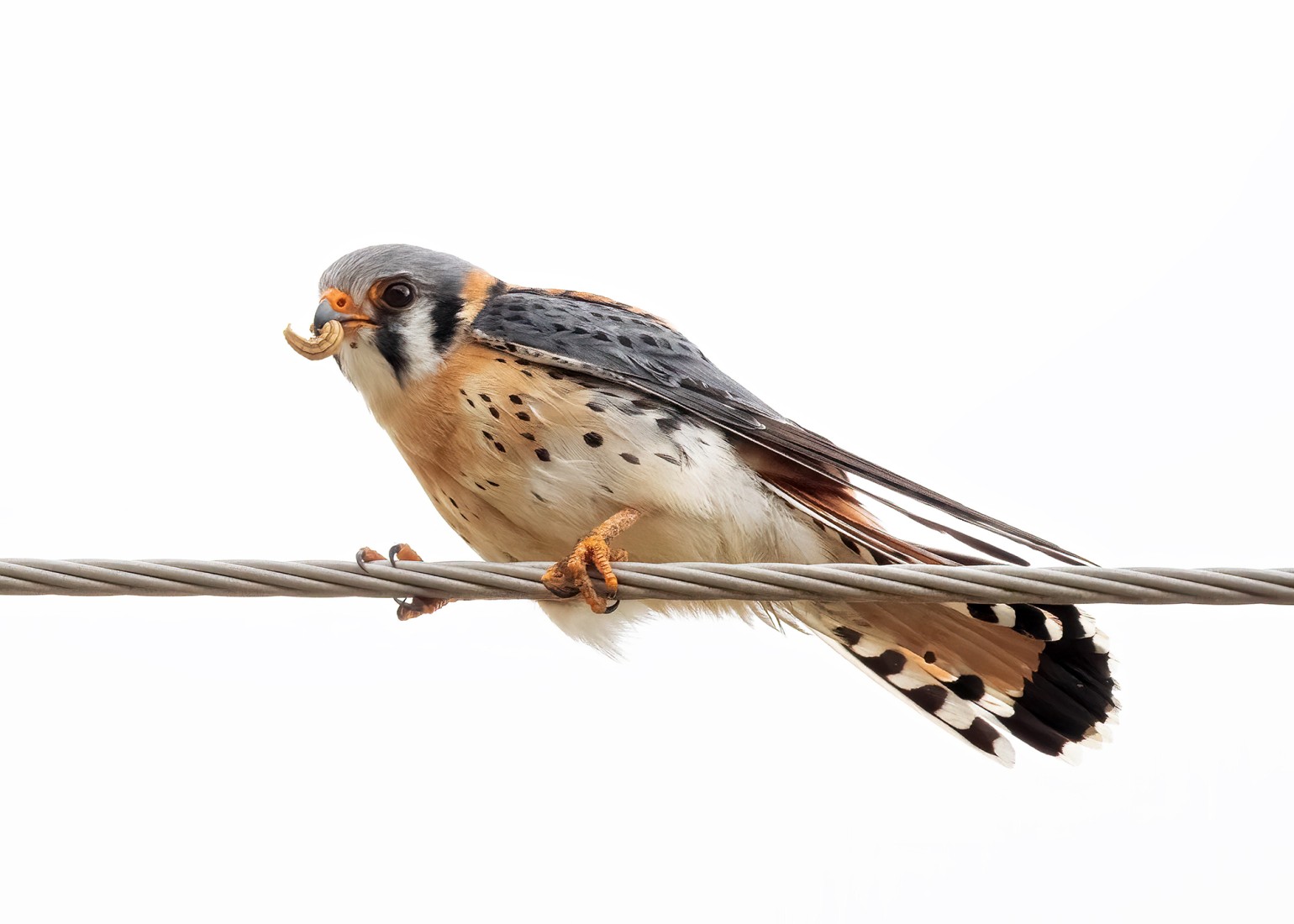
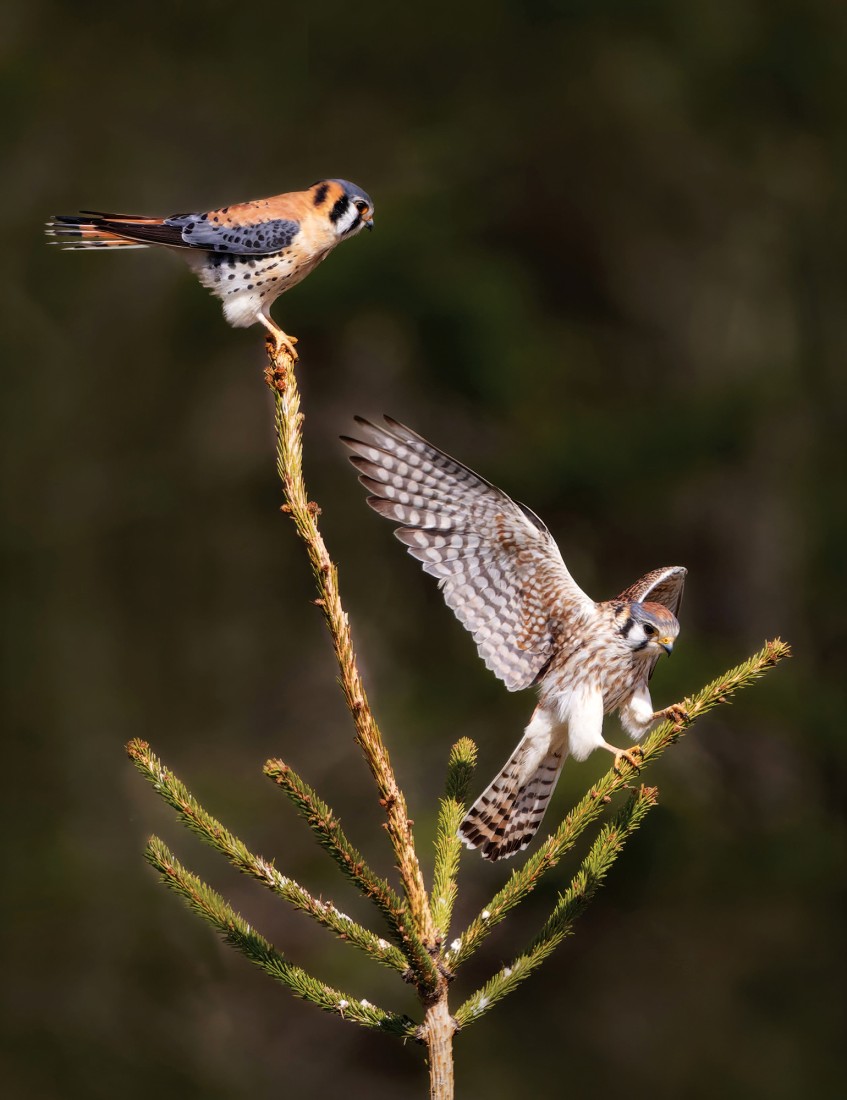
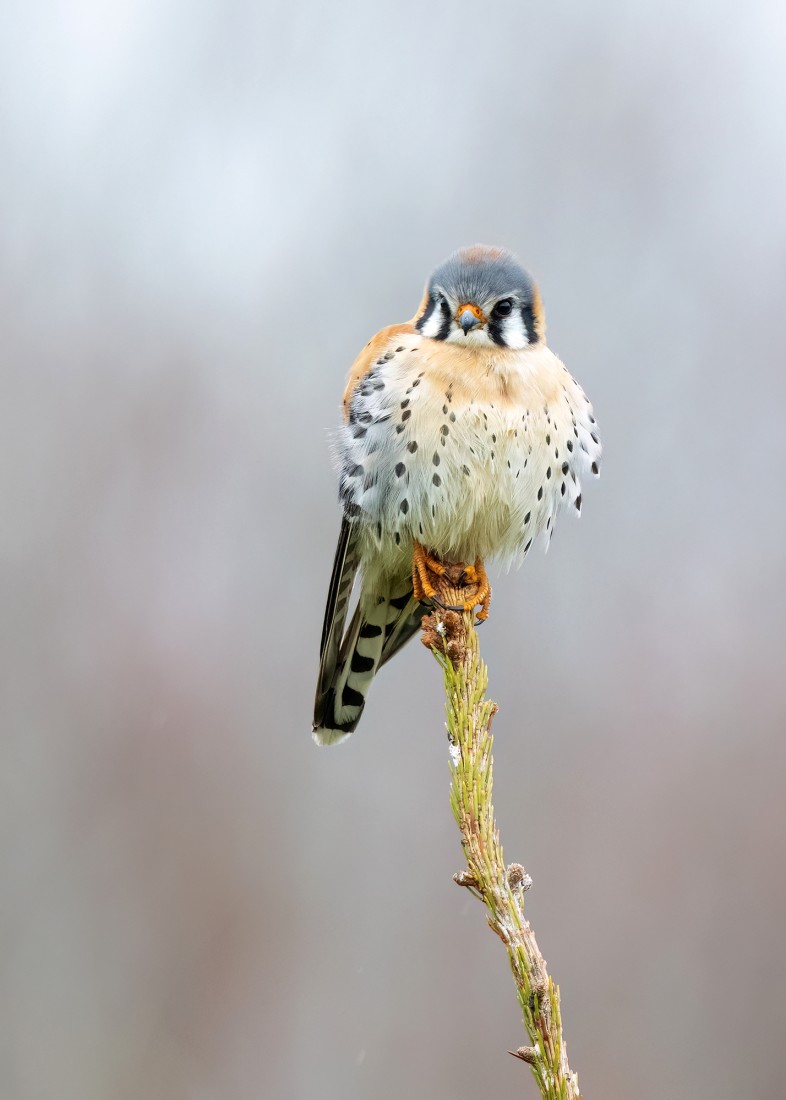
The American kestrel (Falco sparverius) is a formidable predator in a petite package. About the size of a mourning dove, kestrels are the smallest falcons in North America – and the most colorful. Males sport a cool-blue cranium and wings, a warm-brown back and tail, and a beige breast and belly, all mottled by black spots. Females lack the blue coloring, but both sexes have black slashes, sometimes referred to as their “mustache” or “sideburns,” on either side of their beaks. Kestrels’ underwings are checkered, and their squarish tails end in a black bar.
The species’ breeding range comprises nearly the entirety of the western hemisphere, reaching from the southern tip of South America to the northern reaches of Alaska. Across their range, kestrels favor open spaces with short vegetation and few trees, where they can hunt for prey appropriate to their size: large invertebrates such as dragonflies, butterflies, and grasshoppers, as well as small mammals, reptiles, amphibians, and songbirds. This diet most often attracts them to rural locales including pastures, meadows, and grasslands, but kestrels have adapted to life near humans and also may live in suburban and urban environments such as city parks.
For Wheeler, these kestrel traits combine to make the species favorite. “They’re colorful and charismatic,” he said. “They’re found where people are found. They live where we live.”
But these nesting and habitat requirements also render kestrels vulnerable to landscape shifts. American kestrels are cavity nesters. They cannot build nests themselves, so they rely on other species, particularly woodpeckers such as the northern flicker, to excavate holes they can use as nest sites. Northern flickers, however, have declined by nearly 50 percent since 1966, creating a carpenter shortage. Meanwhile, forest management in the Northeast tends to reduce the number of standing dead trees on the landscape, eliminating many potential nesting sites around field edges where kestrels occur.
“We know that [kestrels] are facing multiple challenges,” said Erynn Call, a raptor biologist with the Maine Department of Inland Fisheries and Wildlife (MDIFW). “These include degraded, disappearing, and altered habitats, fewer available nesting sites, and changes in prey and predator populations. Up to this point, we have not been able to identify a single cause to explain their decline, but together, these pressures have been eroding the populations for decades.”
Kestrel trends in northern New England are grim. Call reports a 4-percent drop per year in Maine’s kestrel population from 1983 to 2018, with similar trends in Vermont and New Hampshire, according to the most recent available data for northern New England from the North American Breeding Bird Survey. These declines outpace the national trend of a 1.41-percent annual drop between 1966 and 2019, amounting to a 53-percent continentwide decline over that time period.
Nest Boxes to Fill the Gap
Of the factors driving kestrel declines, a lack of nesting sites is perhaps the most tractable – at least on a local scale. Individuals and conservation organizations can build, install, and monitor nest boxes without effecting politically sensitive reforms such as new development laws or restrictions on pesticide usage.
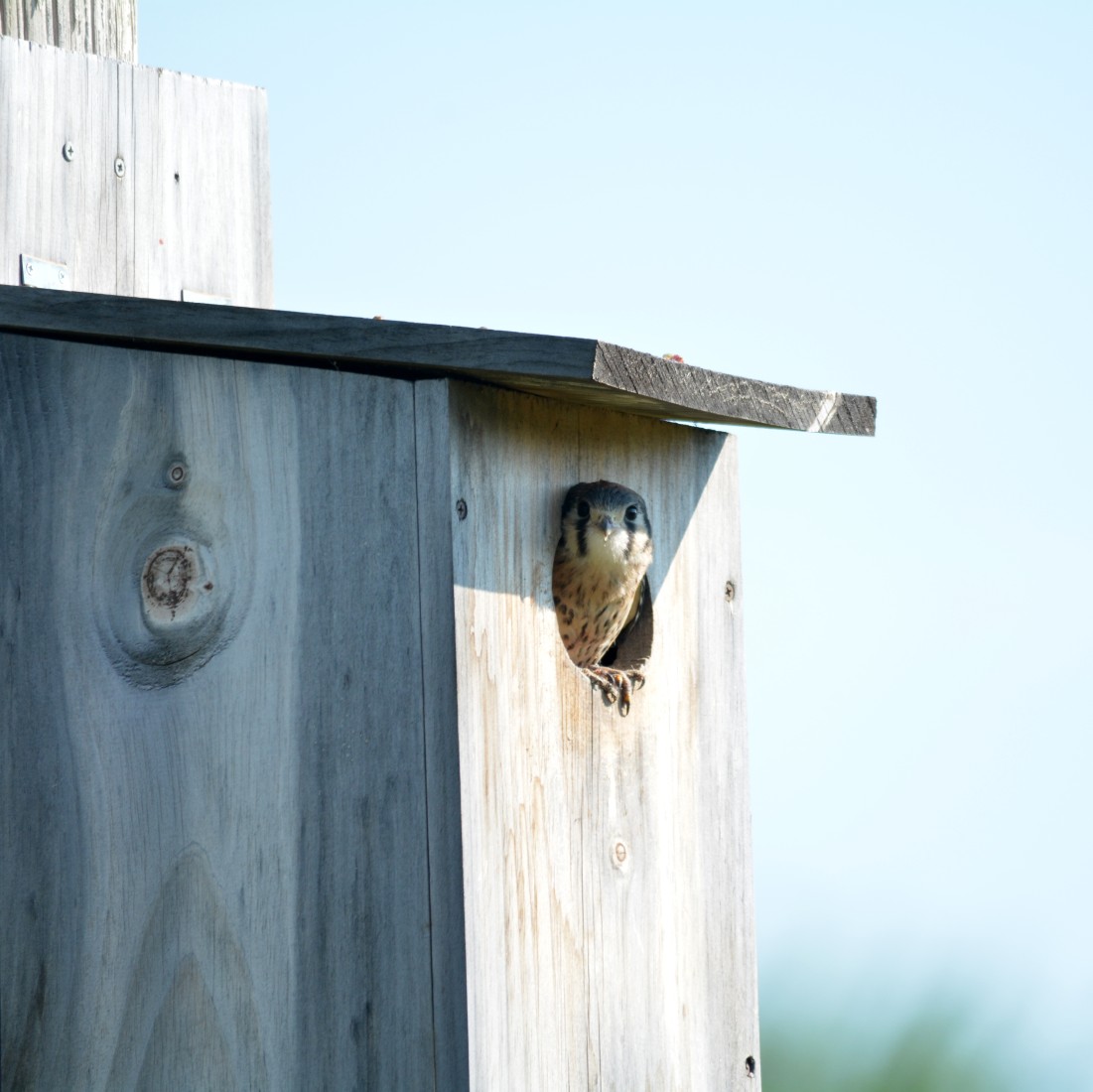
Steve Eisenhauer, a self-described sufferer of “kestrelitis,” founded a group of volunteers called the American Kestrel Recovery Team in 2018. The group includes as many as 30 volunteers, including Wheeler, from 11 states up and down the East Coast. They install, maintain, and record data from nest boxes sited mostly on private land. (Volunteers must acquire the necessary local, state, and federal permits to handle birds.) Each year, participants send data from their nest boxes to Eisenhauer, who recently retired from his role as the regional director of stewardship and land protection at a land trust in Pennsylvania. Eisenhauer collates an annual report summarizing the data. In 2025, volunteers in the group banded a total of 5,229 kestrel fledglings.
Even among this dedicated cohort, Wheeler’s effort stands out. Inspired by his aunt, a fellow bird lover, he acquired a federal bird-banding license in 1973. The following year, he designed, built, and installed his first nest box, which he describes as “an enlarged bluebird box.” He also began work that year as a fisheries biologist with the New Hampshire Department of Fish and Game.
Fifty-two years and 241 nest boxes later, his monitoring protocol is largely the same as in those earliest days. Regularly joined by his wife, Mabel, Wheeler checks each box for occupancy starting the third week of May, often finding a female incubating her eggs. He bands the mother, tallies the number of eggs, and moves on. In June, he returns to band nestlings, timing his visits carefully so that fledglings do not flee the nest prematurely.
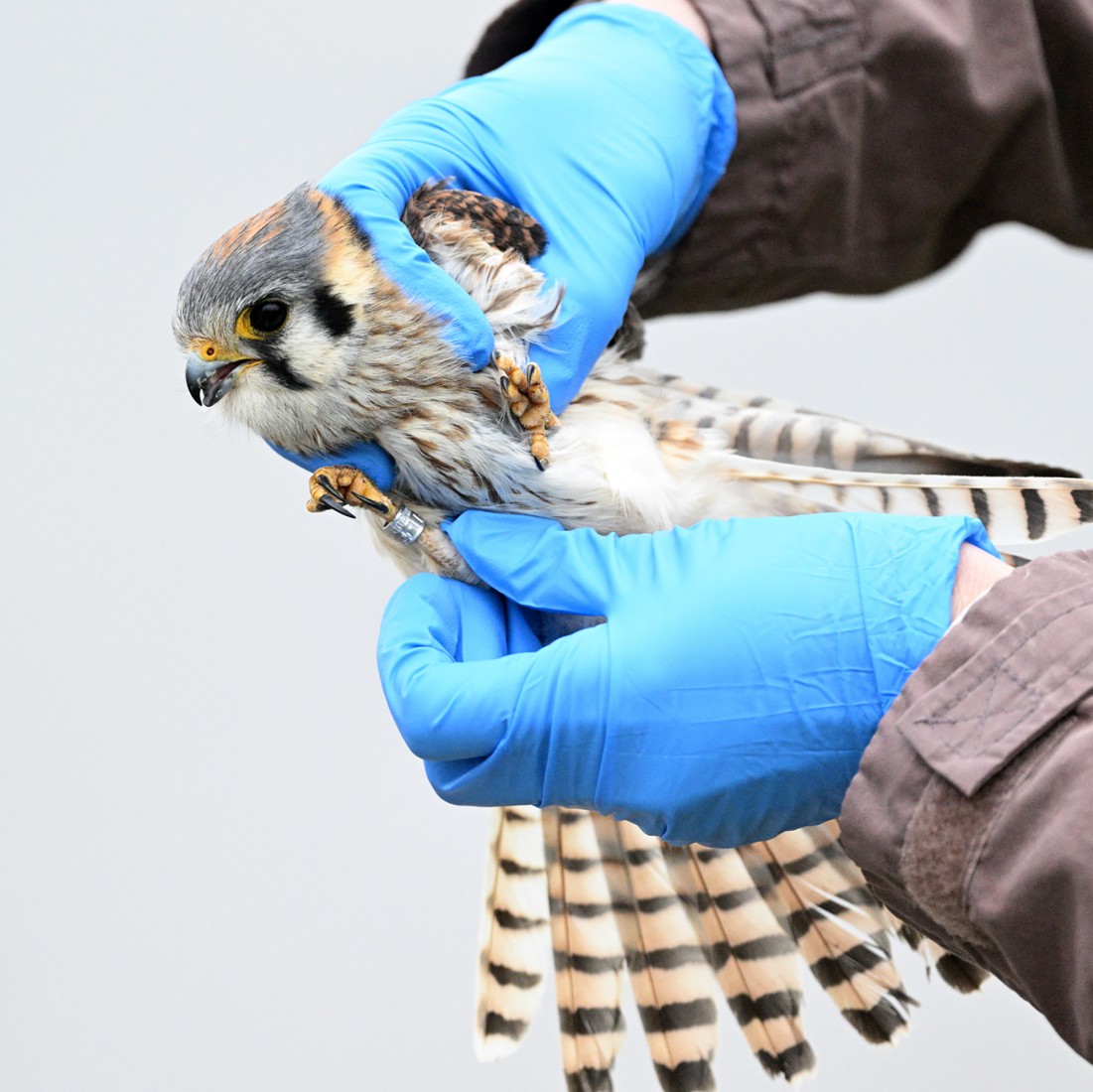
In 2016, Wheeler began using a new post design that allows him to move uninhabited nest boxes around the landscape more easily, which quickly boosted occupancy rates from between 20 and 30 percent to between 40 and 50 percent. Whereas he once identified suitable habitat from his truck and tracked down landowners via tax maps, he now uses digital applications including onX Hunt to identify landowners who may be willing to host a nest box or two, and eBird to better match the placement of his boxes with locations where kestrels have been spotted.
Over the years, Wheeler has found that reaching out directly to landowners and interacting with them in person helps to make them more comfortable with the idea of someone installing and monitoring a nest box on their land – and allows Wheeler to convey his passion for kestrels, something he usually finds landowners share. The approach has yielded dividends for the falcons. In 2025 alone, Wheeler banded 309 fledglings across his boxes, and since 1974, he has banded 3,179 young birds.
A Public-Private Partnership Offers a Hopeful Model
A handful of the programs in Eisenhauer’s consortium receive training and some funding from their state wildlife agencies, because kestrels in those states are officially classified as threatened or endangered. But in New Hampshire, Maine, and Vermont, kestrels occupy a conservation gray area that, in some ways, puts them at an even greater disadvantage: declining rapidly, but still too numerous to trigger a state threatened or endangered listing that would unlock more attention and funding.
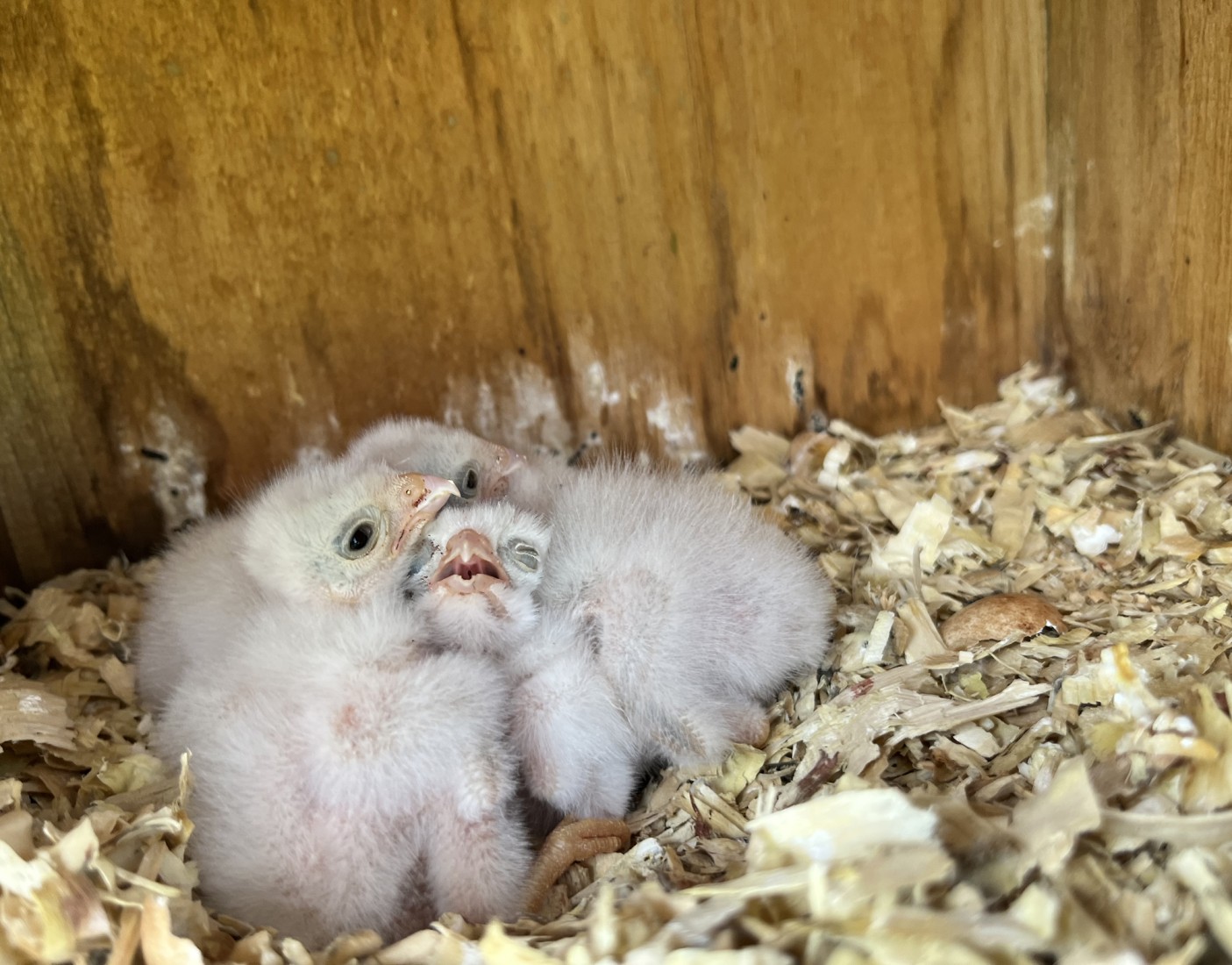
A nest box program to Wheeler’s northeast, however, has catalyzed greater public investment in kestrels and their recovery. Near St. Albans, Maine, Marek Plater maintains 20 kestrel nest boxes. Plater is a longtime hobby falconer who spent decades banding migrating hawks in Pennsylvania. In 2012, he moved to Maine with his wife to be closer to their children. The following year, he installed several nest boxes near his property and began collecting data, tracking egg and fledgling counts and banding adults and chicks.
Two years into his effort, a falconer friend told him that Erynn Call, the MDIFW biologist, had recently taken on a raptor-focused role at the department.
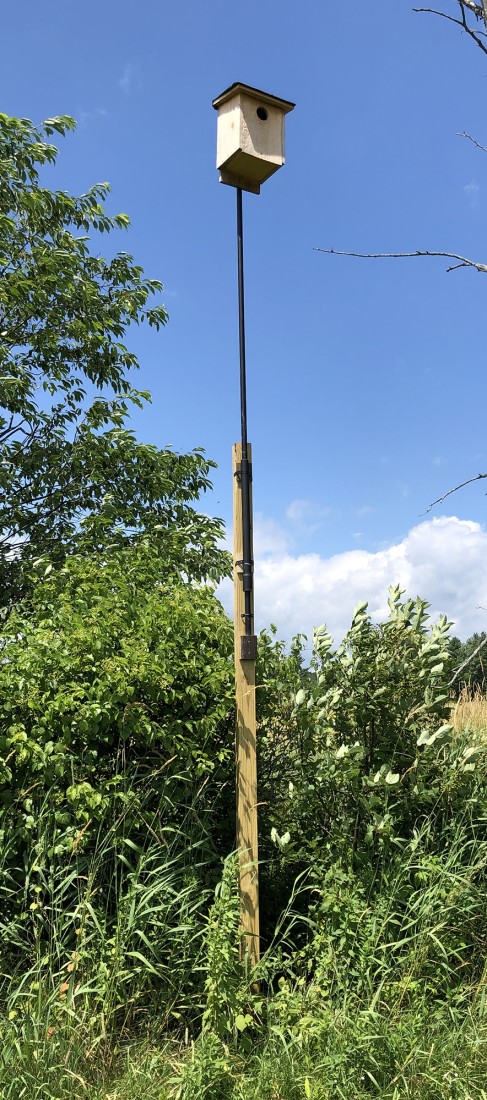
“I called her and introduced myself and told her what I was doing,” Plater recounted. Call was intrigued. She and several MDIFW colleagues went with Plater to monitor some of his boxes, and they soon became regular participants in his monitoring outings. Plater, who is 81, welcomed the help, as climbing ladders to install and monitor nest boxes is taxing work.
Plater and Call’s decade-long partnership has brought a new degree of efficiency to Plater’s data collection. “Erynn has taken this to a whole other level,” he said. “She started by copying the data over from my ‘scribble sheets.’ Over the years she has interpreted all of that data and fed it into databases. She’s also taken the GPS coordinates of all of my boxes. It’s become a very computerized process.”
Call is quick to point out that Plater has done just as much for Maine’s kestrels – and for her – as she has done for him. “Marek’s is the only long-term kestrel monitoring program that we’ve had in Maine,” she said. “More than that, his enthusiasm is contagious. Working with him has turned my professional interest in kestrels into something immediate and hands-on.”
Cataloging Plater’s data was just the beginning. Under the banner of the Maine Kestrel Project, a subdivision of the newly minted Maine Open Habitat Raptor Program at MDIFW, Call and her colleagues plan to collaborate with land conservancies to install nest boxes and develop monitoring protocols for data collection. The aim is an initial collection of 25 new nest boxes overseen by the state to be complemented by 25 others, likely to include some, if not all, of Plater’s boxes, kept up by private individuals or groups.
For Call, the expanded program is the most persuasive evidence that community-led efforts like Plater’s, no matter how humble, can have an outsized impact. “Working with Marek has demonstrated how much long-term conservation can depend on a single individual,” she said. “He created a record of kestrel nest box use that would not exist without his persistence.”
The Future of Nest Box Programs – and Their Inhabitants
As hopeful as Plater and Call’s example of public-private collaboration is, it is not the norm. With state wildlife budgets stretched and kestrels still unlisted as threatened or endangered in many states, most nest box programs are likely to remain run by volunteers who commit a significant amount of time to banding birds and gathering data. And those volunteers skew older.
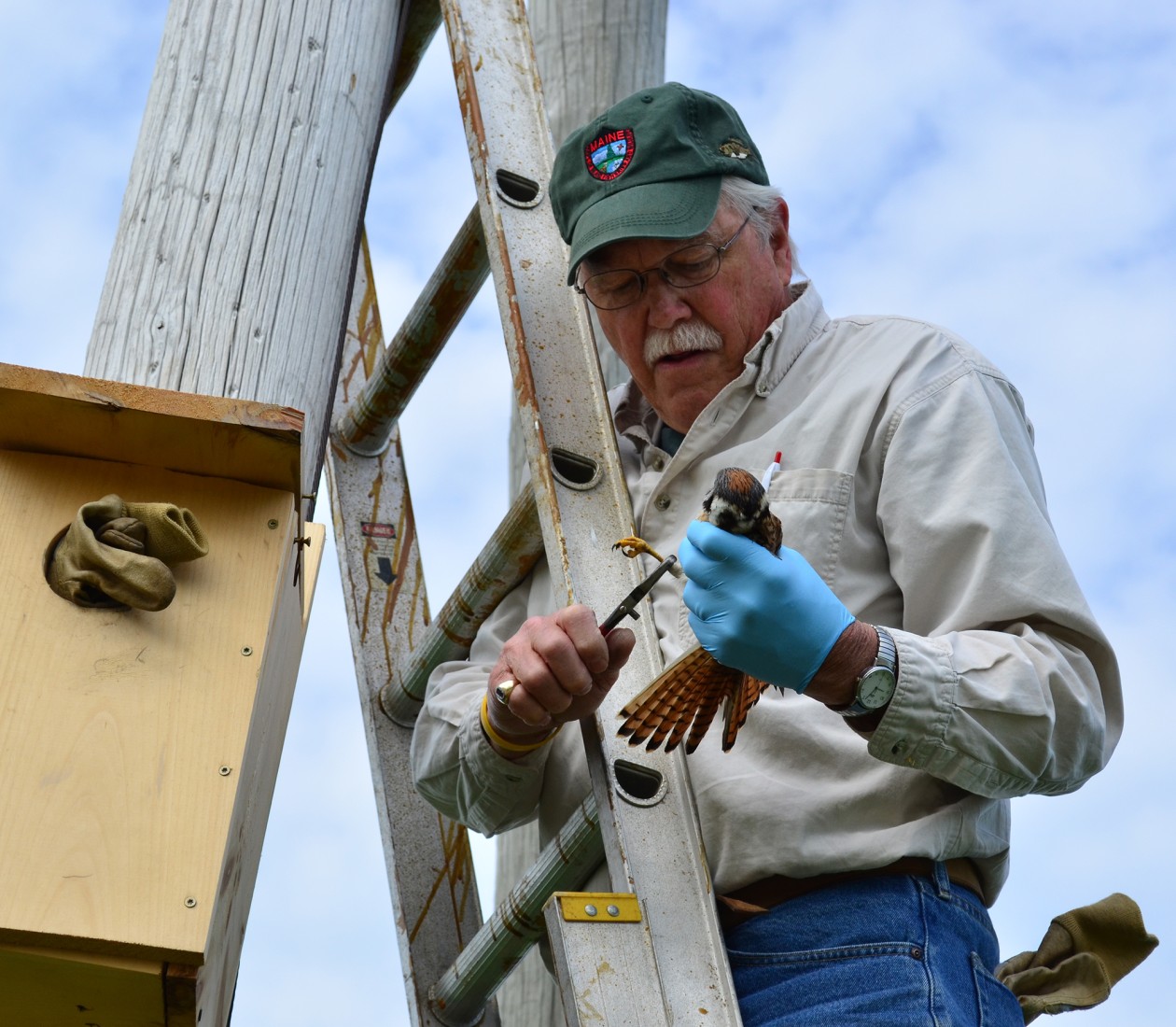
“One of the biggest problems is that we’re aging out,” said Eisenhauer, who turns 73 this year. “Finding people who really have the necessary love and commitment and expertise is hard. Often, every single nest box site in a program requires specific instructions. Farmers want to know who’s coming into their fields. That’s why people like Steve and Marek have done so well.”
That’s part of what makes Plater so grateful for his partnership with Call. “When I’m gone, I know she’ll continue what I started,” he said. “That’s a good feeling, that it’ll be carried on afterward.”
Wheeler wonders about the fate of the massive network of nest boxes he has built over more than five decades. While he does not yet have a clear succession plan in place, he and Call have discussed transferring his extensive data into her growing database, which could help to inform regional kestrel conservation efforts in the future.
The fate of programs such as Wheeler’s and Plater’s could bear on the future of the American kestrel. While Call is careful to point out that isolating any one factor’s relative impact on a species’ trajectory is difficult, properly tended nest boxes are certainly a part of a brighter future for the falcons.
“I think it’s important, at the small scale, to break a problem like population declines into smaller pieces,” Call said. “In combination with landowner outreach, nest boxes can make a real difference.” She and her team are beginning to analyze the data from Plater’s boxes to see if a clear positive trend emerges in the totals.
Similarly, for Eisenhauer’s American Kestrel Recovery Team, researchers need more data to assess whether its nest box programs are meaningfully influencing kestrel populations. The number of young kestrels reaching banding age across the team’s service area has risen nearly every year since 2018, but this metric alone does not indicate whether those kestrels that fledge from nest boxes survive into adulthood. Moving forward, Eisenhauer plans to ask participants to also measure and report their occupancy rates, which tracks how many of their nest boxes host a breeding pair each year, as part of their data submissions.
Those rates, along with kestrel tallies from marquee surveys such as the Christmas Bird Count, will help to prove or disprove Eisenhauer’s optimistic outlook that kestrel numbers are climbing, at least locally. Plater shares that optimism, pointing out that the proof for him is right there on the landscape. “This all started for me when I was told, ‘There are no kestrels here,’” he said. “I really feel like I’ve produced a kestrel community, because now you see them all over the place.”
Wheeler, meanwhile, is not so certain. He notes that he has boxes that were once used and are now empty, and some that never host birds at all. “It’s clear now, unlike when I first started doing this, that new boxes do not always equal more kestrels,” he said. If mortality rates are too high among adult and juvenile birds off the nest, whether because of habitat loss, prey reductions, or other factors, their populations will continue to decline, no matter how many nest boxes dot the landscape.
Still, Wheeler indulges in moments of pride for what he and others have done for this charismatic falcon. He points out that kestrel numbers in northern New England have yet to plunge as low as they have in some other areas – a point he at least in part attributes to the recovery team’s efforts.
“I’m not sure we’re ever going to see [kestrels] rebound to the levels of the ’70s or earlier,” he said. “But kestrels, I don’t think, will ever become threatened or endangered here, and that’s because of nest boxes.”
Discussion *