

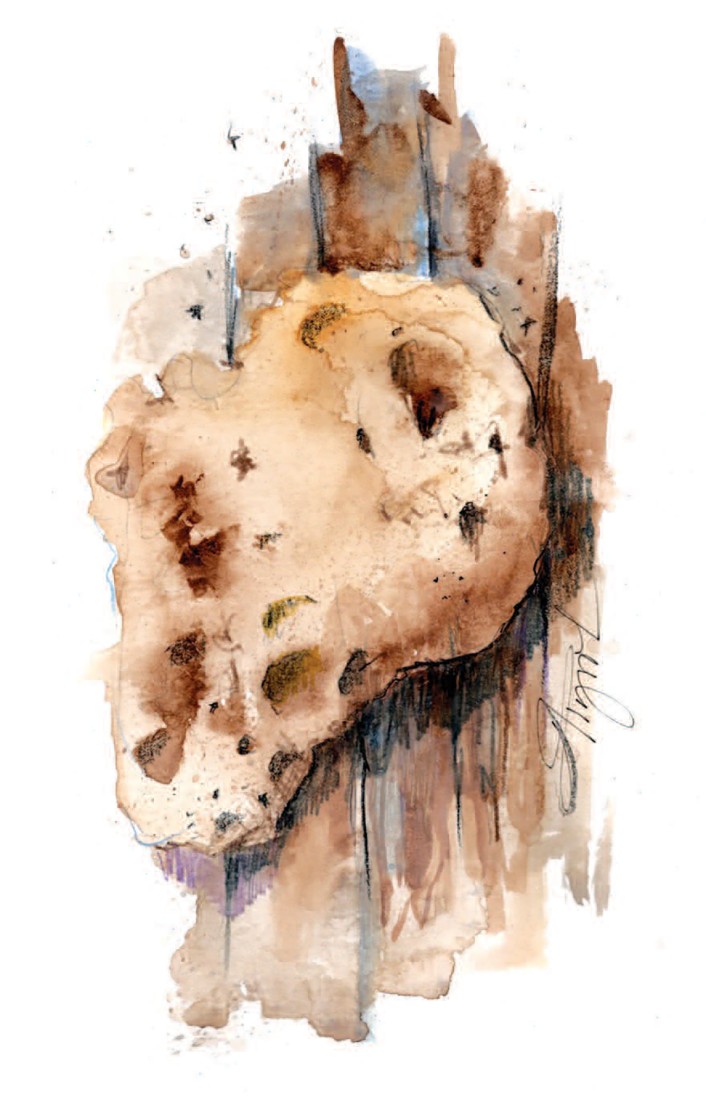
As I was prepping my fall invertebrate zoology course, a colleague mentioned that a local berry farmer had scraped mud dauber wasp nests off an outbuilding and suggested these would be of interest to my students. Because mud dauber wasps are slow to sting and they pollinate flowers, I would normally be reluctant to disturb them. Because these nests had already been removed, however, I stopped by the farm and left with a bucket of amorphous wasp nests for students to dissect.
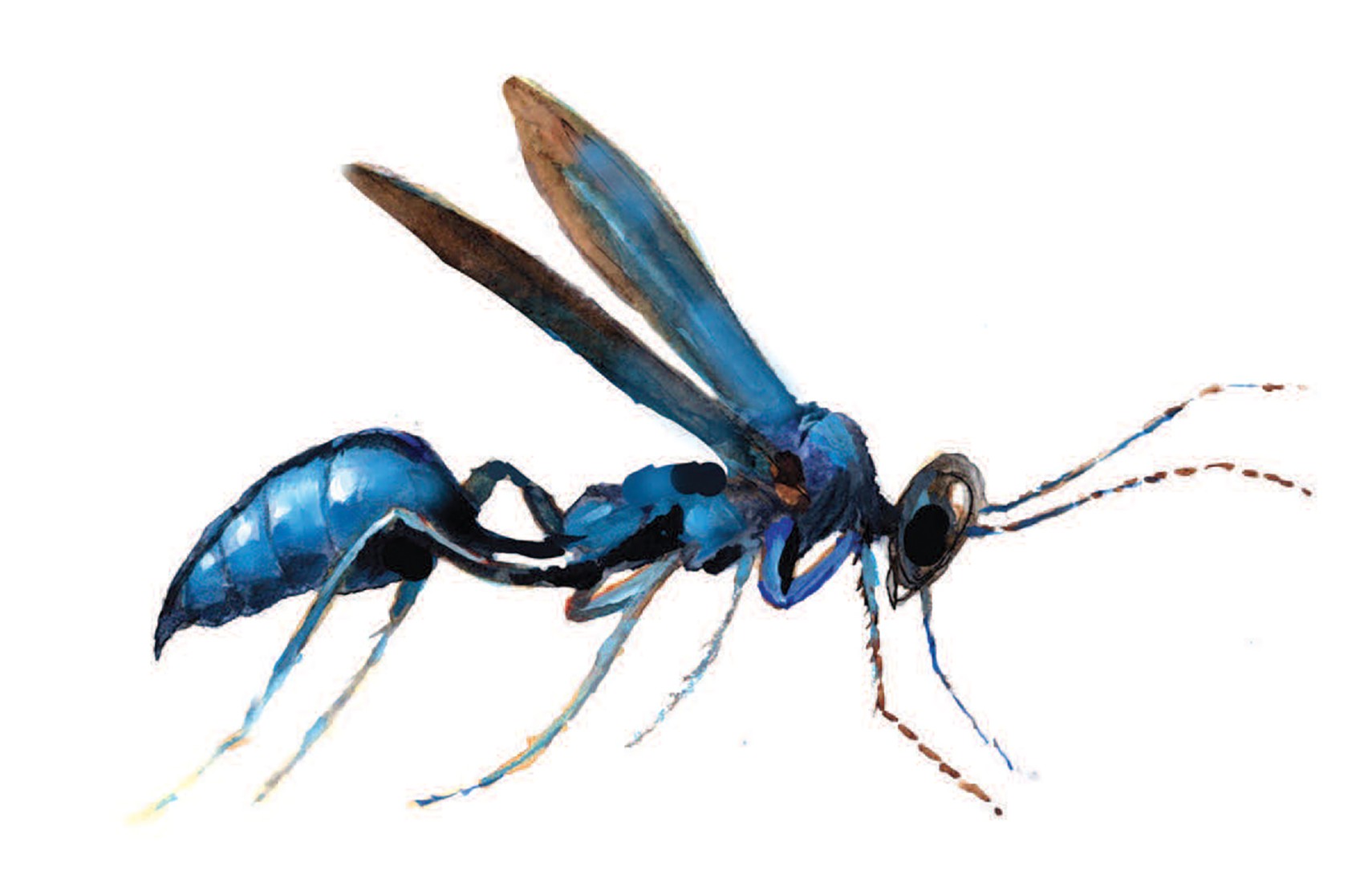
These were common blue mud dauber wasp (Chalybion californicum) nests. This dark, metallic blue species is a common summer sight throughout the Northeast. The dried mud nests had accumulated over several years and were lumpy, divided into chambers, and clumped on top of each other like an apartment complex built absent any concern for architectural aesthetics or clear paths to exit.
Like most insects, mud dauber wasps go through complete metamorphosis from egg to larva to pupa before the winged adults emerge. Female mud daubers construct mud nests consisting of several individual cells between June and August. A female wasp lays a single egg into each cell and provisions these with paralyzed invertebrates before sealing the cell with more mud. The eggs hatch, the larvae feed and grow, and by September, they pupate. The pupae overwinter in their sealed chambers and metamorphose to adults in late spring. Adult wasps bore exit holes through their mud cell walls to emerge at the end of May or early June and begin foraging for nectar to fuel their activities, spiders to supply to their offspring, and mud to build their nests. Gathering mud takes effort, and the common blue mud dauber is not above reusing old nests, including those of other mud dauber wasp species.
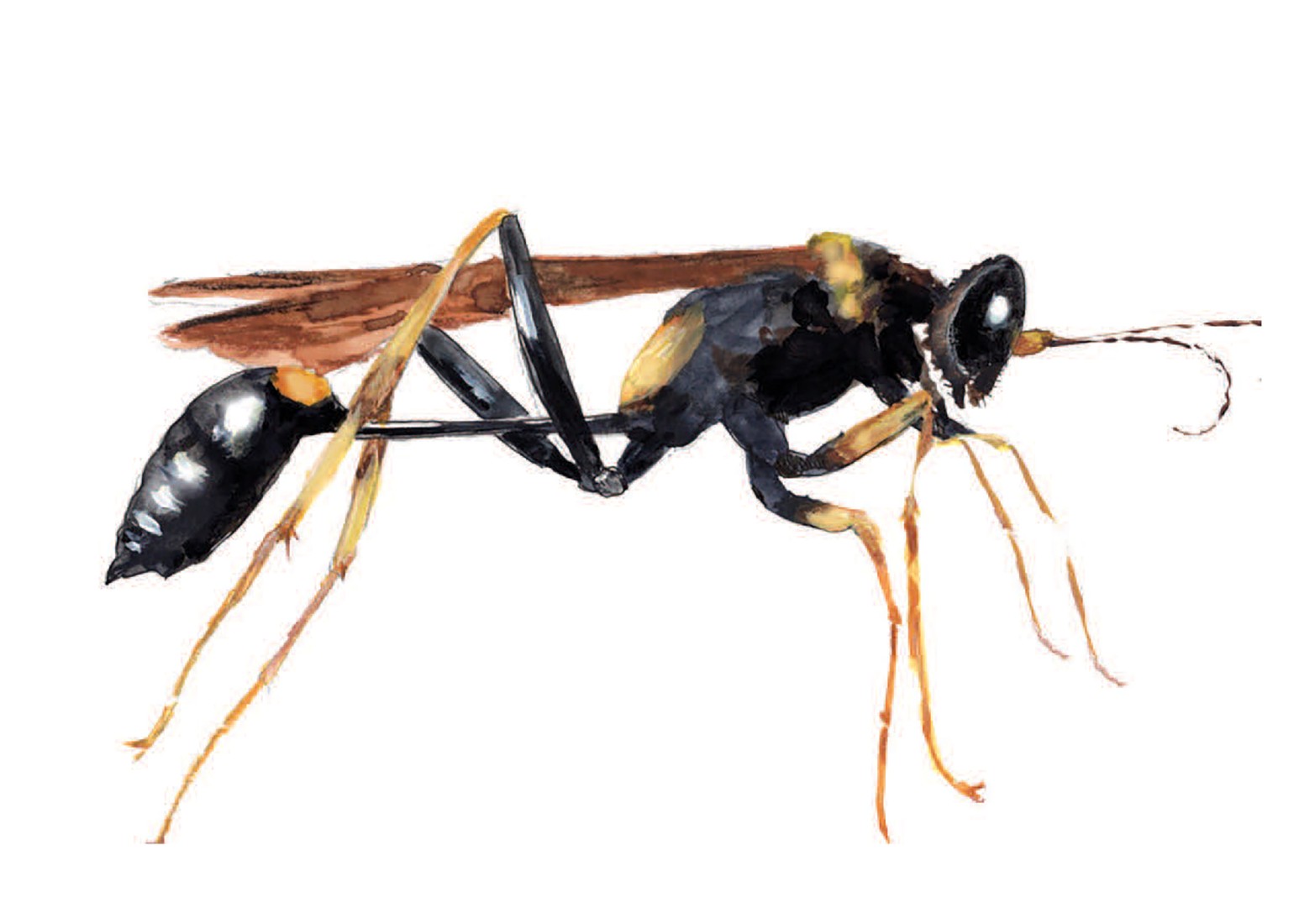
Another species abundant in our region is the yellow-legged mud dauber (Sceliphron caementarium). These wasps build nests that resemble a tidy set of stubby pipes lined up horizontally. Depending on when you happen upon such a nest, a chamber may still be open, awaiting the next prey item and egg before being sealed up with mud carried by the mother wasp between her mandibles and front legs. A set of neatly spaced openings in the mud suggests you have found the nest after the adults have emerged.
The four mud dauber species most common in the Northeast – including the two mentioned here, plus the native Zimmerman’s mud dauber wasp (Chalybion zimmermanni) and the non-native Asian mud dauber wasp (Sceliphron curvatum) – often nest in hollow trees and cave openings. They may also build nests in the shelter of human-made structures such as overhanging eaves, outbuildings, and picnic pavilions, which provide protection from rain. These wasps each have a strikingly long and slender stalk-like petiole connecting the thorax to the abdomen. It is a feature our local mud dauber species share with others in their family (Sphecidae) and provides the family’s common name: “thread-waisted wasps.” Despite its very narrow diameter, this long petiole carries the digestive tract; tracheal tubes that move oxygen and carbon dioxide; nerves; and hemolymph (insect “blood”) between the fore and aft portions of the insect.
The thread-waisted wasp family also includes both sand wasps and digger wasps. To further complicate the taxonomy, some mud dauber wasp species belong to an entirely different family – the square-headed wasps (Crabronidae) – another group that also includes sand wasps and digger wasp species. These complications result from giving groups common names based on behaviors, such as digging or sandy habitat use, rather than on evolutionary family ties.
In the classroom, as students dissected the nests, they discovered some chambers contained spiders and not much else. This posed a research question, and students learned that some mud dauber wasp species provide spiders as sustenance for their offspring. A mother wasp will sting and paralyze several spiders; after laying an egg on one of them, she daubs some mud on the chamber opening to seal it. Once the eggs hatch, the larvae consume the still-living spiders before pupating.
We entirely missed the tiny, white, cylindrical eggs, although they were certainly there in the sealed mud nests. The spiders, though, were fresh and intact enough for students to add to their invertebrate collections. And although common blue mud dauber wasps are partial to black widow spiders, we didn’t find a single one. Other chambers in the nests contained wasp larvae and the shriveled remains of spider legs. Clearly, the larvae had devoured the spiders and were well on their way to developing to the next phase of life. Some chambers contained pupae, while others held long-dead adult wasps trapped by multilayered concretions of hardened mud added to the higgledy-piggledy dwelling by wasps completing their singular missions.
“Singular” is the operative word in this case: these wasps are solitary nesters that often happen to nest together because conditions that are right for one wasp are also right for others. Mud dauber wasps are not particularly territorial with their own kind and, unlike yellowjackets, they do not aggressively defend their nests against predators or humans. Mounting an aggressive nest defense makes sense for a yellowjacket, because she will be quickly supported by hordes of stinging reinforcements. A mud dauber wasp’s nest defense would be a solo effort and therefore not worth the risk.
If you deliberately catch a mud dauber wasp in your hand, however, it will likely sting you, although the sting is not particularly painful. (As with many insect stings, allergic responses can be more severe for affected individuals than the physical or chemical pain inflicted.) So, if you find mud dauber wasps during your summer rambles, feel free to admire, photograph, and observe, secure in the knowledge that unless you threaten them, they are unlikely to cause harm.