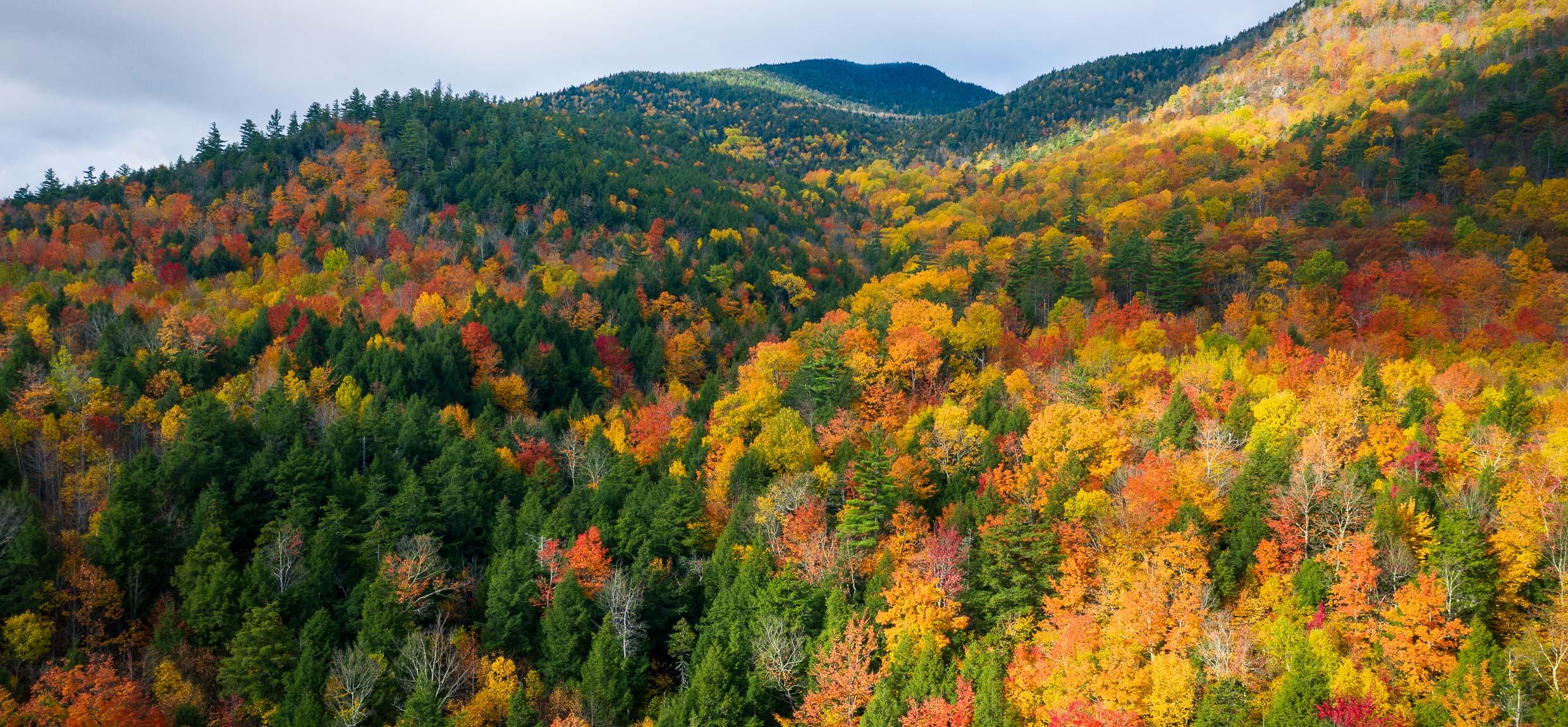


This past winter, my partner and I became first-time owners of forestland – 30 acres of mixed hardwoods dominated by sugar maple on a north-facing ridge in Vershire, Vermont. In the months since, I have felt an interconnectedness with millions of others tending land throughout our region – and most immediately with owners of adjacent properties. A 36-mile trail used by numerous recreationists links our woods with other consenting landowners across four towns and two states. The tracks of fishers, foxes, and coyotes stitch together the many small parcels such as ours that make up a 400-acre contiguous forest block these animals depend on. A few token buckets of our sap blend with our neighbors’ in tanks in sugarhouses down the road. A stream along the eastern property line reminds us of these upland forests’ role in determining the impacts of heavy rain on people downhill from us.
Forest benefits and risks exist, of course, at scales beyond individual properties – on these levels of woodsheds, watersheds, large-mammal habitat, and the like. Paul Catanzaro and Anthony D’Amato (a Center for Northern Woodlands Education board member) remind us of this fact in their co-authored book, Tending Your Forest: A Guide to Ecological Forest Stewardship in the Eastern and Central United States (reviewed on page 73). “Forests and the processes that shape them know no boundaries,” they write. “Instead, your forest establishes, grows, and develops at a scale far greater than the size of your property and as part of the forest to which it is connected within your landscape. Though you can only make decisions for your own land, that does not mean that the perspective you take can’t operate at a larger scale.”
We can optimize positive impact by working together and considering context. As this issue’s Stewardship Story subject Sabina Ernst has found (page 26), controlling invasive species in your woods becomes all the more Sisyphean if an untended supply in the surrounding neighbors’ woods remains ready to spill over into yours, and silvicultural treatments (and the thoughtful lack thereof) can complement and diversify a larger landscape, with encouragement of underrepresented age classes and creation of corridors between forest blocks. The research Loren Merrill highlights (“How Natural Disturbances Affect Forest Management,” page 69) suggests that the choice between management and no management – so often framed in the abstract as a black-and-white issue – should also depend on context, particularly on the local disturbance risk. In consideration of carbon stocks, biodiversity, and wood production, both passive and active approaches belong on our landscape.
Just as one property makes up part of a wider forest context, CNWE makes up part of an ecosystem of reciprocal learning, one that comprises landowners associations, peer-to-peer teaching networks, state extension and service forestry programs, and fellow publications such as The Northern Logger & Timber Processor and From the Ground Up. It also includes generous readers and supporters of Northern Woodlands who’ve provided me with inspiration as they gave tours of their properties and described their stewardship choices with a profound sense of purpose. As an individual with the recent privilege of forest ownership, I look forward to tapping into this network in a new way. As an organization, we at CNWE take pride in belonging to this community and hope we can help to empower others to act in accordance with the latest, most accessible, and most complete forest knowledge, with their own values and aims, and with a deeper relationship with their woods and each other.