
This past spring and summer, I spent a lot of time driving through various parts of the Northeast – and beyond – most of it with my youngest, who was exploring college campuses and competing in soccer tournaments. In one period of just over a week, I visited every New England state more than once, drove through two different stretches of New York, and traveled far enough north – in two different states – that my cell phone pinged with the message, “Welcome to Canada!” A couple of weeks later, we drove from our home in New Hampshire, over the Connecticut River into Vermont and down the length of the Green Mountain State, then through Massachusetts and Connecticut, across a chunk of New York and a (very busy) sliver of New Jersey, and into Pennsylvania. On the next day’s drive, we crossed a corner of Maryland and a slice of West Virginia, traversed the Blue Ridge region of Virginia, and – finally – arrived in North Carolina.
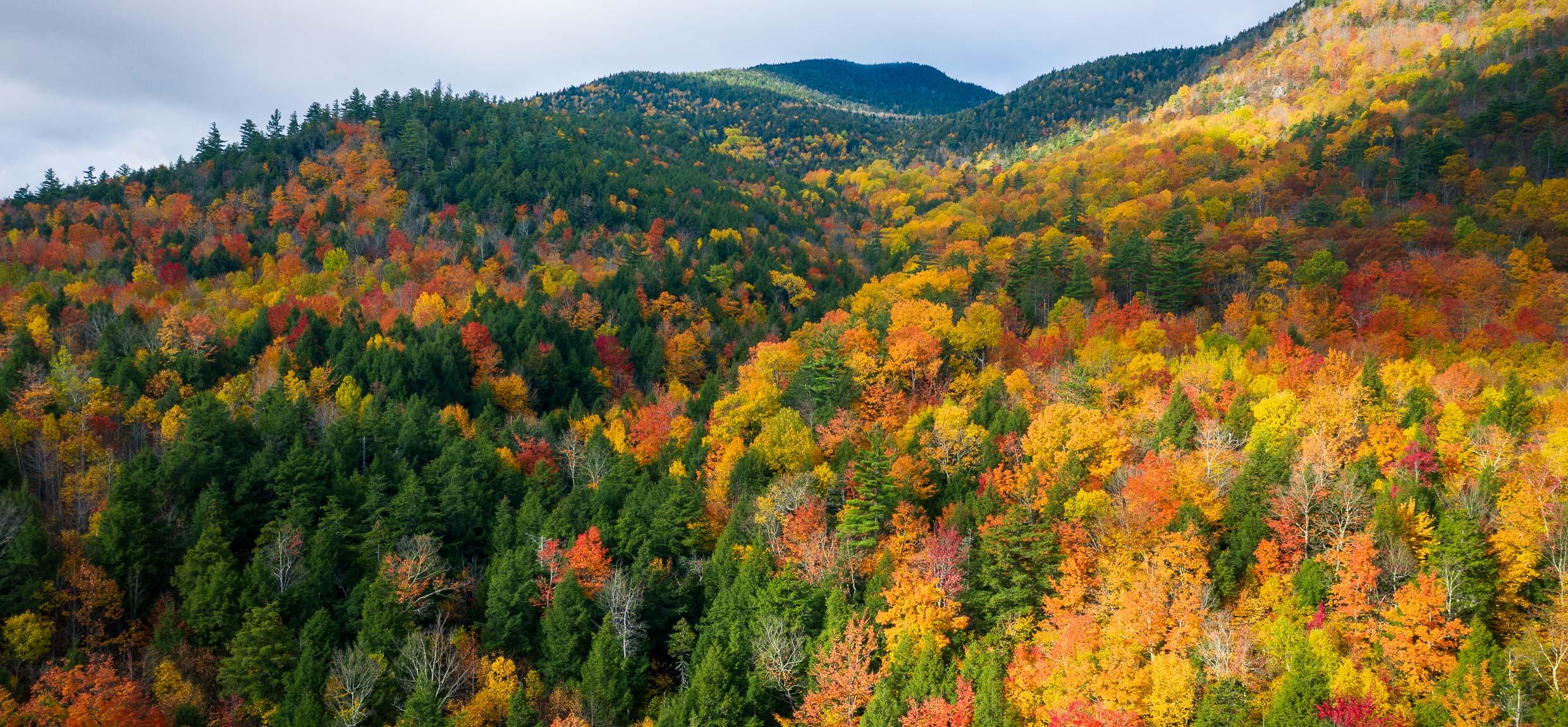
While my travels were unrelated to my work for Northern Woodlands, I find that I cannot drive along a highway or backroad without scanning whatever trees are alongside it. On quieter routes, driving more slowly, I peer at bark and branches, trying to determine which species of trees line the roads. And I lament the Japanese knotweed (or is it giant knotweed or some hybrid? – see page 22) that grows in thick swaths in many areas. When I pass the Tree Farm signs at the ends of long driveways, I wonder what is beyond – what trees and wildlife inhabit the woods, what management and stewardship happens there. From the interstates, as I chug along at a swifter clip, I look out to the hills near the road and more distant, scanning the landscape for patches of evergreens and hardwoods, recently cut places and those regenerating to young forests.
My highway journeys this year sometimes brought me near or through large urban areas, and the heavily forested landscapes so near those citified settings caught me by surprise. Not far from Springfield, Massachusetts, Albany, New York, and Providence, Rhode Island, we drove along highways bordered closely by trees on either side. On our way into Winston-Salem, North Carolina, it seemed we turned only a couple of corners to traverse from woods to agricultural land to urban center. On the way home, we traveled for hours through a wooded landscape – the kind where you can look in all directions and see far more trees than human structures – before arriving in the Scranton/Wilkes-Barre region of Pennsylvania, then plunged back into a sylvan realm.
New Hampshire, Maine, Vermont, and other parts of the Northeast are, after all, among the most heavily forested regions in the country. Even with all the trees we have, there are efforts to plant more, as Jennifer Durgin writes about in “Promise & Potential Pitfalls of 25 Million Trees,” on page 40. What we plant, of course, is also important. The connection of native fauna species to the availability of native flora is something entomologist Doug Tallamy has spent much of his career studying, fostering in his own yard, and sharing with others; his Community Voices interview is on page 58 of this issue. And anyone who has taken the time to examine any one section of forest and has noticed – and wondered about – the varied species that grow there together will likely appreciate “Finding Natural Communities: Adventures in Conservation,” written by ecologist Liz Thompson (page 50).
“Thankfully, we are still learning,” Thompson notes in that piece, later writing that “even with sophisticated tools, walking in the woods, slogging through bogs, and scaling cliffs is still the only way to really know what’s out there.” I am happy to be among this community of people – scientists, foresters, those simply planting things in their yards and gardens, and folks who spend time wandering the woods for whatever reason – who are learning all the time, sometimes in the forest, other times gazing at trees from a vehicle traveling the highway. I hope each of our readers finds plenty to spark that learning in these pages.