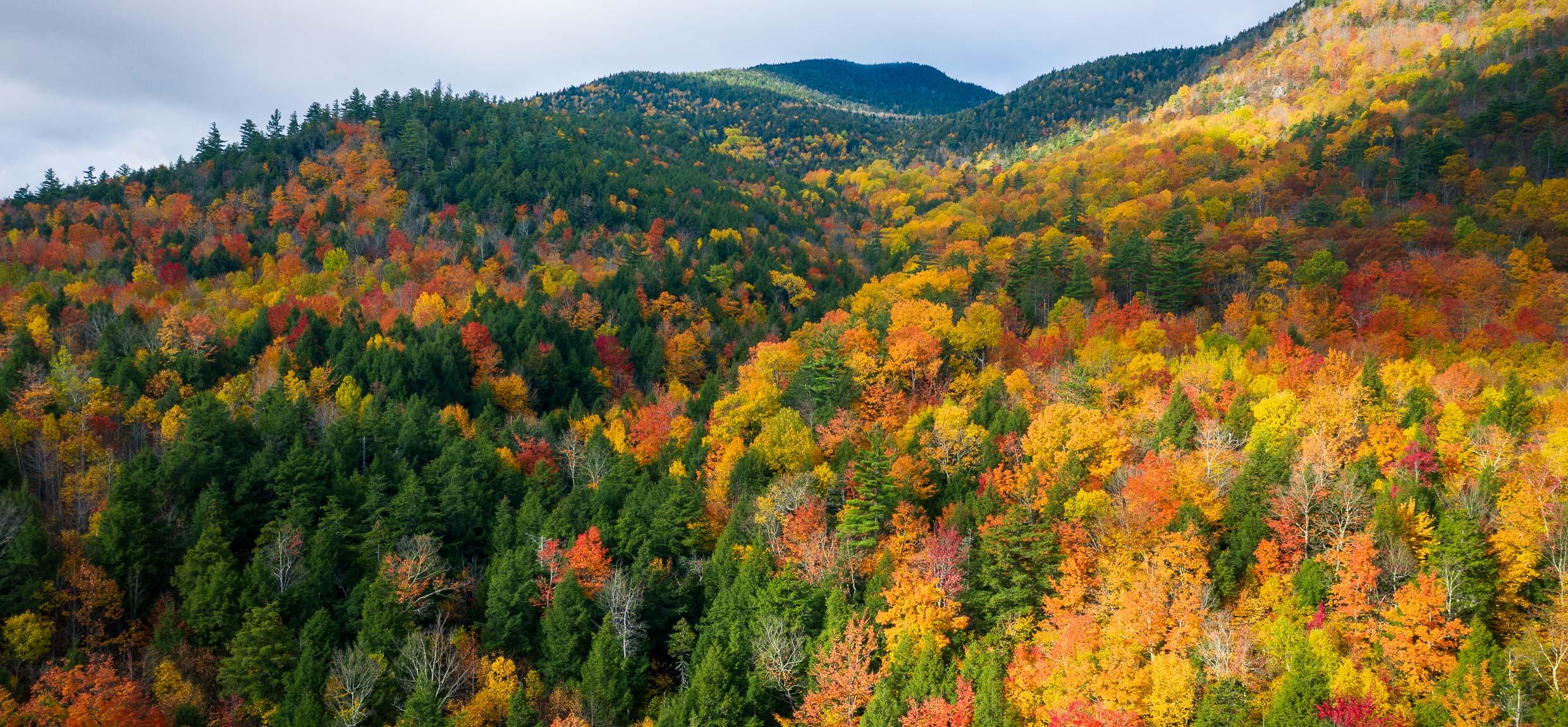

During autumn, hillsides in the Northeast transform from a summer green to a patchwork of color. Sugar maple turns orange, paper birch glows lemon yellow, and serviceberry deepens to crimson. Yet among these changing canopies are trees that remain green all winter: spruce, pine, fir, cedar, and hemlock. Why do some trees invest in leaves that last a season, while others invest in leaves that last for years? What determines whether a tree is evergreen or deciduous? And why do both types coexist in the forests of the Northeast?
The Leaf Economics Spectrum
All trees rely on photosynthesis to capture carbon dioxide from the atmosphere and energy from the sun to make carbohydrates used for growth, defense, and reproduction. Leaves are the primary organs of photosynthesis and are central to plant survival.
As leaves absorb carbon dioxide through tiny pores called stomata, water simultaneously escapes into the atmosphere – a necessary cost of photosynthesis. Every leaf must balance carbon gain against water loss. The environment in which the tree grows shapes how it achieves that balance, and trees have evolved a remarkable variety of leaf forms, traits, strategies, and structures.
Many deciduous and evergreen species occupy opposite ends of what ecologists call the leaf economics spectrum. Deciduous trees build relatively inexpensive leaves that capture carbon dioxide rapidly but last only a single season, while evergreen trees invest more resources in durable leaves that may persist for years.
The Fast Strategy: Deciduous Trees
Deciduous trees lose all their foliage for part of the year. In the Northeast, they shed their leaves in autumn to avoid cold damage and winter drying, when frozen soils prevent trees from replacing water lost through leaves. In other regions, deciduous trees may drop their leaves during the dry season to conserve water and to avoid drought stress.
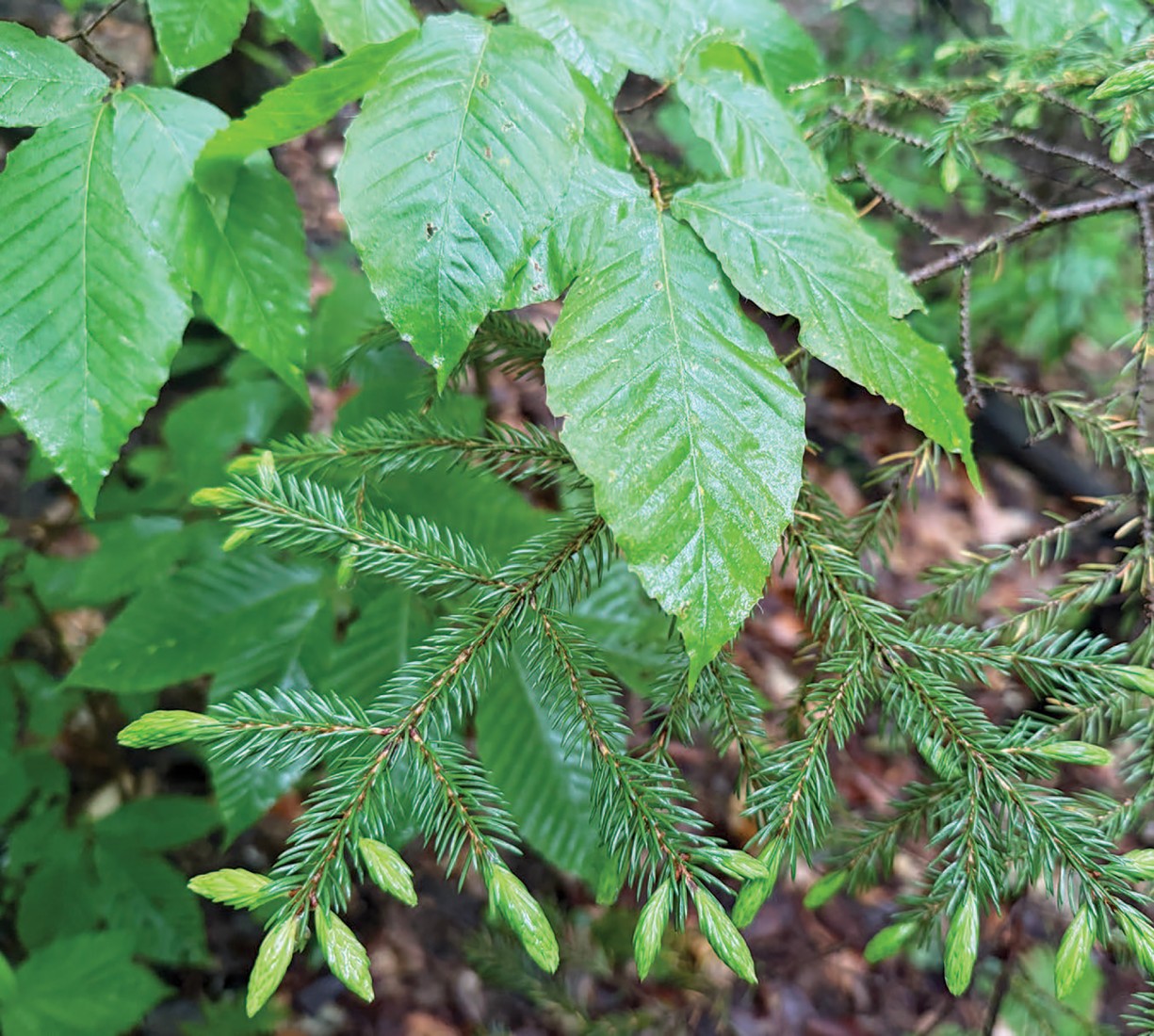
Deciduous leaves are built to be disposable. In effect, deciduous trees trade durability for performance. Their leaves are typically broad and thin, maximizing surface area for capturing sunlight and carbon dioxide. This design supports rapid photosynthesis, allowing trees to generate enough carbohydrates in a single growing season to repay the cost of producing an entire canopy.
Before shedding their leaves, deciduous trees recover part of their investment by moving nitrogen, phosphorus, and other nutrients from leaves to branches, stems, and roots, where they’ll be stored through winter. The brilliant colors of autumn appear as chlorophyll breaks down and the tree withdraws these nutrients.
Even so, trees cannot recover all nutrients from their leaves. Deciduous trees must acquire additional resources from the soil each spring to build a new canopy, and many invest heavily in fine roots to support this nutrient uptake. Although rebuilding a full set of leaves each year is costly, the payoff is rapid growth and high productivity. Because deciduous trees are already adapted to rebuilding their canopy annually, they are often better able to recover from leaf damage and defoliation than evergreen species.
The Slow Strategy: Evergreen Trees
Evergreen trees retain functional foliage year-round. They build leaves for durability, allowing them to withstand a wide range of environmental conditions. To remain green through winter, evergreen leaves must tolerate freezing temperatures, snow and ice loading, and winter drying when frozen soils limit water uptake. As a result, they are typically needlelike, scalelike, or leatherlike, with thick tissues and waxy coatings that reduce water loss. Pine needles, for example, have a small surface area and a thick cuticle that helps conserve water and resist freezing.
These adaptations come with tradeoffs. Evergreen leaves photosynthesize more slowly than deciduous leaves, but they remain functional for much longer. Evergreen foliage can photosynthesize during periods when temperatures are mild and water is available, including in early spring, late fall, and even during mild winter thaws, providing an important advantage in environments with short growing seasons.
Evergreen leaves require more carbon and nutrients to construct than deciduous leaves and often contain higher concentrations of chemical defenses, such as tannins and resins, that deter herbivores. Because evergreen leaves represent a large upfront investment, they must persist for years to recoup their construction costs.
Despite their name, evergreen leaves are not permanent. Evergreen trees shed and replace their leaves gradually rather than all at once. Like deciduous trees, evergreens recover a portion of the nutrients from aging foliage before losing their leaves, allowing those resources to be reused elsewhere in the tree. If a tree retains its leaves for three years, it only needs to replace one-third of its canopy annually. Red spruce may retain needles for seven to nine years, while black spruce can hold them for up to two decades. This slow turnover spreads the cost of leaf construction over many years, reduces annual nutrient demand, and allows nutrients such as nitrogen and phosphorus to remain within the tree for longer.
This strategy only works if foliage survives. If an evergreen loses most of its leaves at once – during a severe spruce budworm outbreak, for example – it may struggle to recover. Retaining leaves through winter also carries risks, including snow and ice damage and winter water loss.
The Larch Exception
Leaf form and leaf longevity are usually linked – but not always. In the Northeast, most needle-bearing trees are evergreen, but eastern larch (tamarack) is a notable exception. In springtime, larch produces clusters of soft, light green needles along its branches, and each autumn, these needles turn a brilliant gold before the tree sheds them all.
Larch is adapted to cold climates and waterlogged soils, where winter conditions are especially harsh. By shedding its foliage annually, it avoids many of the costs facing evergreens, including winter desiccation and snow loading. It also avoids the need to invest in the thick, waxy coatings and other structural defenses required by evergreens. As a result, larch needles are soft, lightweight, and relatively inexpensive to produce.
In effect, larch combines a needlelike form with a deciduous strategy, showing that leaf shape and leaf lifespan are related but separate adaptations. The success of different leaf strategies depends largely on climate, soil fertility, and the length of the growing season.
Where Each Strategy Works Best
The global distribution of evergreen and deciduous trees reflects the environments in which different strategies are most successful. Evergreen species tend to dominate where the benefits of retaining leaves outweigh the costs of building new ones each year. This often occurs where soils are nutrient-poor, growing seasons are short, or climates allow photosynthesis throughout much of the year. Evergreen broadleaf trees are common in many tropical and subtropical forests, where warm, moist conditions allow year-round photosynthesis. At the other extreme, evergreen conifers dominate many boreal forests and high-elevation mountain environments. Evergreen trees and shrubs are also common in nutrient-poor bogs, peatlands, and sandy soils.
Deciduous species, conversely, are most successful where there is a distinct growing season and where soils are fertile enough to support annual leaf replacement. They dominate many temperate forests, including those of the Northeast, where cold winters give way to warm summers. Deciduous trees are also common in tropical and subtropical regions with pronounced dry seasons, such as savannas.
No single strategy is superior under all conditions, and in cool temperate regions such as the Northeast, evergreen and deciduous trees commonly grow side by side. The Northeast contains considerable variation in soils, topography, moisture, temperature, and disturbance history over relatively short distances. As conditions change from ridge to valley, wetland to upland, or young forest to old forest, the balance of advantages shifts between evergreen and deciduous species. Because these environmental conditions often occur side by side across the Northeast, evergreen and deciduous species frequently grow together.
Hemlock follows cool stream corridors and shaded ravines, whereas oaks and hickories are more common on warmer, drier sites. Fir often occupies high-elevation ridges and cold-air drainages. Red spruce may dominate a rocky outcrop where soils are thin and acidic, while sugar maple, basswood, and white ash thrive nearby on deeper, more fertile ground. A windstorm can reset these patterns entirely, creating canopy gaps that favor fast-growing species such as paper birch, white pine, and quaking aspen.
Every autumn, the contrast between brilliant yellow, orange, and red deciduous foliage and dark green evergreen crowns reflects millions of years of evolutionary adaptation. Trees have evolved two different solutions to the same challenge: build inexpensive leaves that work fast, or durable leaves that last. Neither strategy is universally superior. Together, they create the diversity of species, colors, and habitats that define northeastern forests.