

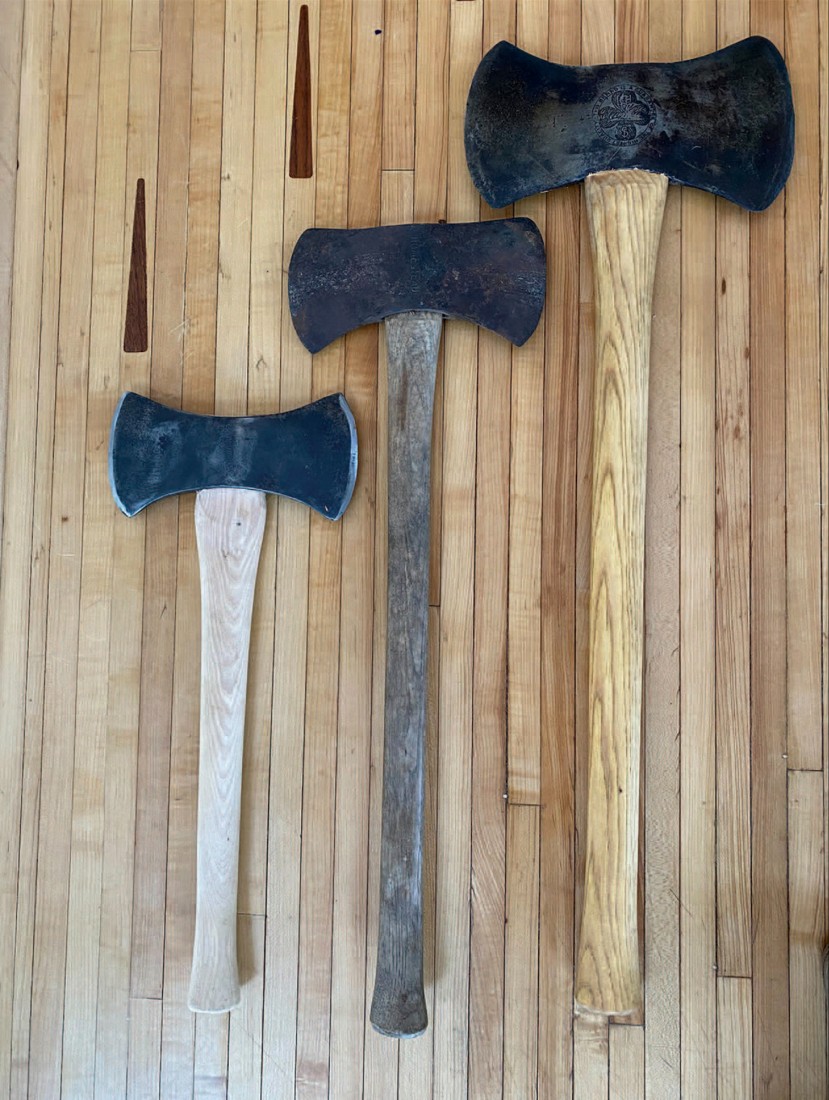
In case you missed the memo, the double-bit cruiser axe is back in vogue – and commanding respectable prices both from online vendors and at flea markets. So, just what is a “cruiser” and why is it so special?
The cruiser axe emerged in the late 1800s and was named for timber cruisers, later called forest engineers, who worked for early lumber companies. The job of the timber cruiser was part surveyor, part engineer, and part forester. They were responsible for indicating harvest boundaries, laying out skid trails, and marking trees to be harvested or left standing. Lumberjacks would trail the timber cruisers and follow harvest prescriptions based on the cruisers’ tree blazes.
The typical cruiser axe consists of a 2½-pound head with a 28-inch handle – about a pound lighter and 8 inches shorter than a full-size double-bit axe. The size made it not only easier to carry in the woods, but also easier to swing in the confines of a dense forest. One edge of the axe was filed at a stouter angle for dirty work (cutting near the ground), while the other side was razor sharp and reserved for blazing.
The slim profile (absent a clunky poll) made the double-bit cruiser ideal for blazing trees. Timber cruisers could also use this axe to fell small trees obscuring boundary lines, cut around crop trees, clear campsites, and brush out skid trails. They could use the handle of the cruiser as a hypsometer to estimate the number of logs in a given tree.
The golden era for cruising axes ran from the early 1900s through World War II. Every major axe manufacturer produced both a full-size double-bit and a scaled-down cruiser. A full-size double-bit axe has an eye that is approximately 3 inches across, while a cruiser axe eye is 2¼ inches or less. The eye is an important distinguishing feature as it indicates a true cruiser axe as opposed to a worn out and ground-down full-size double-bit. If you’re searching for a cruiser, keep an eye out for etched maker’s marks and weight stamps. Cruisers are often marked as “22” which means 2½ pounds (the superscript number represents the number of quarter pounds).
A cousin to the standard cruiser is the saddle cruiser, designed to be lashed to a horse saddle or stowed in panniers. Some manufacturers used a standard cruiser head with a shorter handle (usually 19 inches) to make saddle cruisers, while others scaled down both the head and handle. The shorter handle allowed the saddle cruiser to be used one-handed from atop a horse.
Today, foresters use either tree paint or flagging to do many of the historical timber cruiser tasks, but the cruiser axe remains a favorite – tucked behind the seat of the truck and pulled out to clear downed limbs, or stowed in the corner of the woodshed for making quick work of kindling.