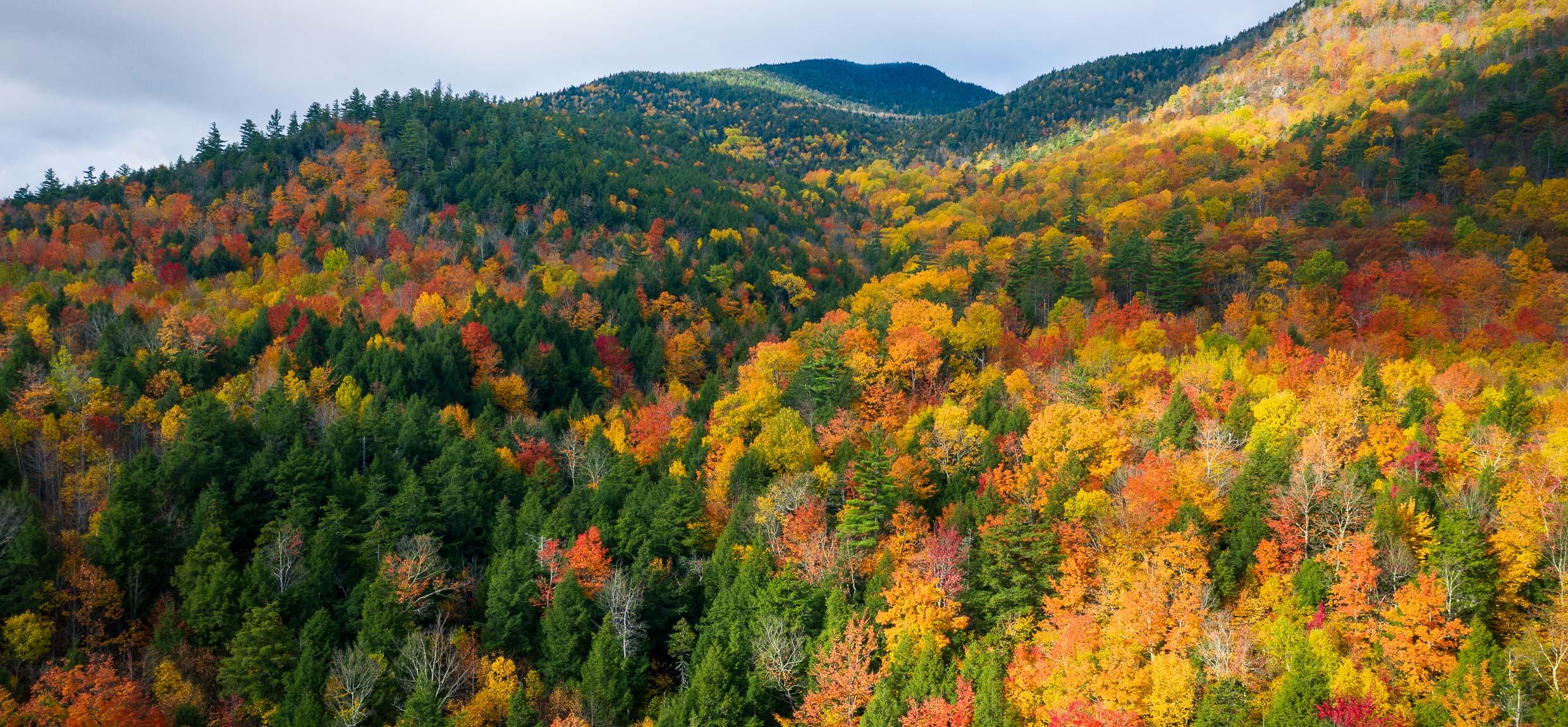


Named for the string of lakes where the Connecticut River begins its 400-mile flow from northern New Hampshire, the Connecticut Lakes Headwaters region has long been prized for its thick stands of spruce, fir, and hardwoods. For more than a century, the forests across this remote expanse were worked hard.
From the 1880s through the 1990s, a series of corporate owners – Connecticut Valley Lumber Company, St. Regis Paper Company, and Champion International – practiced industrial-scale logging across this section of New Hampshire that reaches above the 45th parallel. For these companies, the forest’s capacity to regenerate itself was ancillary to its ability to generate profits. And for much of that period, there were relatively few legal limits on how much timber they could extract from the region.
When the parcel changed hands again at the century’s end, there was an opening for a new management approach. In 2000, International Paper (IP) acquired Champion and, with it, both the Headwaters and $2.3 billion in debt. To pay it off, IP started selling large tracts of land. When the company put the 171,500-acre Connecticut Lakes parcel on the market in July 2001, then-Senator Judd Gregg, a Republican, and then-Governor Jeanne Shaheen, a Democrat, jointly convened a 42-member task force to explore the possibility of permanently protecting the Headwaters from fragmentation and development. They sought to ensure this land would remain open to the public for hunting, fishing, and outdoor recreation – and that its forests would be managed sustainably as a source of both timber and livelihoods.
The task force met through autumn of that year, soliciting input from local residents and stakeholders from across the state. The Trust for Public Land (TPL) stepped in as a temporary caretaker owner for the parcel, which stretches across the towns of Pittsburg, Clarksville, and Stewartstown, allowing time for the state-led effort to coalesce into a shared, legally binding vision for the Headwaters.
Within two years, the state had assembled more than $42 million in federal and state funding for the project, including the purchase of a conservation easement for 146,400 acres of the Headwaters, which Lyme Timber Company purchased from TPL. At the same time, the state purchased 25,000 acres of abutting, ecologically rich land and established Connecticut Lakes Natural Area, to be managed for biological diversity by its Fish and Game Department. This amounted to the largest conservation project in New Hampshire’s history and the culmination of years of planning by state and federal agencies, local governments, nonprofits, and private sector actors.
“We were trying to perpetuate a new paradigm of what a conservation-minded working forest would look like,” said Charles Levesque, a retired forester who served as the lead coordinator for the task force and helped draft the easement in his role as a consultant to TPL during that period. “The purpose was to make this a timber-producing forest forever. That was what we were striving for, so that this property provided jobs and tax revenue forever and conserved sensitive areas as well.”
The 108-page easement document reflected a consensus among local officials, members of the forest products industry, state legislators, conservation groups, and citizens about how to manage the Headwaters for the common good and how to strike a balance between timber harvesting and other values, such as recreation access and wildlife habitat. For the first time, the owners of the tract would be legally bound to manage the forest sustainably, in accordance with the global standards of the Forest Stewardship Council.
Now, two decades later, this forestland is yet again under new corporate ownership. And that consensus codified in 2003 is being tested by a novel value that the easement’s authors did not anticipate: carbon sequestration and storage.
In 2023, North Country loggers, mill operators, and truckers were caught by surprise when the tract’s new owner, Aurora Sustainable Lands, LLC, suddenly curtailed harvesting. They soon learned why: Aurora made its money mostly from selling carbon credits instead of timber.
“[Carbon credits] never came up in our discussion,” said Levesque of the task force conversations he facilitated in the early 2000s. “Back then, it just wasn’t a thing. We blew it, because we couldn’t predict the future.”
The future, in the form of the global carbon offset market, has since come to Coös County. And it has triggered a strong backlash from local residents and officials, one that is reverberating throughout the Granite State. The Connecticut Lakes Headwaters have become a flashpoint for a much wider debate over the role of the Northern Forest amid a changing climate and the ongoing contraction of the region’s forest products sector.
Headwaters’ Harvesting History
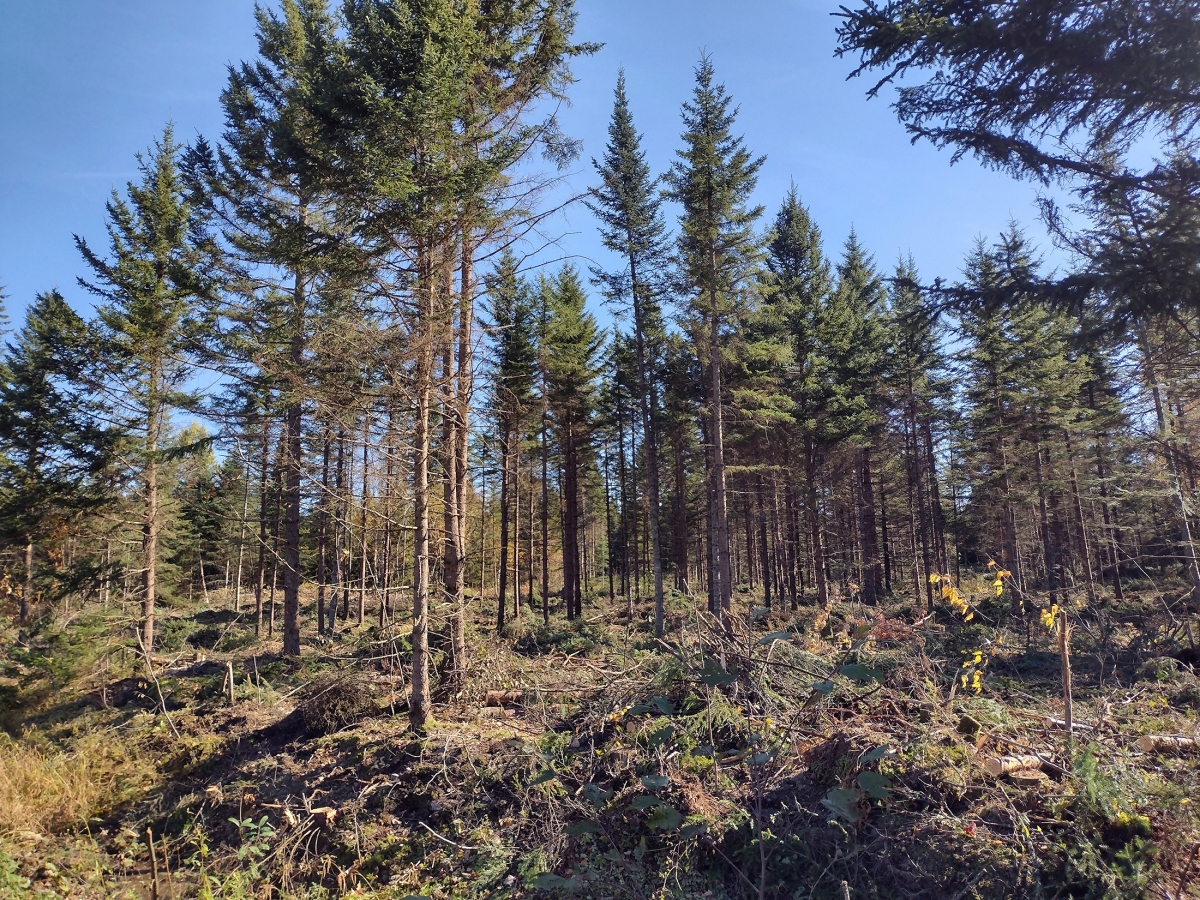
The easement stipulates that the Headwaters tract’s owner must submit an updated stewardship plan for approval by the state forester every 10 years. The state forester determines whether that plan aligns with the “purposes and stewardship goals” outlined in the conservation easement, which range from maintaining “a sustainable source of timber” and “soil productivity” to “regeneration of forest stands” and “enhancement of water quality.”
The easement does not, however, spell out precisely how much timber must be cut to maintain it as a “productive, working forest.”
That figure – representing both what the forest can sustain and how much cutting is necessary to support the local economy – has become the primary bone of contention between Aurora’s leadership and Coös County administrators, lawmakers, loggers, truckers, and mill operators.
From the mid-1970s to the mid-1990s, crews hauled out at least 40,000 cords each year – and sometimes much more – using the logging roads that vein their way up into the catchments of Connecticut tributaries such as Indian Stream and Perry Stream. (Logging peaked in 1995, when Champion’s crews harvested 150,000 cords.) During Lyme Timber’s tenure, harvesting levels averaged roughly 40,000 cords annually. In 2013, Lyme sold the tract to The Forestland Group (TFG), which promptly registered the property under California’s carbon offset program. For the next eight years, harvesting dropped to a yearly average of 30,000 cords. The company had sold millions of dollars’ worth of carbon credits, which required it to put a certain amount of timber off limits.
That initial drop in harvests didn’t cause much of a stir, because TFG still kept loggers busy in the Headwaters, according to Levesque. “They didn’t kick a single contractor off,” he said. “It was seamless and hard to notice. The Forestland Group was selling carbon, but also cutting a significant amount of timber.”
When Aurora took ownership of the Headwaters tract in late 2022 after its parent company, Bluesource, merged with TFG, it inherited the stewardship plan registered with the state in 2013. That plan had an annual harvest target range of 25,000 to 30,000 cords per year. It also had, like the easement itself, the force of law.
According to Levesque – who today serves on the citizens committee that formally advises state agencies on the Headwaters’ management – the trouble started in July 2023, when the logging contracts Aurora had also inherited expired. “All of a sudden the bomb dropped and they halted harvesting,” he said. “They had six separate logging contractors operating on the property. Then they kicked everybody off but one.”
That autumn, Aurora’s executives announced that they planned to reduce annual harvesting by 50 percent going forward.
Word quickly spread among local sawmill operators, county commissioners, and town selectboard members. So did concerns about the new owner’s long-term intentions. Coco Amey runs Amey Log Yard, which sits at the confluence of Indian Stream and the Connecticut River. Her family has operated trucking and forest products businesses in Pittsburg for more than 50 years. She noticed the drop-off immediately. “It was a big loss,” she said. “At the beginning of the first year [of Aurora’s ownership], I lost $10,000 every month.”
State-maintained records show that harvest levels dipped below the 25,000-cord threshold in 2022, climbed back up above 28,000 in 2023, and then dropped below 20,000 in 2024. “As soon as they stopped harvesting and weren’t going to hit their targets that were in the stewardship plan they inherited, they were in violation of the easement,” said Levesque.
But Aurora’s leadership sees things differently. “We’re confident that our management meets the legal side of the easement and spirit and letter of it completely,” said Blake Stansell, Aurora’s president and chief operating officer.
Stansell maintains that Aurora has been in compliance all along, and that the whole fracas stems from an incomplete picture about how their business operates.
“There was a misunderstanding about what Aurora was planning to do on the property,” Stansell said. “This often applies outside of New Hampshire as well. Aurora has an all-in strategy on forest carbon, our entire portfolio is enrolled in forest carbon projects. The perspective in the outside world is that our all-in strategy means we’re all out on the timber side. That’s not the case at all. We’re leaning in to carbon stewardship, which means enhancing carbon removal and storage on a project, but that means a healthy forest. And the only way to have a healthy forest is to manage it. That means harvesting some timber.”
Whereas past owners sought to maximize their timber production, however, Aurora “focuses on maximizing natural carbon removal and storage potential,” as the company explained in a June 2025 announcement of a new 10-year agreement with Microsoft. Aurora sells some timber from its land holdings, but most of its revenue comes from the sale of carbon credits to companies seeking to offset their own climate-warming emissions. That means its business model hinges far more on the count of trees standing in the forest than on the number of logs stacked on the landing. And that, in turn, means less revenue for towns and local businesses.
Coös County officials and legislators contend that Aurora is effectively in breach of contract. “The state needs to enforce the terms of that easement,” said Coös County Administrator Mark Brady. “[Aurora is] not cutting based on the stewardship agreement that’s in place. That’s lost revenue to the towns, first. Secondly, it’s also about on the margins being able to support what we have left of the logging industry.”
A Working Forest – Working for Whom?
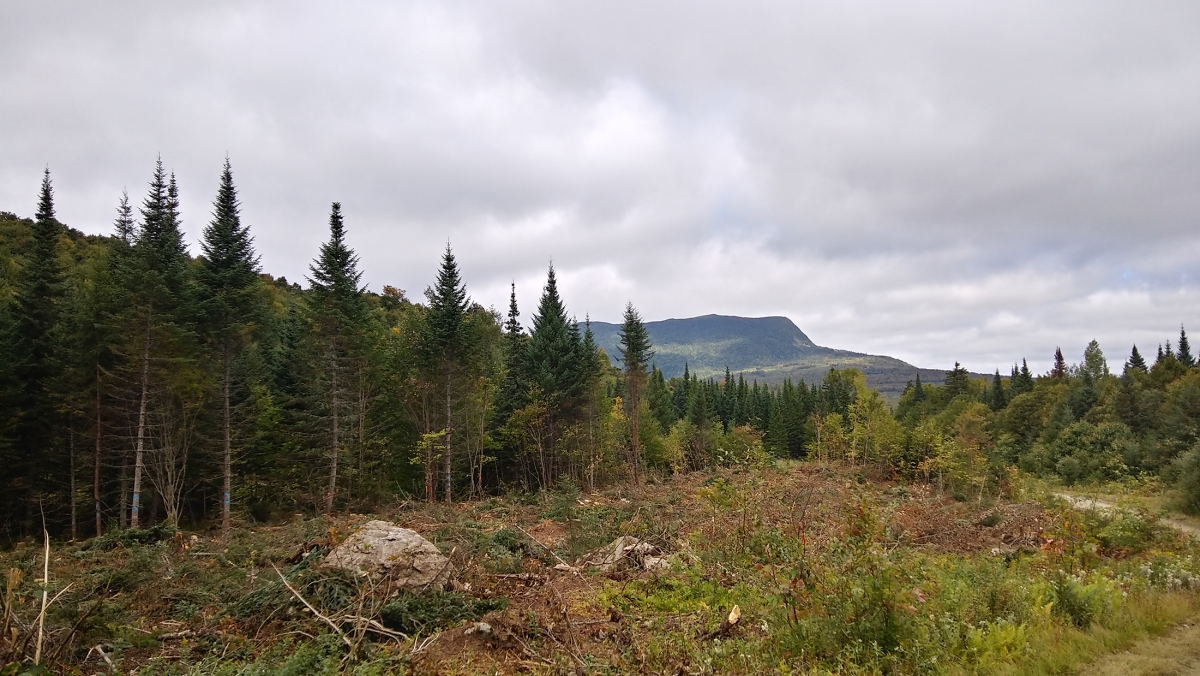
When Aurora submitted its new stewardship plan to the state in January 2024, it proposed reducing the annual harvest range to between 10,000 and 20,000 cords over the next decade, citing its “desire to grow carbon stocks at a much higher annual rate than in the recent past.” That adjustment, the company estimated, would lead to an additional sequestration of 1.5 million tons of carbon.
The North Carolina–based firm – which has described itself as the world’s “largest private forestland owner focused entirely on climate mitigation” – owns or manages 1.7 million acres across 14 states, from West Virginia to Wisconsin. The Headwaters is its only property in New England.
“We calculate carbon removed by monitoring real-time growth and ecological recovery as our forests heal from industrial harvesting,” reads the company’s website. “Aurora buys forests where trees hold more value as carbon than as timber, allowing us to conserve them through our carbon projects.” Forests that have been logged on an industrial scale offer the most attractive investments to firms like Aurora, because they sequester more carbon as they regenerate than more mature, less intensively managed forests do. As Stansell puts it, “The removals credits are coming from growth” above a certain baseline, business-as-usual management scenario. Large-scale land holdings also allow for spreading out costs associated with inventories and verification required by carbon registries.
Distant owners extracting and exporting value from the Headwaters is nothing new. Indeed, that’s been the norm since the late 19th century, when “Lumber King” George Van Dyke controlled the region through his Connecticut Valley Lumber Company, which was headquartered for a time in Pittsburg. Van Dyke famously drove his men hard, and he supervised the massive log drives down the Connecticut toward his Massachusetts mills. St. Regis turned the Headwaters’ abundant softwoods into paper for Montgomery Ward’s mail order catalogs from 1927 through the 1960s. Then Champion International aggressively logged spruce and fir stands to feed its own softwood mills and to pay off its debts. (That followed a sustained period of heavy felling in the 1970s and early 1980s to prevent a spruce budworm infestation from spreading.)
“The technical term in the forestry world is that they hammered that property for about 10 years,” said Levesque.
While it fed corporate owners’ bottom lines, all that logging also created plenty of jobs in a region where employers were scarce, and it fueled economic activity in downstream businesses in towns such as Colebrook, Berlin, and Milan.
Logging, trucking, and mills are major sources of both livelihoods and cultural identity in New Hampshire’s far north. But the forest products sector has faced strong headwinds, from a shrinking workforce to tightening lumber markets. Over the past three decades, the pulp and paper mills that buttressed the county’s economy have largely disappeared.
“We’ve had a forest products industry here,” said Brady. “We’re losing that. And it has profound economic implications.”
The reduced harvesting in the Headwaters added one more pressure point for an already struggling industry. Milan Lumber, a softwood dimensional lumber mill, which had previously sourced about 20 percent of its logs from the Headwaters, had to search for suppliers in New York and Maine to make up the difference, and at a higher marginal cost. They reduced their operations from five days a week to four.
In April 2024, New Hampshire State Forester Patrick Hackley rejected Aurora’s draft stewardship plan. “Simply put, the projected 10-year Harvest Plan of 10,000 to 20,000 cords is inconsistent with historical use, not economically viable, nor representative of a sustainable tract of land for the production of timber, pulpwood, and other forest products,” wrote Hackley and Sarah Stewart, commissioner of the state Department of Natural & Cultural Resources, in explaining their decision.
Since Champion’s ownership, the forests of the Headwaters have been recovering, adding more biomass per acre, year after year – “restocking,” in forester lingo. Aurora’s critics contend that this robust net growth permits more harvesting. Local officials want a target of 35,000 to 40,000 cords, in line with harvest rates from 2003 to 2013. Instead, Aurora came back in the summer of 2024 with a new proposal for an “annual allowable cut” in the range 20,000 to 30,000 cords per year.
Brady is skeptical that the company’s “carbon-first” management approach is compatible with the cultural and economic fabric of New Hampshire’s North Country.
“The [Coös County] Board of Commissioners has made it very clear that using our forests primarily for carbon sequestration is an existential threat to Coös County’s economy, tax base, and way of life,” he said. “And what is not good for Coös County ultimately is not good for the state as a whole.”
Timber Taxes and Revenue Streams
The controversy has spilled far out of the Headwaters, all the way south to the statehouse in Concord – about a 3½-hour drive from Fourth Connecticut Lake.
Governor Kelly Ayotte referenced the controversy in her February 2025 inaugural address: “My administration is going to enforce the state’s conservation easement on the Connecticut Headwaters tract negotiated under the bipartisan leadership of then-Governor Jeanne Shaheen and Senator Judd Gregg to ensure that this beautiful tract of land remains open for recreation and local timber harvesting for the people of New Hampshire.”
But what has consumed lawmakers in the capital most of all is a subject of longstanding fixation for Granite Staters: taxes.
New Hampshire established a timber yield tax in 1949 with a law titled “An Act Relating to Forest Conservation and Taxation,” aimed at preventing landowners from cutting too heavily. Before that time, the state had assessed properties with stands of timber at a higher value, so forestland owners had an incentive to overharvest their properties to avoid paying higher taxes. Legislators saw that this trend, if left unabated, could have dire implications for the forest products industry. They enacted a new tax “for the purpose of encouraging conservation of the forest resources of the state.”
In January 2025, State Representative Arnold Davis of Berlin introduced House Bill 123, co-sponsored by State Representative Mike Ouellet of Colebrook and several other Coös County lawmakers. It proposed to update the timber yield tax – a 10-percent levy on the “stumpage” value of timber at the time of harvest – to include an equivalent tax on the sale of carbon credits.
Their proposal was mostly motivated by concerns that a substantial increase in the number of landowners enrolling in forest carbon projects could blow a hole in towns’ budgets. Of New Hampshire’s 218 towns, more than 190 collect some amount of timber tax each year. Nowhere is it more critical to municipal budgets than in the communities of Coös County.
“We’re watching income from the tax base erode for Stewartstown, Clarksville, and Pittsburg, because they’re not following the easement,” said Ouellet. “It’s not necessarily the biggest part of the tax base, but it’s part of the stream you don’t want to lose either. In Pittsburg, that’s 20 percent of the town’s income.”
Beyond the fiscal impacts on its biggest towns, Coös County administers 23 of New Hampshire’s 25 “unincorporated places,” townships such as Dixville, Wentworth’s Location, and Dartmouth’s Second College Grant. These areas depend on nearby towns for essential services. In recent years, the timber tax has provided a quarter of the budget for unincorporated places. “Let’s say you move 20 percent more acreage into carbon sequestration,” Brady said. “That’s 20 percent not going toward the timber tax. We have the biggest dog in this fight in the state. That’s why we are so exercised.”
The New Hampshire Timberlands Owners Association (NHTOA) opposed the early version of House Bill 123, arguing that it set up a new form of taxation. “It could double tax timber because you have a tree growing, and if you were to enter that tree in a forest carbon program, they would tax the value of that forest carbon contract,” said Jasen Stock, executive director of the NHTOA. “And again, when you harvest that tree at a later date, you get the timber tax. That tree is getting taxed at least twice.”
But Levesque takes issue with that argument. “It’s taxation on a stream of income,” he said, noting that there’s nothing stopping a landowner from enrolling in a carbon offset program for 20 or 30 years, and then cutting that stand and getting paid again. He sees this as two distinct streams of income subject to two distinct tax payments. Ouellet agrees. “They say, ‘You tax us twice, when we cut it, we will pay it again,’” he said. “That’s absolutely true. You are getting two yields, so you should pay the tax again. It’s like doing two cuts – 10 years later you pay the tax again.”
In the view of the bill’s sponsors and supporters, taxing carbon credit sales at the same rate as timber is a matter of basic fairness, and of stewarding taxpayer dollars. “Right now, on the books, Aurora specifically, they’ve got an effective 10-percent subsidy from the state,” said Brady. “That’s how we view it. The state has incentivized them to hold carbon.”
But technical concerns derailed the proposed bill. The state Department of Revenue Administration deemed the initial bill “unworkable” as written. “The language in that bill had conflicting definitions and lot of ambiguity,” Stock said.
Studying Sequestration
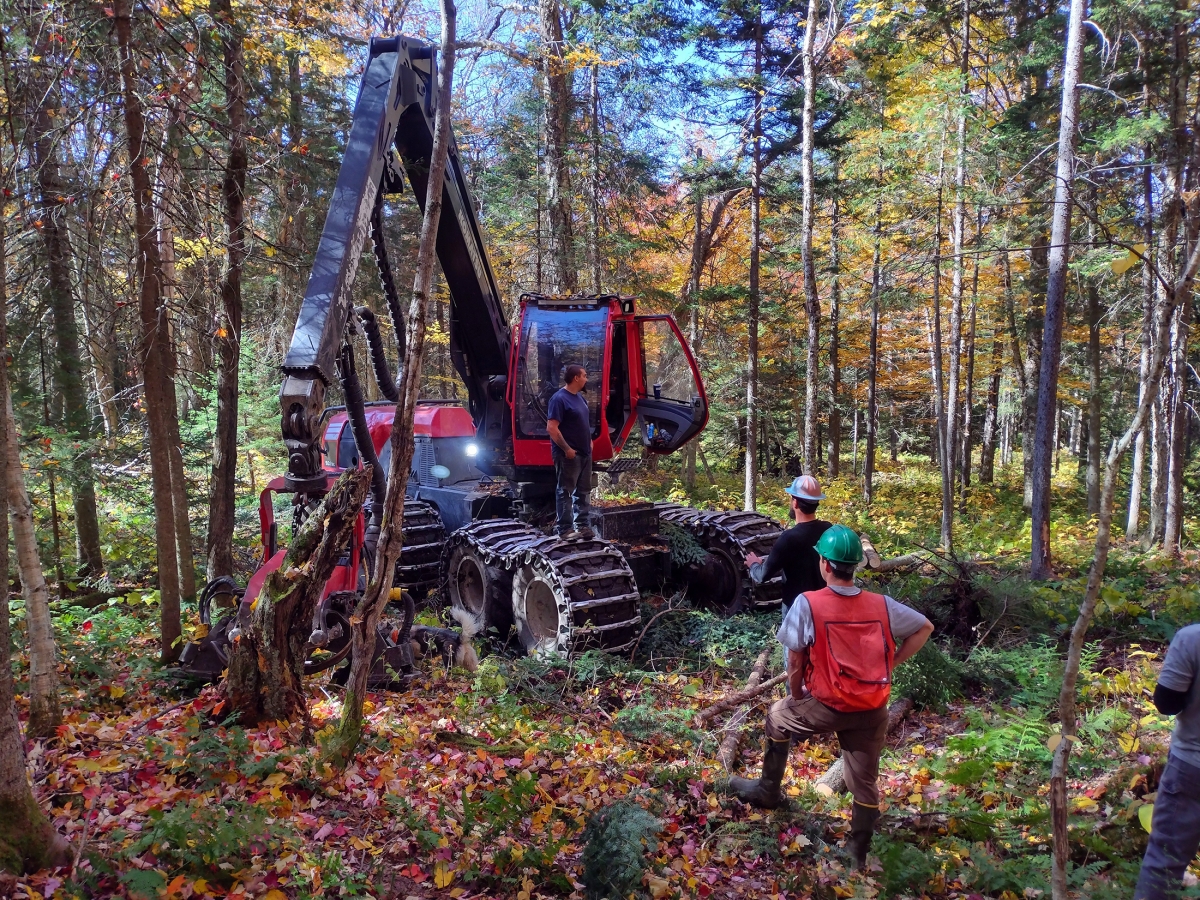
After raucous debates among lawmakers, the state senate passed an amended version of HB 123 in July 2025 that punted on the proposed 10-percent carbon levy and instead established a new two-year-long study commission on carbon sequestration. The law tasks the commission’s members with scrutinizing the impacts on forests, the forest products sector, and the state’s broader economy, and with issuing recommendations in November 2027 to ensure towns don’t suffer from a loss of tax base.
The law also established a moratorium on forest carbon projects for parcels more than 500 acres. Some, including Stock of NHTOA, fear the backlash has spread too wide, and that the moratorium could lead to future restrictions on landowners’ rights to put their forests into carbon programs.
“I’ve had meetings where I explained the moratorium [to landowners],” said Stock. “And they say, ‘I don’t understand, if someone is willing to pay me for my carbon or an easement or right of way, that’s a private deal – why is the state stepping in to that?”
The irony is that the property that triggered this whole debate is in a category of its own. The Headwaters tract comprises about 3 percent of the state’s land area. The state owns all its major roads, which is unusual for conserved lands. It is a prized destination for fishing, ATV riding, hunting, hiking, birding, and biking.
“There’s no question that the Connecticut Lakes property is very unique, in so many different ways,” said Stock. “But is this representative of timber land ownership across the entire state? Not really. The New Hampshire General Court is debating a policy that affects every landowner in the state, based on what’s happening in one parcel.”
He describes the spark that lit the statewide debate as a narrow “real estate dispute” between Aurora and the state, as easement-holder. “To adopt legislation and a statewide policy that affects every single tree farmer and property owner in the state” because of it, he said, “seems inappropriate.”
Both Aurora and the NHTOA opposed the moratorium. The latter argued it might be unconstitutional. The people of New Hampshire are famously averse to more taxation. But the “Live free or die” ethos articulated by the state motto extends to property rights, too, and many landowners look askance at any state restriction on their freedom to do what they please with their forests. That includes leaving them alone, to grow and soak up carbon.
Still, there’s broad support for the study commission. “I’m not unhappy with it,” said Ouellet, one of the co-sponsors of HB 123, “because it will bring all parties to the table with an open discussion.”
Brady, who serves on the commission, says it offers a chance to thoroughly scrutinize the nascent forest carbon market, and the risks and opportunities it presents for different types of forest landowners.
Chasing Carbon
The fast-growing carbon offsets market has been plagued by concerns about whether the money flowing into carbon credits adds up to real-word emissions reductions or corporate greenwashing. These challenges include proving additionality (that the carbon removal wouldn’t have happened anyway), demonstrating permanence (that a forest will continue to lock up that carbon for the contract’s entire duration), and preventing leakage (wherein reduced harvesting in one place leads to more logging somewhere else, often without as many environmental safeguards). Aurora’s critics in northern New Hampshire have raised questions about the emissions resulting from loggers and truckers taking longer trips to New York and Maine to source logs for local sawmills. “How good are these carbon credits when we have to spend extra fuel and energy driving an extra 300 miles to get timber?” asked Ouellet.
In the past few years, a growing number of climate scientists and carbon cycle experts have suggested that offsets incentivize companies to divert investment away from achievable reductions in their own direct emissions and to funnel it to projects of questionable value. A 2025 analysis by researchers at University of Oxford and University of Pennsylvania reviewed 25 years of literature on the subject and concluded that over-crediting in carbon offsets “is an intractable problem.”
A 2021 study found “systematic over‐crediting” in California’s forest carbon offsets program. “Rather than improve forest management to store additional carbon, California’s forest offsets program creates incentives to generate offset credits that do not reflect real climate benefits,” the researchers wrote.
University of California–Berkeley scientist Barbara Haya, one of that study’s authors, co-wrote a memo in May 2025 calling on California regulators to end the state’s carbon offset program – the same one in which the Headwaters Tract is registered. “California sends approximately $140 million out of state each year for carbon offsets, most of which have little-to-no actual climate benefit,” the researchers warned.
In response to these critiques, industry players say they have made improvements in the way they quantify and verify emissions reductions. And proponents caution more broadly against discarding a promising climate mitigation tool – one that also offers a critical funding source for conservation programs around the globe and for new revenue streams to incentivize landowners to keep forests intact.
In New Hampshire, the study commission will have a chance to consider the latest research on these questions, and to listen to a broad range of voices weigh in on the risk and opportunities for the state’s forestlands.
During the commission’s second meeting in October 2025, former state representative and third-generation sawmill operator Eamon Kelley of Berlin testified about the potential impacts of expanding forest carbon markets on businesses such as his, White Mountain Lumber. He shared his fear that, in the coming years, more carbon companies will look at New Hampshire, with 84 percent of its area covered by forests, and “its low regulation relative to neighbors, and say, ‘Let’s go there.’” And that loggers and mills like his will be locked out of more and more of the state’s woods as a result. Kelley echoed Brady’s contention that the state was effectively subsidizing landowners who sell carbon offsets by not taxing them in the same way timber yields are levied. “The state must put these activities on the same level as traditional harvesting,” Kelley said.
Despite these fears and all the political wrangling, New Hampshire has few forest carbon projects today. Of the dozen parcels listed in the state’s carbon registry, the Connecticut Lakes parcel is by far the largest, accounting for more than 76 percent of the total acreage.
Meanwhile, two years after it first rejected Aurora’s initial vision for its own Headwaters stewardship chapter, the state is still in negotiations with the company about the levels of timber harvesting it must pursue to comply with the easement. In mid-November, Governor Ayotte reiterated her opposition to reductions in logging activity on the Headwaters. “There’s been very productive discussions, but I am not going to agree to something that I don’t think benefits the people of the state and especially the North Country.… We are hopeful there will be a resolution soon.”
“We’re not locking the gates and turning the harvesters away,” said Stansell. “We’ve worked hard to make discussions (with the state) more about the overall management of the forest rather than a specific volume that needs to be cut. Ultimately, we’ll get to a point where both sides are comfortable with the level of harvesting.”
At the October meeting of the citizens committee, a forester from LandVest, the company retained by Aurora to oversee operations on the parcel, reported “robust” harvesting with between five and seven crews active, and predicted that they would meet or exceed their target of 25,000 cords for 2025. “We have more than half a dozen logging operations going on right now,” Stansell said. “We’re operating under the previous stewardship plan.”
Levesque agrees that activity has ramped up, based on what he’s seen and heard.
For his part, Levesque – who helped shepherd the easement two decades ago, and who remains closely involved as a member of the citizens committee – thinks that managing for forest carbon and managing for forest products can go hand in hand.
As a consulting forester, Levesque tells landowner clients that revenue from carbon credit markets can help buffer the forces pushing them to sell, subdivide, and develop. “Especially for large landowners, this forest carbon market thing is a fantastic deal,” he said. “They can use the market as a hedge, because timber markets go up and down. In a bad year, sell more carbon. When timber is more valuable, sell timber. It’s a wonderful product that didn’t exist 15 years ago.”
And it’s one that, if regulated properly, could potentially help achieve the goal that everyone, on different sides of the debate, agrees upon: keeping the state’s forests intact for generations to come.
Toward the end of 2025, Coco Amey said there were more logs coming through her yard.
“I think they’re getting better now,” she said, referring to the Headwaters’ new management. “They’ve been cutting more wood. The past six to nine months, I’ve been busy, compared to two years ago.” She, too, sees room for both carbon storage and timber production in the region. “I have a log yard, but I don’t want them to cut all the wood either. You need to manage the land. You can strike a balance – based on common sense.”
Discussion *