

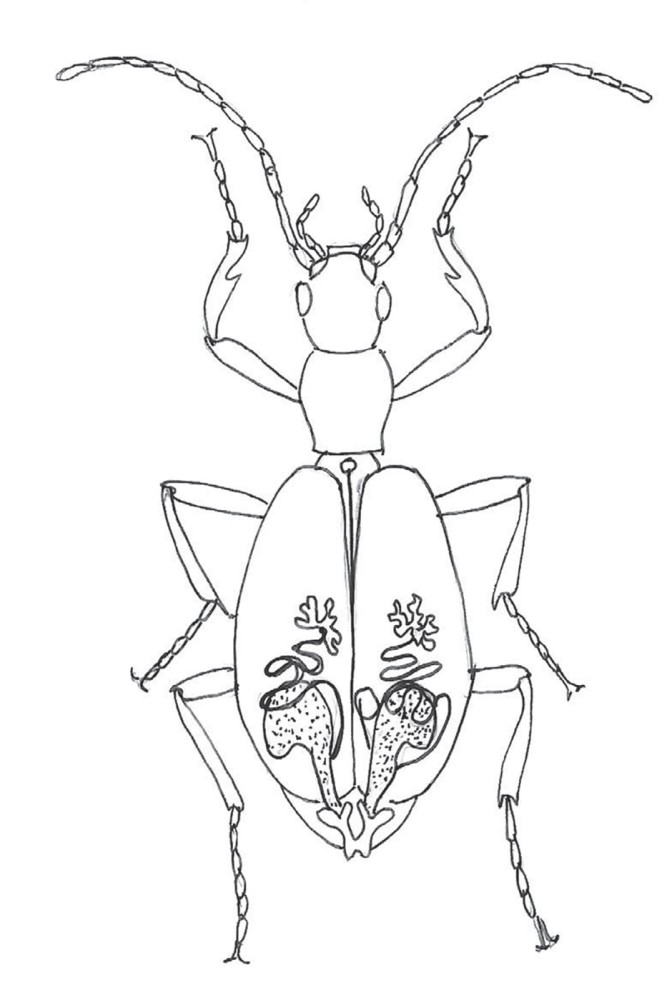
During a trip with Saint Michael’s College students to Bunratty Castle in Ireland, our guide explained that medieval castle defenders poured scalding liquids on invaders through a “murder hole.” It might seem that only humans could concoct such a barbarous defense, but nature is creative. Bombardier beetles (genus Brachinus), including roughly a dozen species that live in the Northeast, douse perceived enemies with a concoction perhaps even more lethal than what ancient Irish warriors used.
Bombardier beetles rarely exceed half an inch in length, but their brand of chemical warfare is unmatched. When threatened, the beetles combine two chemicals stored within their small bodies to expel an explosive spray of boiling hot corrosive irritants from their backends, often with fatal results for the attacker.
The several bombardier beetle species native to the northeastern United States and eastern Canada are broadly similar in appearance. The head, thorax, and legs are a warm orange, while the elytra, or wing coverings, are blueish black with subtle parallel groves running front to back. Bombardier beetles hunt invertebrates at night along forest floors and also eat decomposing organic material. They favor protected moist habitats in soil or under tree bark.
Hidden locations and nocturnal habits might seem like all the protection an insect might need. But these beetles are capable of mounting an aggressive defense, as Charles Darwin discovered during his time at Cambridge (1828–1831). About his encounter with a bombardier beetle, Darwin wrote, “One day, on tearing off some old bark, I saw two rare beetles, and seized one in each hand; then I saw a third and new kind, which I could not bear to lose, so that I popped the one which I held in my right hand into my mouth. Alas! it ejected some intensely acrid fluid, which burnt my tongue so that I was forced to spit the beetle out, which was lost, as was the third one.”
The defense that repelled Darwin works well on other, smaller predators such as amphibians and spiders. In the 1970s and ’80s, Cornell University’s Jeffrey Dean studied bombardier beetle defenses by feeding beetles to toads and spiders. American toads (Anaxyrus americanus) that swallowed beetles quickly vomited and developed a brief beetle aversion. Cane toads (Rhinella marina), legendary for their broad diet that seems to include anything they encounter in the parts of Australia they have invaded, showed slight discomfort but went right on eating beetles. Spiders attempting to bite beetles were quickly repelled; however, spiders that silk-wrapped the beetles first were protected from the beetle’s corrosive spray.
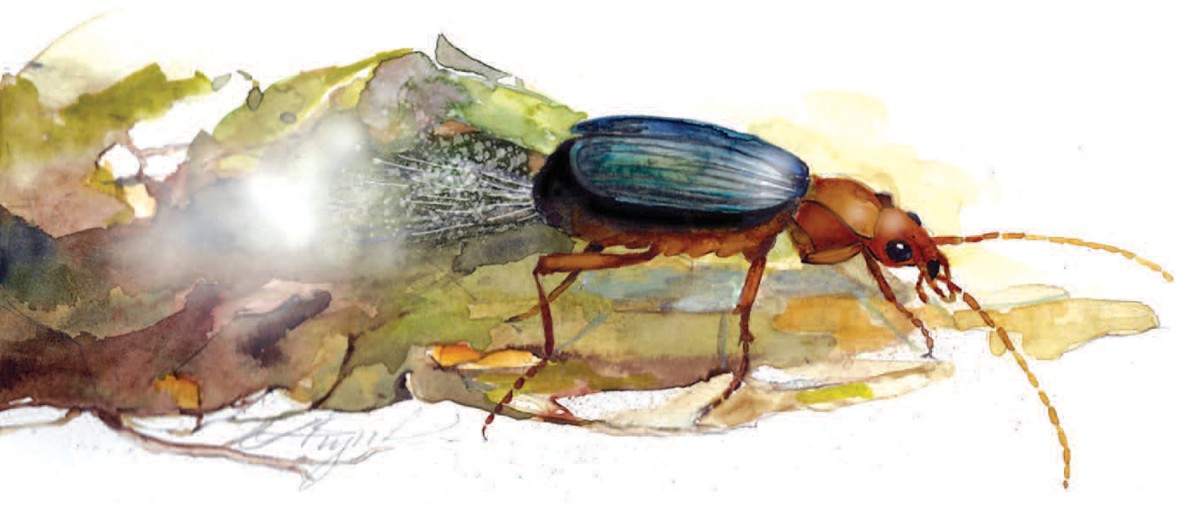
As with any defense, caustic spray from beetles need not be perfect to provide advantage in the predator-prey arms race. Evolutionary theory suggests that slight advantages that increase survival will pass to future generations. Random mutations that improve defense accumulate over time and have, in the case of bombardier beetles, made these invertebrates capable of shooting chemicals at a rate of 500 pulses per second, or five times faster than a machine gun fires bullets.
When I purchase chemicals to use in laboratories, I study hazard pictograms on safety data sheets and purchase the least hazardous material that will work for classroom purposes. Battery acid requires a pictogram indicating corrosivity; the alcohol found in adult beverages needs two pictograms indicating eye irritation and flammability. The chemical that bombardier beetles expel – benzoquinone – requires six hazard pictograms, more than any chemical I have used in 40 years as a scientist.
How, you may wonder, can a ½-inch beetle not succumb to its own flammable, toxic, irritating chemical that causes burns, eye damage, allergies, and genetic defects in other species? The answer is that a bombardier beetle stores relatively harmless raw materials, hydroquinone and hydrogen peroxide, in chambers in its abdomen. When it perceives a threat, the beetle can combine these with an enzyme to manufacture its chemical weapon.
To do this, a beetle contracts the muscles around reservoirs in its abdomen, forcing hydroquinone and hydrogen peroxide through a one-way valve into a third chamber, where enzymes cause an exothermic reaction to produce benzoquinone. The heat generated by this reaction brings the mixture to its boiling point, releasing enough steam to pressurize the reaction chamber, which is lined with protective material to prevent internal injury. The split-second chemical reaction produces an audible pop and blasts boiling hazardous chemicals from the beetle’s backside.
Harassed bombardier beetles raise their butts, at which point wise attackers might beat a hasty retreat. But if the mere threat is not enough, the beetle releases hot, caustic blasts in quick succession. The beetle can point the paired nozzles on its rear in various directions and can even shoot forward between its legs, effectively aiming the toxic blast. Smaller predators such as spiders may be killed by the encounter, and larger predators are likely distracted long enough for the beetle to move to safety.
Chemical attack is the provenance of adult bombardier beetles, but the larvae of some species have their own interesting biology. The narrow-necked little bombardier beetle (Brachinus tenuicollis) lays its eggs near giant water scavenger beetle (Hydrophilus spp.) pupae. The hatchling larva attaches to and consumes the still living pupa. After undergoing several molts, the larva enters its own pupal state, and if not consumed by some other thing, it will emerge as an adult beetle completing the life cycle.
So, if you are a fan of spineless beasties, and you happen upon a beetle fitting the description above, admire from a safe distance – and, if possible, suppress any urge to pop it into your mouth.