
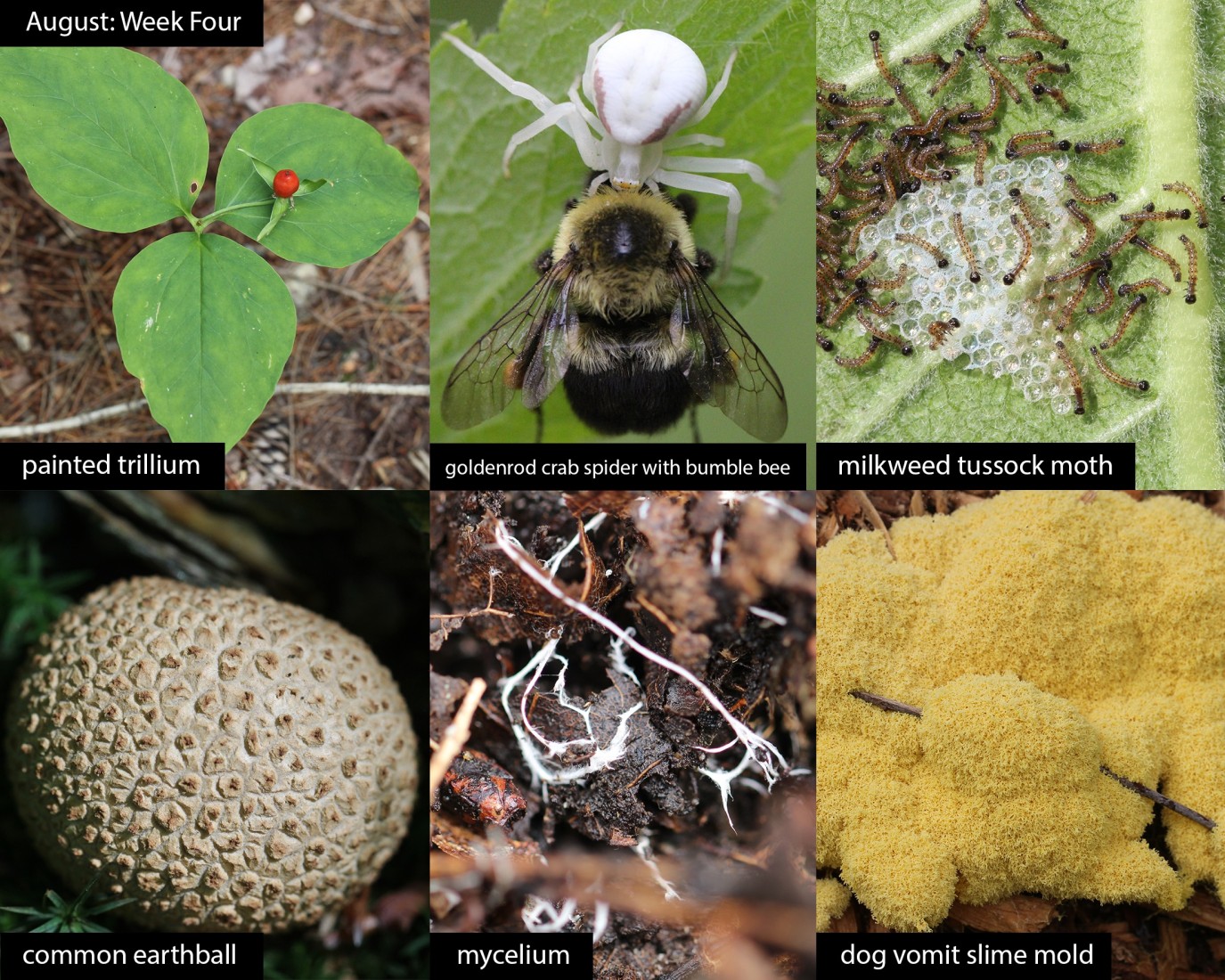
This week in the woods, the scarlet oval fruit of painted trillium stood out among the drab brown debris of the late-summer forest floor. We can also find the red trillium’s similar but more maroonish berry during this time but in nutrient-rich, lower-elevation hardwood forests rather than in painted trillium’s preferred mountainous mixed woods. Both species’ seeds have oily food bodies attached called elaiosomes – an attractive food source for ants, which play a vital role in the plants’ distribution.
Nearby, a bumble bee intended to drink nectar from another flower but instead had its own bodily fluids slurped by a goldenrod crab spider that it failed to notice, camouflaged to match the white blossoms. All known spider species produce silk, but half, like this one, which we also wrote about in July last year, do not spin orb webs, cobwebs, or funnels; alternatively, it relies on disguise and surprise to catch its prey. While the powerful enzymes of its venom can liquify tissues of bees and flies, crab spiders rarely bite humans and only in self-defense. Around here, only the rare northern black widow spider poses any threat to humans. “As far as spiders go,” write Doug Bennet and Tim Tiner in The Wild Woods Guide, “the north woods is probably the safest part of the country.”
These milkweed tussock moths (photographed by Ann Little and positively identified by lepidopterist JoAnne Russo) hatched beneath a milkweed leaf, and the larvae immediately began eating leaf tissue. The small, black dots on the caterpillars’ bodies are the beginnings of bristly tufts; we showed a photo of a later-stage instar, with these bristles fully expressed, when we wrote about this species back in October.
The common earthball fruits between July and November, with a peak about now. The stemless, spherical fungus has a yellowish or tan color to its thick rind, darkened by small, crackled scales. Also called a pigskin poison puffball or a hard puffball, this toxic species differs from the closely related edible puffballs; both kinds of fungi release powdery spores through holes or expanding cracks when ripe, but only the earthball has such a warty surface, and its interior begins white like puffballs’ but turns purplish-black with time.
A mycorrhizal species, the common earthball grows from the ground and always near trees. The fungus taps a host tree for carbohydrates and helps it garner nutrients more efficiently through its network of hyphae – thin, hair-like filaments that form a web called the mycelium. While these threads make up the vast majority of fungal mass, they remain largely out of sight until reproduction, when compatible strands encounter one another, fuse or graft together, and result in a fruiting body. This process requires the right environmental cues, such as sufficiently moist conditions, and mushrooms most often appear in the late summer and autumn, when precipitation increases.
While often mistaken for fungi and also fruiting in damp forests, slime molds (or myxomycetes) have more in common with amoebas. This life form begins as multiple amoeba-like cells, roving about and engulfing bacteria and spores for sustenance. Scientists have observed one species in this feeding phase navigating a maze in order to reach oatmeal at the end. For reasons yet to be fully understood, the separate entities at some point clump together to form a new spore-bearing superorganism, a giant, singular cell with numerous nuclei. This particular mucus mass – found by Northern Woodlands staff member Nancy Farwell on mulch behind our office – goes by the common name dog vomit slime mold. Virginia Barlow has more on this species and slime molds in general in her 2008 Outside Story article, “Tonight’s Feature: Return of the Blob.”
What have you noticed in the woods this week? Submit a recent photo for possible inclusion in our monthly online Reader Photo Gallery.