

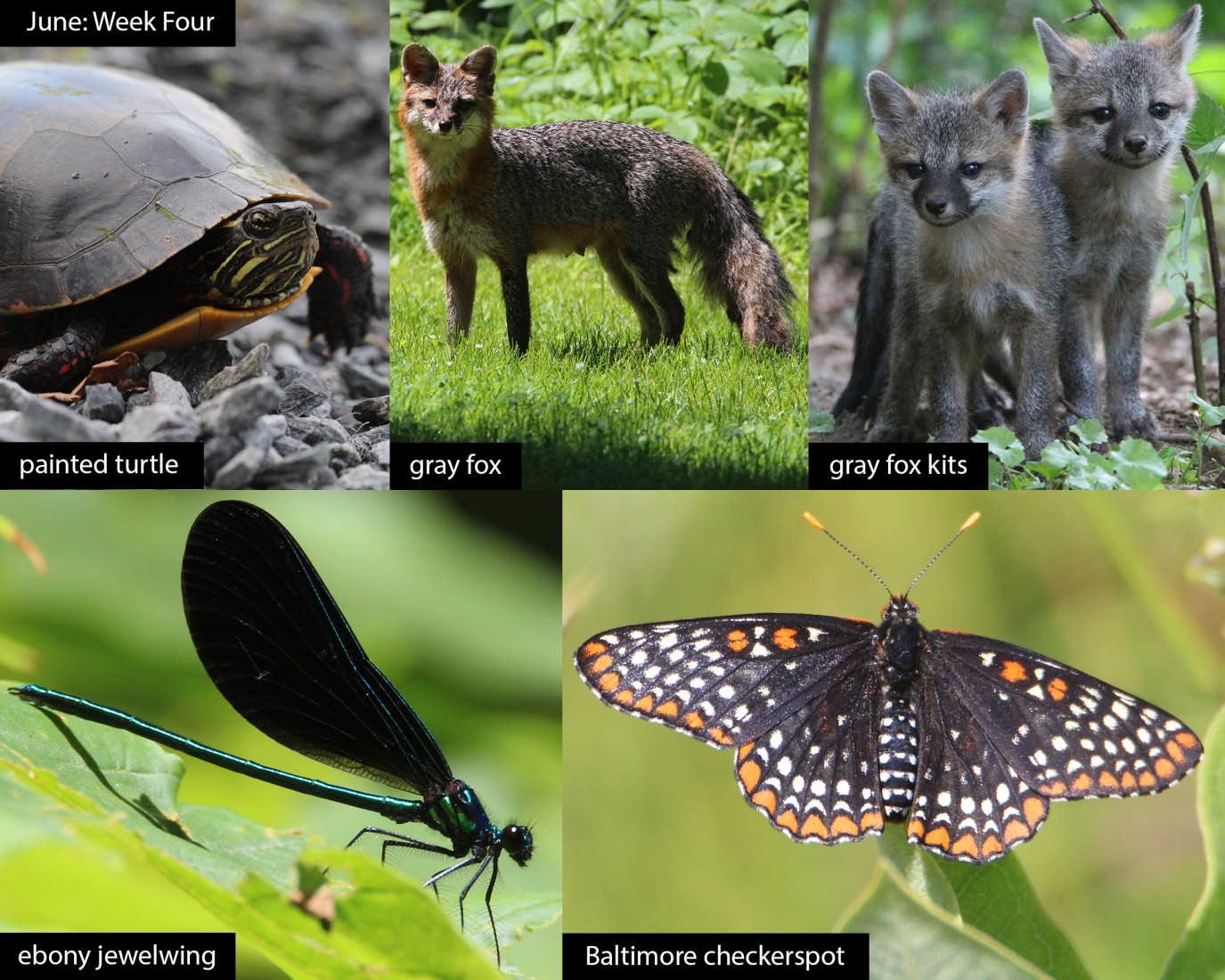
This week in the woods, the female painted turtle – the most common and perhaps most familiar turtle in our region, besides the snapping turtle – lumbers out from her aquatic home to some dry, sandy location several hundred yards or even a mile from the water’s edge. There, she digs a nest with her back feet (perhaps softening the soil first with her urine), drops in up to a dozen slightly oblong, wine-cork-sized white eggs, covers the site with dirt, pats it down with her underside, and returns to the water, leaving the eggs to incubate on their own. Egg temperature – affected by the nest’s northern or southern aspect, the amount of shade, and summer weather – dictates the developing embryos’ sex: warmth (a steady 72–79 degrees Fahrenheit) yields males, and temperatures above or below lead to females. Predators take up to 70 percent of nests during the two-month incubation period, but once they reach adulthood, painted turtles have an annual survival rate of up to 99 percent, which rivals that of perhaps any other species ever studied and offsets the high nest predation. Unless struck by disease, predators, or accidents, painted turtles can continue laying eggs throughout their lives, which can last up to 40 years.
Slightly farther along in the reproductive process, this gray fox mother rushes off to find prey for her offspring; the male (known as a tod) also helps the vixen tend the young but does not always den with them. The kits, born in March or April, have by now weaned and only just begun foraying beyond the den and hunting for themselves and with their siblings or parents. This transition makes June perhaps the best time of year to see gray foxes in daylight; usually nocturnal, gray fox parents now hunt more hours of the day in order to help feed the maturing, active family of up to seven kits. Semiretractible, curved claws and rotating forelimbs allow this species to climb trees – useful both for foraging and evading bullies like the eastern coyote. (For more on these canids, see Meghan McCarthy McPhaul’s Outside Story article “The Tree Fox” from our archives.)
Damselflies resemble their odonate relatives the dragonflies but with some key differences. Like dragonflies, damselflies have tooth-like mandibles, heads dominated by huge compound eyes, two sets of transparent wings, and bendadable, ten-segment abdomens. However, the smaller, more delicate and slender damselflies hold their wings vertically over their backs rather than spread out while at rest, and they have eyes perched on short stalks that remain separate from one another, while dragonflies’ eyes more often touch atop their heads. The ebony jewelwing (a damselfly) has an especially long flight season, lasting all summer and peaking in our area in late June and early July.
The distinctive, unmistakable Baltimore checkerspot also has a flight season peaking about this time. This butterfly sometimes inhabits dry fields and open oak woodlands but more often wetlands, bogs, marshes, and wet meadows, ideally where white turtlehead (its primary larval foodplant) grows. In an Outside Story article from last summer, Susan Shea explains that Baltimore checkerspots have adapted to the loss of wetland habitat (and corresponding decline of white turtlehead) by using other plants as hosts, such as the non-native English plantain, which grows in dry fields, as well as tertiary choices like white ash and false foxglove. The 17th-century colonizer of Maryland and first Lord Baltimore, George Calvert, had a black and orange coat of arms and inspired the names of both this checkerspot and the Baltimore oriole. Many plant species the adult butterflies feed on contain toxic chemicals that make the insects unpalatable, and their striking colors may serve to warn predators of this toxicity.
What have you noticed in the woods this week? Submit a recent photo for possible inclusion in our monthly online Reader Photo Gallery.