
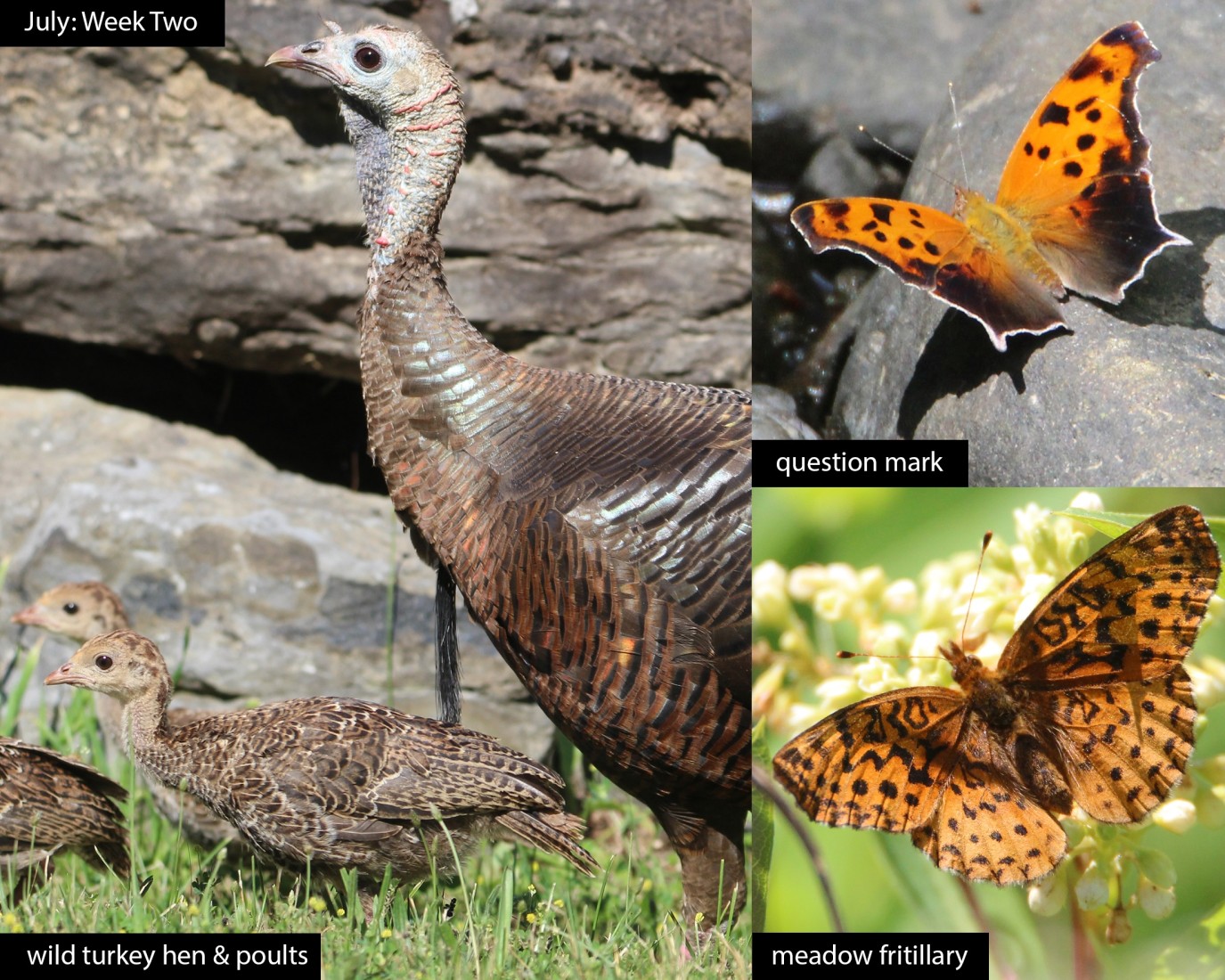
This week in the woods, we count wild turkey poults as they forage with their mother. Wild turkey young leave the nest soon after hatching (often in late May or early June in our area) and fly after only a few weeks, which earns them the designation of “precocial.” However, only 25 percent survive their first month, when they risk predation and vulnerability to cold, rainy weather, and they won’t reach full size for several months. While all adult males (toms) have a coarse black breast “beard,” nearly 10 percent of adult females (hens) also have them – often shorter and thinner, like this one’s. Male beards likely serve as indications of dominance, age, and health for mate selection, but biologists know less about why some females have beards, beyond simple genetic variation.
This question mark butterfly rested on rocks in a streambed before fluttering on. Like other anglewings, the question mark feeds on sap and rotting fruit as well as carrion and scat. Its appearance differs from the similar eastern comma, which we wrote about last April, in its two-parted “question mark” marking on the underside of its underwing, as opposed to the comma’s “comma,” and the question mark’s larger overall size and longer tails. Both butterflies have flight peaks from their second broods at about this time.
The meadow fritillary has peak flights in May and late July and sometimes a third brood in August or September. The butterflies patrol wet meadows and open disturbed habitats in quick, jerky flight; they may get tantalizingly close to the observer but touch down only occasionally and for frustratingly short periods.
What have you noticed in the woods this week? Submit a recent photo for possible inclusion in our monthly online Reader Photo Gallery.