
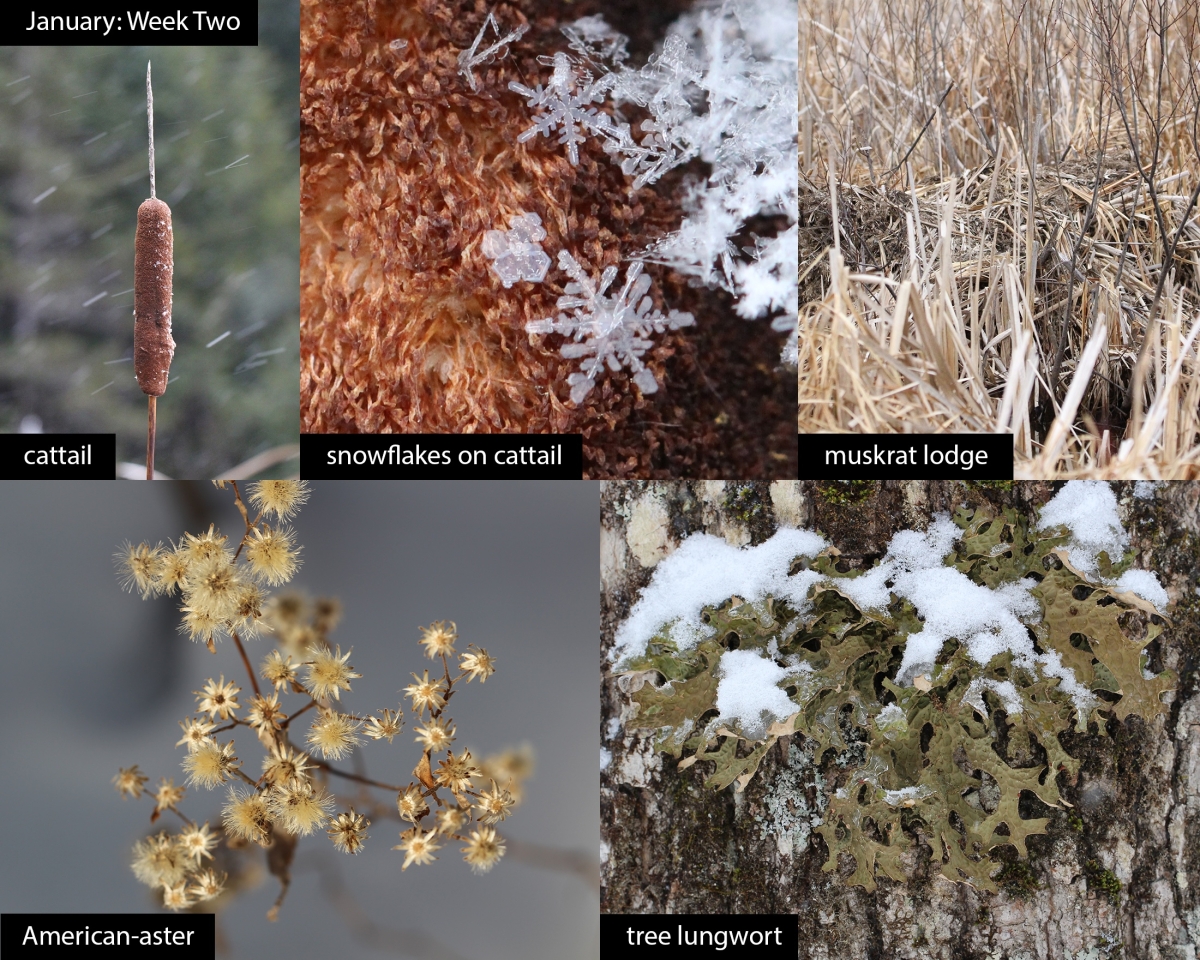
This week in the woods, the familiar cigar shapes of cattails’ pollinated female flowers waved over a beaver pond in West Fairlee, Vermont. These cylinders are densely packed with hundreds of thousands of miniscule brown fruits, each attached to the stem by a small stalk. The resulting felt-like texture suits catching snowflakes for photographs, just like the velvet used by the original snowflake photographer Wilson “Snowflake” Bentley or the microfiber glove by Brent Haglund, whose photographs appeared in the Winter 2025 issue of Northern Woodlands. The snug environment the compressed fibers create also suits overwintering caterpillars, like that of the shy cosmet moth. When the seed heads burst from the pressure, the fluffy stalks carry the fruit away on the wind. If not met with sufficient warmth, the seeds can overwinter and germinate next year – or even up to five years from now. Once a seed does germinate, it can spread by rhizome and produce up to 100 stalks in a year. This prodigious reproduction means that cattails would threaten to choke out many habitats – if not for the control muskrats exert on their populations. Muskrats feed extensively on starchy cattail rhizomes, especially in the winter, once the plants have stored their nutrients there. Muskrats also build their domed lodges out of cattails’ long, sword-shaped leaves and see out the cold months huddled together behind mud-packed walls.
The name aster, from the Greek word for star, refers to the shape of their flowers but could also apply to the shape of their dried bracts and receptacles in winter. Just as many American-aster species have similar fruiting and flowering structures in late summer and fall, they also have similar structures in winter and can be just as difficult to tell apart. Their seeds feed redpolls, snow buntings, and common winter feeder birds like nuthatches, goldfinches, cardinals, chickadees, titmice, and woodpeckers; they also feed muskrat.
The wide, broad-lobed Lobaria pulmonaria gets its common names tree lungwort and lung lichen from the ridged, pitted surface suggestive of lung tissue. When wet, the green algae (Dictyochoropsis) in tree lungwort’s complex of algae, cyanobacteria, and fungi causes it to turn deep grassy green. When cut open, the lichen reveals a different color: the dark blue-green of the cyanobacteria inside. Lichen species in the Lobaria genus tend to indicate rich, unpolluted, often very old forests. Old-growth forests in general have the greatest diversity of lichen species, and less common species appear later in forest succession.
What have you noticed in the woods this week? Submit a recent photo for possible inclusion in our monthly online Reader Photo Gallery.