
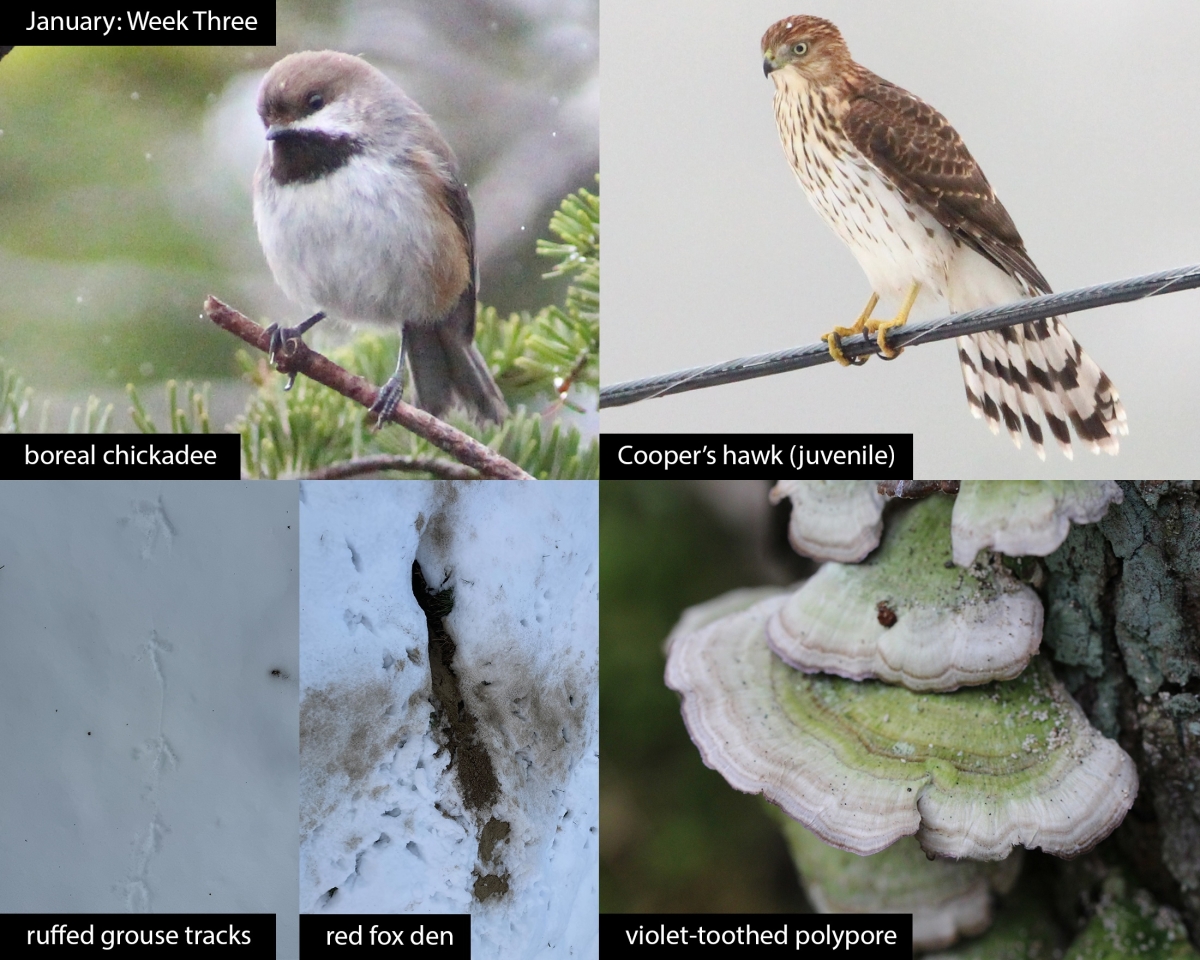
This week in the woods, we shared a moment with a boreal chickadee, the more reclusive, higher-elevation cousin of our familiar feeder bird, the black-capped chickadee. Through the winter, the boreal chickadee gleans spiders, insects, and their eggs and larvae from conifer branches, pries seeds from cones, and retrieves food caches it has secured to tree branches and trunks with plant down or saliva. The subalpine coniferous forests of the Northeastern US mark the lower extent of the bird’s range, which will likely edge northward as the climate warms and spruce-fir zones shift.
Cooper’s hawks migrate short distances but appear year round in northern New England. While adults have slate gray backs and darker caps, juveniles, like this one photographed by Ann Little, have brown backs and white, brown-streaked underparts. Nestlings’ gray eyes become yellow at the one year mark and grow a darker orange with time. These birds mature rapidly for birds their size, and 25 percent of young birds breed within a year of hatching. Birders often risk confusing Cooper’s hawks with sharp-shinned hawks. Cooper’s hawks have squarer heads and the appearance of a cap, due the brownish nape separating top of head from back (think cap = coop). In flight, Cooper’s have less buoyancy and a straight leading wing edge, while sharpies’ heads barely extend beyond the fronts of their wings. Cooper’s tails are longer and rounder than the sharpies’ squared off ones (think sharp corners = sharpie). As juveniles, Cooper’s hawks’ lower breasts have more white and finer brown streaks. Size (Cooper’s hawks are larger, about the size of crows) and habitat also make good clues. Both accipiters enjoy shade and cover, but Cooper’s hawks will much more likely perch in the open, especially near fragmented forests interrupted by clearings such as farm fields and lawns (think of the animal that took its name from human naturalist William Cooper preferring the company of humans). These hawks’ short wings help it maneuver through brush and other obstacles in pursuit of its favorite meal of small birds – often caught around bird feeders. “It can be shocking to witness the capture of a small bird by one of these hawks,” writes ornithologist David Allen Sibley, “but it is important to remember the critical role that predators play in ecology.” The mere suggestion of a predator causes prey species to flee or stay still under cover, giving their own prey (insects, seeds, and so on) the opportunity to survive. (A last Cooper’s hawk anecdote: A juvenile like the one pictured was observed using a walk signal [or, coincidentally, a high-intensity activated crosswalk beacon, or HAWK] to its advantage in ambushes; read more at The Smithsonian magazine.)
Like other gamebirds, ruffed grouse usually only fly short distances, most often when flushed from cover, and spend a great deal of time on their feet. Those feet transform in the winter when scales on the toes enlarge into a comblike, horny fringe and become akin to snowshoes; the doubled surface area distributes their weight and allows them to walk across snow without breaking through. As Mary Holland explains on her Naturally Curious blog, the two-inch, three-toed imprints of ruffed grouse tracks fall one directly in front of the other. Unlike wild turkeys, which flock in the colder months, ruffed grouse disperse from their families in the fall and find their own winter territories for foraging and roosting in solitude.
Even in winter, thick-furred red foxes mostly sleep in the open, curling into a ball and wrapping their bushy tail around themselves. However, in instances of extreme cold, they may seek shelter in previously vacated dens. A fox could have used this den, which housed four kits last year, to keep warm overnight, or else started preparing it for reuse this spring.
The perennial fungus violet-toothed polypore, also known as purple tooth, persists for years on dead and dying deciduous trees, often until they completely decompose. With age, the purple porous surface on the fungus’s lower side develops into minute teeth and fades to tan; the younger outer edges remain brighter and more pore-like. Bands of pink, purple, and brown on top of creamy white fade and smooth out with age and sometimes go green with algae, as here.
What have you noticed in the woods this week? Submit a recent photo for possible inclusion in our monthly online Reader Photo Gallery.
Discussion *