
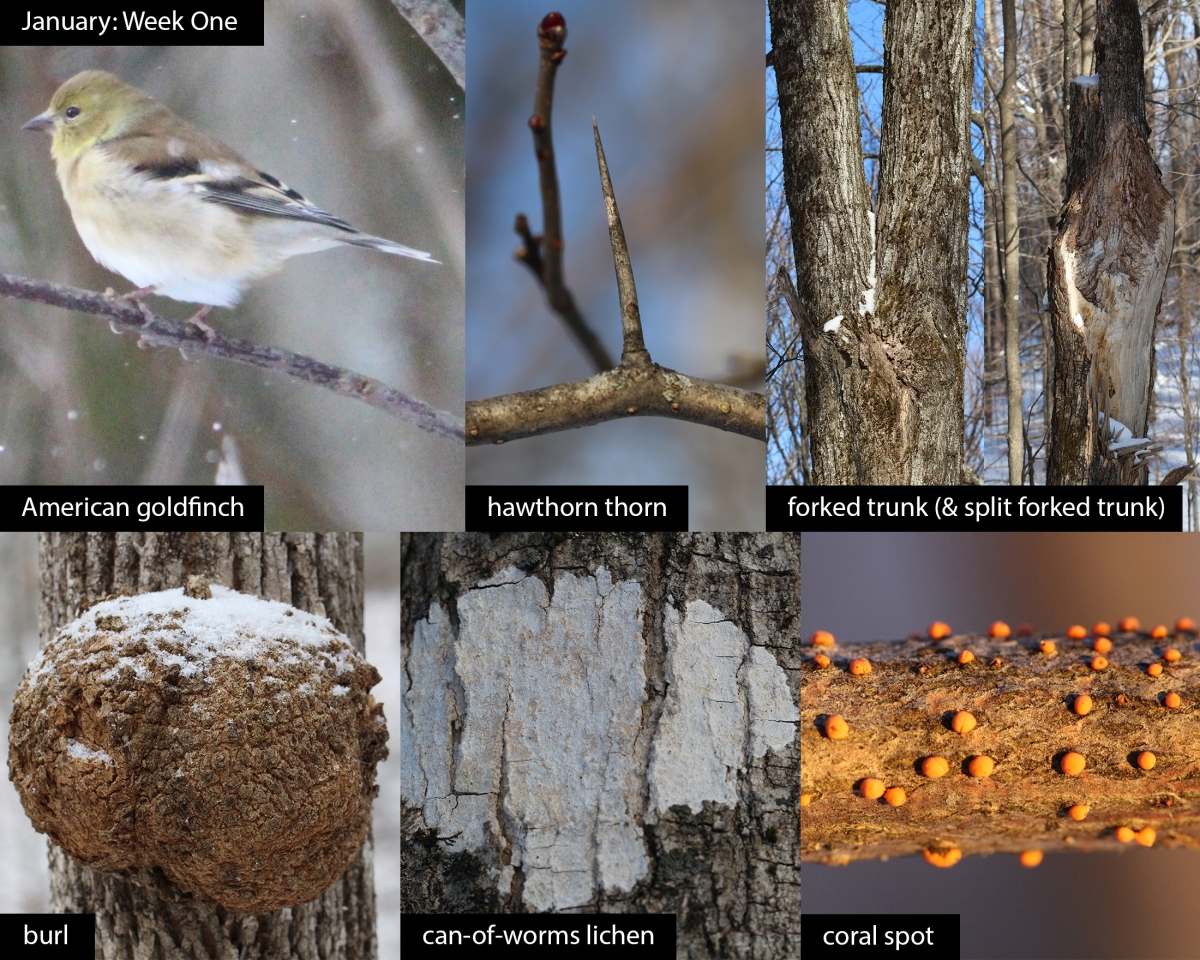
This week in the woods, we’re watching the bouncy, undulating flight of the American goldfinch, which has earned comparison to a rollercoaster, a stone skipped across a lake, and a sine/cosine graph; they fly “rising and falling,” wrote Thoreau, “as if skimming close over unseen billows.” Hardly territorial, even during breeding season, these perky, cheery, social birds assemble in flocks at all times of year. Adult males exhibit a much brighter yellow and black forehead patch during breeding season but after a fall molt come to resemble females and juveniles: duller, grayer, and more olive than yellow. This bird might have the most exclusively vegetarian diet of all bird species. It uses its sharp conical bill to crack open and eat seeds, preferring thistle, sunflower, and mullein. “I wish that every one knew the Goldfinch,” wrote ornithologist Frank Michler Chapman in 1897’s Bird Life. “His gentle ways and sweet disposition are never-failing antidotes for discontent.”
The winter months give the opportunity to observe some of the more static characteristics of trees, as well as their lichenous and fungal inhabitants. Hawthorn’s thorns are modified woody shoots that spring singly from leaf axils and reach up to three inches long. In his excellent Field Guide to the Woody Plants of the Northern Forest, Jerry Jenkins notes that the name hawthorn comes from the Old English haga and þorn (hedge and thorn) and that typographers call the letter þ (pronounced like th) “a thorn.”
Forked trunks, like that of this maple, often develop after a pest or weather event damages a young tree’s terminal leader and competing leaders form from side branches. As the tree ages, the junction where the stems fuse together and create “included bark” becomes weak and prone to rot. The tree has heightened risk of splitting along the seam, as in the photo on the right.
As professional woodturner Nick Rosato explains in the Autumn 2019 Northern Woodlands issue, a burl forms in a tree when a bacterium, virus, or fungus stimulates part of the vascular cambium. In response, the cambium divides more rapidly and irregularly and produces a tumor-like woody growth. The conditions that facilitate the process still remain mysterious, and it can be impossible to know precisely why swelling occurs in one place and not another or what triggered a particular burl. Although twisted, burls’ xylem still transports water and nutrients, and burls don’t seem to harm trees or shorten their lives.
The vast majority of lichens we see on tree bark are just as benign as burls. “Better still,” writes Michael Snyder in a 2008 Forest Insights column, “lichens play several vital roles in the forest, from water and nutrient cycling to providing food for mammals, nest materials for birds, cover for mites, and camouflage for tree frogs and lacewings.” This paint-like splotch belongs to the “crustose” group of flat, encrusting species and is most likely can-of-worms lichen (Stictis urceolatum, formerly Conotrema urceolatum); it grows almost exclusively on sugar maple bark. We might see higher lichen abundance on sick and dead trees but not because of any detrimental effect from the lichens’ presence and more likely because of increased light reaching the host trees’ stems and branches after they have lost their leaves.
While lichens are non-parasitic and use trees as a mechanical means to obtain more sunlight than they can on the forest floor, fungal fruiting bodies on the other hand indicate (and sometimes cause) sickness and death. The fungal disease coral spot belongs to the same genus as the fungi associated with beech bark disease. Often after other factors have weakened a tree, the fungus causes branches to die back and produces these small orange or pink raised spots.
What have you noticed in the woods this week? Submit a recent photo for possible inclusion in our monthly online Reader Photo Gallery.