
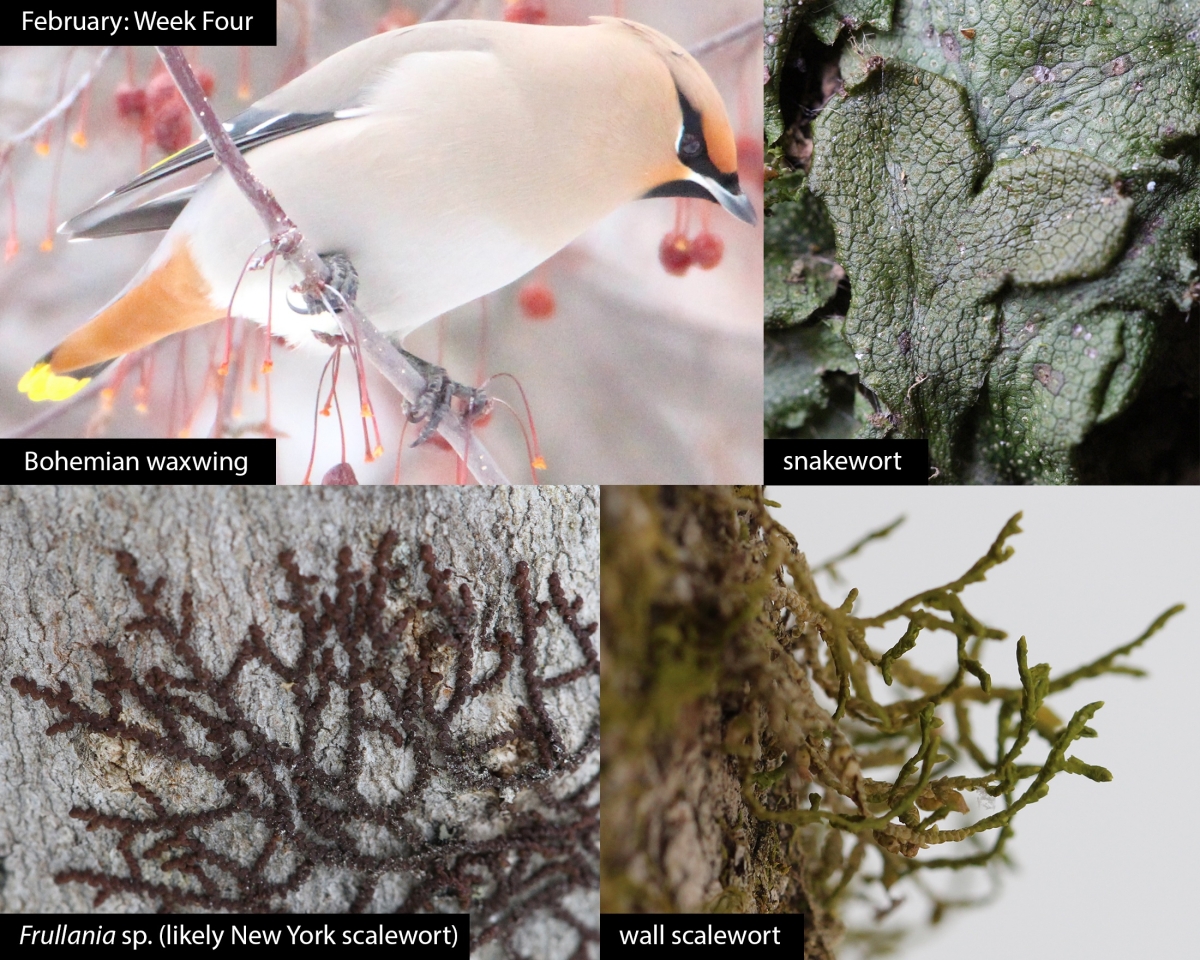
This week in the woods, a swirling mass of Bohemian waxwings gave us a treat as they descended on a neighbor’s tree to consume their own treat of winter berries. These plump but sleek and elegant visitors from the boreal forest are as intrepid, collective, and free as their namesake lifestyle and can be distinguished from their cedar waxwing cousins by their larger size, grayer and less silky plumage, white wing patches, and rusty chestnut undertail.
Waxwings sally for aerial insects in summertime and sip sugar maple sap from the ends of broken twigs in winter and spring, but they feed year round on berries. This largely frugivorous diet determines much for these birds, from the color of their “wax” and sound to their flocking behavior and irregular patterns of movement.
The wax-like substance that makes up the yellow tips on their primary wing feathers and red tips of their secondaries is keratin, the same protein that occurs in all feathers but flattened and hardened. The carotenoid compounds common in fruits and seeds produce a range of red and yellow colors in birds’ plumage. Waxwings’ wax coloration indicates age and health and might impress potential mates more than their vocalizations ever could.
While loud and sociable (Bohemians’ Latin name is Bombycilla garrulus), waxwings lack true songs. In the Winter 2022 issue of Northern Woodlands, Chris Rimmer writes that this lack probably reflects their nonterritorial social structure and diet. The sugary fruits they depend upon “can be locally but sporadically superabundant, are ephemeral, and therefore cannot be readily defended as a resource. This in turn promotes a gregarious lifestyle, discourages territoriality, leads to nomadic movements, and results in delayed breeding schedules.”
Three liverwort species also brightened the snowy landscape for us this week. Named for certain lobed species’ resemblance to the liver and perhaps the first plants to make the transition to life on land, liverworts are a group of small, non-flowering plants that lack true roots, stems, leaves, and vascular tissue. In the absence of structures to keep the plants erect or transport water, liverworts tend to grow flat and prefer moist environments. According to Jerry Jenkins, liverworts and their fellow bryophytes mosses “perform vital functions in forest ecosystems by retaining water and slowly releasing it to the soil, reducing erosion along streambanks, helping maintain humidity, and facilitating the decay of logs and disintegration of rock into soil by holding moisture.” Substrates are an important determinant in what liverwort species grows where, and with its varied topography and bedrock types, the Northeast has a high diversity of liverworts.
Snakewort (snakeskin liverwort, or Conocephalum salebrosum) grows on limy soil, rocks, and ledges. A porous network of interlacing lines on the plant’s surface makes it resemble snake skin and enables an easy ID in the field. It emits a pleasantly spicy fragrance when crushed.
A number of species in the Frullania genus grow in our region and can only be distinguished under a microscope, but this specimen is most likely the most common species, F. eboracensis, or New York scalewort. These leafy liverworts have a reddish-brown, purple, or very dark green color and grow on tree bark in circular mats. “Up close, it’s a riot of compact branches and hand-lens-worthy round leaves,” writes Allaire Diamond in an Outside Story essay. “Like impeccable handwriting caught daydreaming, Frullania branches outward from a central mass, undulating tightly across the mesas and canyons of tree bark, branching repeatedly into fragments and unfinished thoughts.”
Wall scalewort (Porella platyphylla) is identifiable in the field by its overlapping scales with flat margins. The vigorous dark-green liverwort grows in mats, with protruding shelf-like formations, across rocks and ledges and on both the trunks and bases of mature hardwood trees.
What have you noticed in the woods this week? Submit a recent photo for possible inclusion in our monthly online Reader Photo Gallery.
Discussion *