
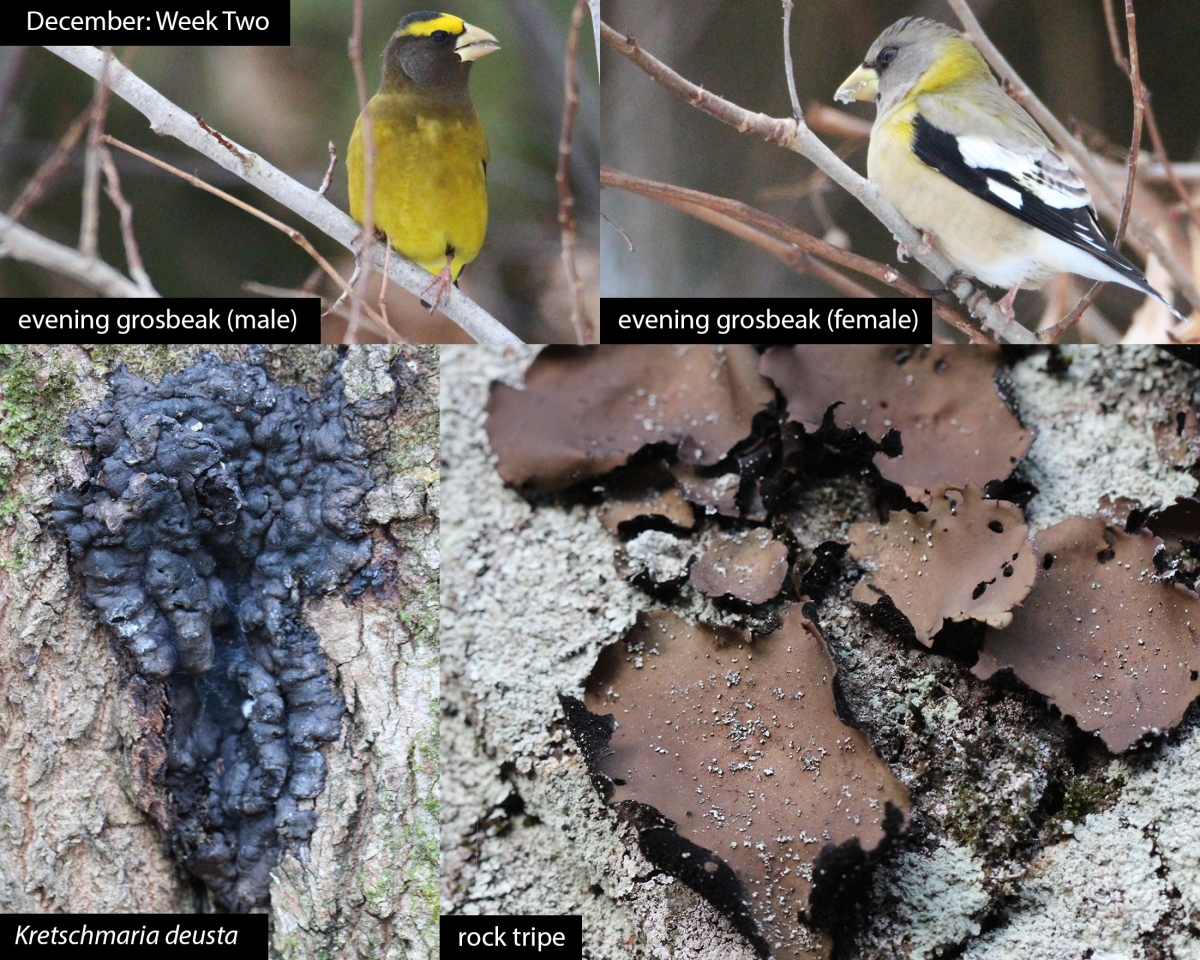
This week in the woods, evening grosbeaks graced a forest margin in West Fairlee, Vermont, and their bright color evoked the sunshine of more tropical climes than their usual Canadian range. These chunky, robin-sized finches have substantial conical bills well-suited for extracting and opening seeds. The male (left) sports a brilliant yellow eyebrow and body, while the female (right) has a more subdued, silvery-gray wash over similar patterning. Their diet consists of a variety of seeds, buds, and fruits – especially those of ash, pine, elm, and maples like boxelder. Widespread planting of boxelders, which retain their samaras on the stems all winter, and the prevalence of bird feeders may have enabled the eastward expansion of their range in the twentieth century. During summers in their spruce-fir nesting grounds, they consume caterpillars such as spruce budworm and other forest pests. Some winters, evening grosbeaks and other winter finches – like pine grosbeaks, common redpolls, red and white-winged crossbills, purple finches, and pine siskins – migrate south into the deciduous and mixed forests of our region. These “irruptions” correspond to a combination of factors. A spruce budworm outbreak can mean more successful breeding for evening grosbeaks, but the insect damage can also lower spruce and fir cone crops and put pressure on the increased population. The birds may then flock to overwinter in more southern areas with higher human populations (and thus more bird feeders) and seed crops of birch, beech, and pin cherry. In the Winter 2024 issue of Northern Woodlands, Colby Galliher wrote about the precarity of this species, which is North America’s fastest-declining landbird. It no longer appears in half of its historical sites, flock sizes have shrunk by more than a quarter, and overall population contracted by 92 percent between 1970 and 2016. Conservationists continue to try to understand this freefall, but it may have to do with the suppression of spruce budworm, high frequencies of vehicular and window collisions, vulnerability to cat predation at bird feeders, and climate and industrial pressures on the boreal forest.
The fungal pathogen Kretschmaria deusta has inspired a number of fiery common names: brittle cinder, burnt crust fungus, and coal fungus. The lumpy, spray foam–like fruiting bodies begin gray, with lighter margins, and darken and grow brittle with time. This specimen appeared on a sugar maple, but common hosts for the species include other deciduous trees – just as often beech and oak. The fungus infects trees through open wounds, frequently at the base of the trunk or upper roots, degrades the cellulose in plant cell walls, and compromises the wood. Even if trees’ crowns show few symptoms, seemingly healthy trees can crack at the site of decay. UMass Extension has more information at this link.
Rock tripe, a common lichen of several varieties, grows on cliffs and boulders with 60- to 95-degree slopes: “any gentler,” writes Allaire Diamond in an Autumn 2009 Northern Woodlands article, “and the rock will host mosses instead, but too much of an overhang won’t let them get established.” The large flakes have a soft, leathery texture with rain and shrivel in dry periods. Dense rhizines – lichens’ root-like structures – cover the undersides. Melanin makes this lichen brown when dry, blocks a wide spectrum of light, and protects against damaging levels of ultraviolet. When ground up and fermented, it can produce a purple dye.
What have you noticed in the woods this week? Submit a recent photo for possible inclusion in our monthly online Reader Photo Gallery.