
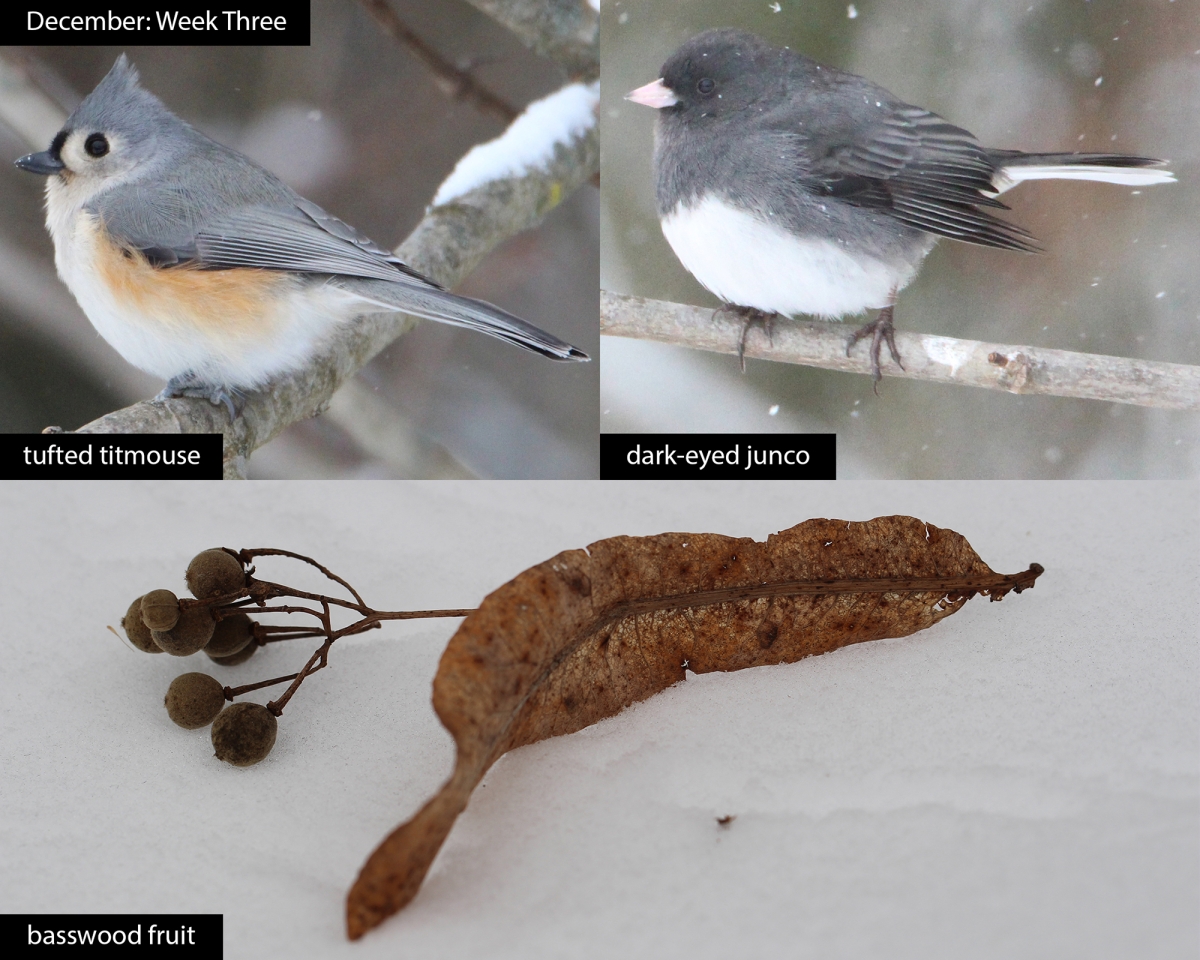
This week in the woods, we’ve appreciated visits from the tufted titmouse, a familiar, alert-looking songbird always busy at our feeders. The crest-headed birds have soft gray backs and wings, white bellies, and rusty sides. We see them year round in mixed and deciduous forest types at lower elevations and especially in human-altered habitats. While many other bird species have declined the past century, the tufted titmouse’s population has increased and its range has expanded; human-provided food and forests taking over former farmlands have allowed for the northernmost edge of its winter territory to move from the upper mid-Atlantic through northern New England and into southern Canada. Mixed winter flocks including titmice often also have nuthatches, kinglets, creepers, hairy and downy woodpeckers, and black-capped chickadees – a close relative to the titmouse. Like chickadees, titmice hoard seeds from feeders and cache them for later retrieval, and like many other birds that nest in cavities during breeding season, they also use such tree hollows for winter shelter.
Another abundant feeder bird (and one of the most abundant North American birds), the dark-eyed junco also has a year-round presence in our region and exhibits, like the tufted titmouse, what biologists call “countershading” – a common coloration pattern with dark upper surfaces and light lower surfaces. When sun lightens the dark areas above and shadow darkens the light areas below, animal bodies appear more uniformly shaded and have less depth relief, providing camouflage from both predators and prey. Numerous vertebrates – from sharks to white-tailed deer – share this trait. Male dark-eyed juncos have slatey chests, wings, heads, and backs and white bellies, making them look as if they have plopped into puddles of white paint. Females have the same pattern but with lighter, browner coloration where the males have gray. We see far fewer females here during the winter; females and less dominant males, which can secure less desirable territory, tend to migrate farther south during the winter in search of food supply.
The fruits of basswood (also called American linden) persist on their parent trees until the beginning of winter, when they fall. A specialized, narrow, bladelike bract – distinct from basswood’s larger heart-shaped leaves – serves as a sail, catching the wind and dragging them across the snow. It takes breaking through the hard outer shells of the round nutlets, but chipmunks, mice, squirrels, porcupines, and rabbits all dine on the tiny seeds.
What have you noticed in the woods this week? Submit a recent photo for possible inclusion in our monthly online Reader Photo Gallery.