
This week in the woods, we continue through the period between the loss of snow cover and the canopy closing. In this window, before light becomes too limited, spring ephemerals can complete their annual cycle, channeling last year’s starch reserves into new tissue, producing chlorophyll, and storing more carbohydrates underground to carry them until next year.
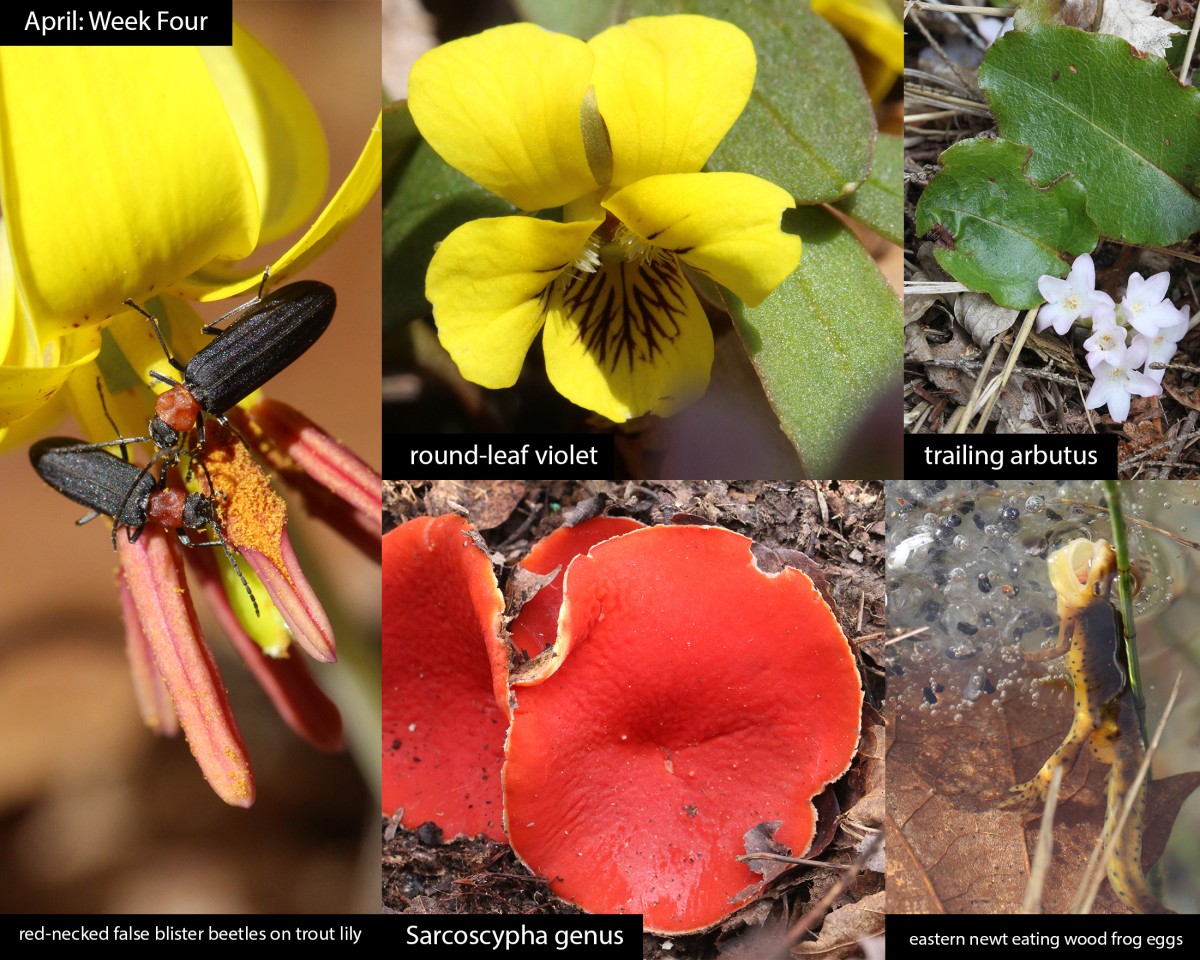
The vast majority of trout lilies – one of the first spring ephemerals to appear – produce just one leaf and no flower during this time. The one percent or so that do bloom take at least five years to do so, and only a small percentage achieve fertilization. Frequent pollinators of these flowers, red-necked false blister beetles often appear on them in pairs. Rather than move pollen among flowers while foraging for nectar, the sloppy beetles eat the pollen and transfer uneaten grains from plant to plant on their limbs, bodies, and faces. Mating takes place on flower heads only after the female has eaten her full; enzymes in her gut open the pollen grains’ protective layer and allow her to digest their contents, providing energy to produce eggs.
Like the rest of the United States and Canada’s almost 100 violet species, the round-leaf violet has a central petal that forms a nectar spur toward the flower’s back and serves as a landing pad for flying insects. Ultraviolet “runway markings” make the flowers all the more visible to pollinators. This particular species’ two lateral petals bear interior “beards.”
While we most often find early spring forest bloomers under deciduous trees, trailing arbutus, which we wrote about in December, prefers acidic sandy or mossy ground under conifers. Its five-petaled waxy, tubular, fragrant flowers flare beneath the round, leathery leaves covered in bristly hairs.
This bright fungus in the Sarcoscypha genus (either scarlet elf cup or scarlet cup) emerges earlier than most other mushrooms of ours in spring. The shallow, wavy cups grow on decaying woody material from deciduous trees, sometimes obscured by soil or moss.
The masses of one or two thousand eggs each wood frog mother leaves make good eating for eastern newts in their aquatic adult form. These adaptable carnivores also eat the larvae of mayflies, caddisflies, midges, mosquitoes, and even their own species, plus minnows, snails, and tadpoles. They may also fall prey themselves to fish, herons, and amphibian blood leeches.
What have you noticed in the woods this week? Submit a recent photo for possible inclusion in our monthly online Reader Photo Gallery.