Skip to navigation Skip to content

The Winter Life of the Skunk

skunk_web.jpg
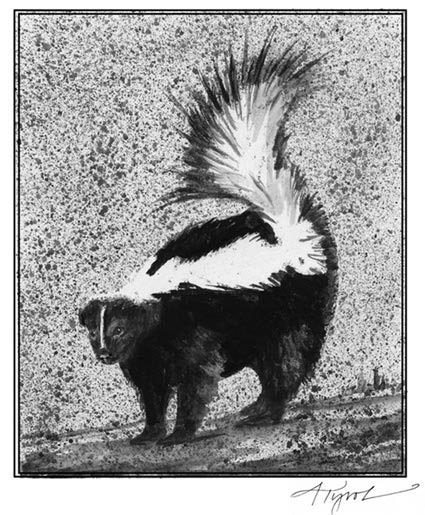
Illustration by Adelaide Tyrol

In summer, you always know when a striped skunk has been around. But in winter, these animals make themselves scarce, hunkering down to wait out the onslaught of ice and snow.

Unlike most rodents and birds, which hoard food for the cold months, the striped skunk will have spent the fall eating as much as possible so it can stay warm during mid-winter dormancy. This binge eating creates thick layers of fat underneath the skin– a winter jacket, of sorts. The skunk metabolizes this fat during its dormant rests, though at a much slower rate than in summer.

Striped skunks use different den sites at different times of year, so their winter burrow will usually not be the same place where they raised their young. While capable of digging their own winter burrows, skunks are more inclined to seek residency in spaces that belong to someone else. For example, they find comfort underneath human-built porches or decks, a fact that some of us (and our noses) may be all-too-familiar with. Those skunks that live away from residential areas will often commandeer burrows dug and deserted by other outdoor dwellers, such as woodchucks or foxes.

Once colder temperatures set in, a skunk will prepare its den by blocking off the entrance to its burrow with leaves and grass to keep the cold air out. It isn’t uncommon for striped skunks to burrow with each other for extra warmth – these cohabitating skunks have the advantage of social thermoregulation, where they use each other to stay warm. Males sometimes den communally during winter, but are not tolerant of each other during other seasons.

Winter denning season in Vermont and New Hampshire typically runs from November through March, but this isn’t to say that skunks aren’t active during winter. Settled into its winter home, the striped skunk becomes dormant, but does not enter a full state of hibernation. Instead, skunks enter a state of torpor – a sort of deep sleep from which they awake from time to time. During torpor, which is influenced by the temperature and food availability, their body temperatures can drop 20degreesand their metabolism slows.

As the season changes from winter to spring, skunks will emerge and seek a mate. Striped skunks are a polygamous species and a male will take multiple mates over the course of late February through April; a female will only mate once. After breeding, both males and females seek to rebuild fat reserves, having lost, on average, about 30 percent of their body weight during winter. Females will establish maternity dens, sometimes communally. Males spend the warm months alone.

The arrival of spring brings not only warmer weather, but new food sources. The omnivorous skunk goes from a lean winter diet of carrion, fruit, and seeds to a summer diet rich in insects, small mammals, and sometimes our trash. As bee keepers are well aware, skunks have a fondness for bees and will consume honey, larvae, and adults.

The scientific name for the striped skunk is Mephitis mephitis, meaning “bad odor.” The word “skunk” itself is one of the few Algonquin Indian words to enter the English language.

Discussion *

Apr 01, 2024

I have a skunk in my crawl space. If I leave it alone will it leave the same way it got in. Thanks

Yvonne
May 23, 2021

Hello, I have a live sunk under my building in which I run my business so it is a truly terrible situation. Any loud noise and the smell is immediately horrendous and I am forced to close my store for several days or more. I’ve had several wildlife control experts come out and they can find no entry or exit points around my building. My business is on a street close right on the sidewalk. it is in a very old historic district. my question is…can there be access under my building several yards from a sewer system running under the street? No one has been able to determine how it is getting in the crawl space! We are facing having to tear up our floors.
Live Traps have been set around the perimeter to no avail. Please provide any opinions on my terrible problem. Thank you

Martha Keats
Mar 15, 2020

Though skunks don’t hibernate, they can burrow in their dens during especially cold spells. This means you would see them most before and after long periods of snow cover.

Builddailys
Mar 11, 2020

Skunks are nocturnal, usually active from early evening through the night. They usually spend their days sleeping in dens, although during the warm months they may bed in vegetation. Dens are usually below ground but may be found in a stream or pond banks, lumber piles, or beneath porches or in crawl spaces.

Fotodor.com
Dec 17, 2019

There is a skunk somewhere on my property. I have two dogs and they have both gotten sprayed, separate times, in my yard. I thought, considering it’s Winter, the skunks would not be around. Nope!  My entire house wreaks. I’m going to look for their tracks in the snow. Sadly, if I trap it, there really isn’t anywhere to bring it. I also don’t want to stress it out and kill it. But, on the other hand, this thing has tortured me. Are skunks considered rodents?

Rachel
Dec 05, 2019

We had one cousin, whom had never smelled a skunk…called the fire department, they came, and died laughing when they found out what it was…we have never let her forget it….when we smell skunk, we usually say…quick call the fire department…lol

Evelyn Jepson
Nov 27, 2019

I feed skunks all year and there the most cutest creatures, first of all there almost blind, I didn’t notice anyone saying that in these comments if you all didn’t know, there so harmless, and in the 4 years I have been feeding them I only smelled them once because a fox was bothering one of them, I feed many animals and they all basically get along, coons, opossums, fox, feral cats, I saw a fox nose to nose with a feral cat once, it looked like there were kissing lol

paul c paci
Nov 17, 2019

I didn’t check to see if the guy who asked about skunk legs growing back posted on April 1, but I hope so. Lizard legs do NOT grow back and neither do the limbs of any vertebrate. Amazing how often vets get asked this question. Should’ve paid attention in biology class, pal.

Mike Anderson
Nov 09, 2019

Last year we had a large white skunk visiting our apartment complex here in NH every night into early morning digging in the yard..This year, he/she isn’t anywhere ( maybe he died?) Last night I went out for a cigarette and caught some eye-shine from a small skunk ( size of a kitten) and when I came out this morning it was still out there digging for grubs. How old are they when they leave mom and venture out on there own and could this be a baby of our albino skunk? Why isn’t he out all summer long and why start foraging now when it just started snowing ? ( Our first snow was yesterday November 8, 2019) Thank you.

Kathy Kelley
Jul 23, 2019

I now have a skunk living in my garage wall. The door is next to the den and when I leave, I open the door a crack and if it’s there, I tell it to “go hide in your den” and it does. So then I can leave w/o fearing to surprise it and risk being sprayed. Ha! I fear it won’t be able to stay there this winter though, it’s too cold. Chipmunks have tried last year and didn’t make it.

Anne Cyr

Leave a reply

To ensure a respectful dialogue, please refrain from posting content that is unlawful, harassing, discriminatory, libelous, obscene, or inflammatory. Northern Woodlands assumes no responsibility or liability arising from forum postings and reserves the right to edit all postings. Thanks for joining the discussion.