
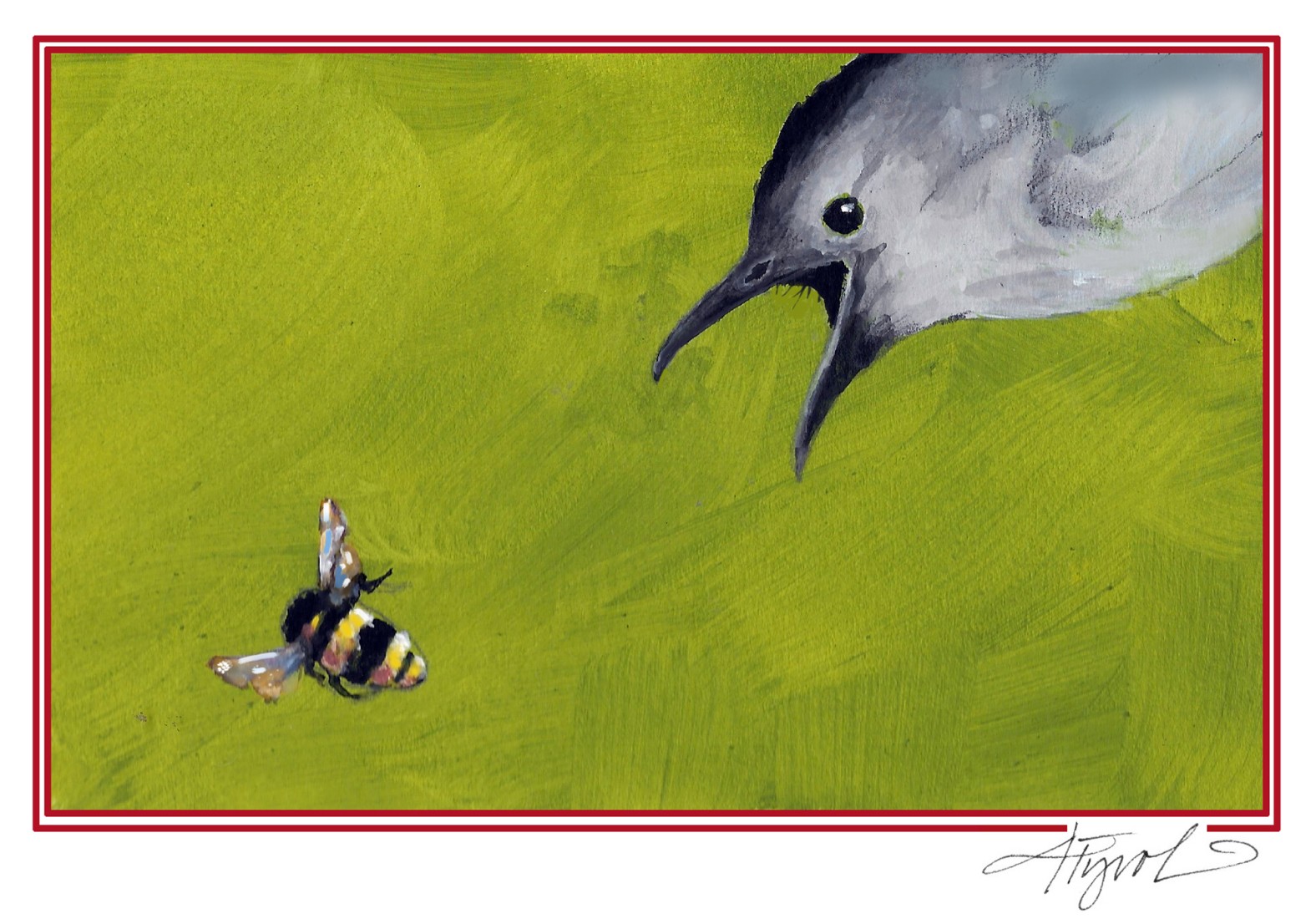
One predator-prey interaction always leaves me torn. Birds sparked my love for the natural world years ago, but after my interest lapsed during adolescence, bees brought me back into the fold. So I found myself split between two allegiances the first time I watched a bird, in this case, a gray catbird, swoop into the garden and snatch a bumblebee on the wing.
I had long assumed, perhaps simplistically, that birds avoided bumblebees (and honeybees and wasps, for that matter) for the simple fact that targeting such stinger-equipped prey was a risky gamble. Plus, it was the height of summer, and the garden teemed with less formidable insects. As I watched the catbird steal into the bushes with its meal, two questions came to mind: How often do birds prey on bees and wasps? And how do they avoid a painful jab when swallowing species with stingers?
Stinging bees and wasps like bumblebees and bald-faced hornets, as well as many species that do not sting, like sweat bees, are members of the Hymenoptera, the scientific order that includes more than 150,000 species of bees, wasps, and ants. According to Desirée L. Narango, a conservation scientist at Vermont Center for Ecostudies, the extent to which birds eat Hymenoptera, whether stinging or not, is somewhat understudied. “We know less than one might think about specific prey items that birds eat,” Narango said. “Most of what we know is that birds eat ‘insects’ or ‘arthropods.’”
Narango pointed to several datasets that document the diets of North American forest birds, which consume a high volume of insects. One from the 1980s found that Hymenoptera comprised 9 percent of the studied species’ diets. This number is far less than the two most commonly consumed orders – Coleoptera (beetles) at 48 percent and the larvae of Lepidoptera (butterflies and moths) at 18.5 percent – but more than other orders like Diptera (flies) at 3 percent.
Another study examined which birds prey on the Vespidae, a family of stinging wasps that includes yellowjackets. The study’s findings indicated that blue jays, Cape May warblers, yellow-bellied sapsuckers, Nashville warblers, and several flycatcher species eat Vespidae wasps. Spencer Hardy, a bee biologist also at Vermont Center for Ecostudies, added that bird species that feed on the ground, such as American robins and eastern bluebirds, are likely to eat bees regularly “since many bees are ground nesters and on cool mornings can occasionally be found crawling around near nest sites.”
A number of our bird species, then, eat a non-negligible amount of stinging bees and wasps. So how do they do it?
The answer may lie in how insectivorous birds take their prey. “Almost all birds that eat flying insects capture them in flight,” said Pamela D. Hunt, senior biologist for avian conservation at New Hampshire Audubon. “My guess is that [bees and wasps] are usually killed outright in the process or shortly thereafter when the bird beats them against a solid surface such as a branch. Either way, bill length likely minimizes the chance of being stung.”
Hardy added that even among bees and wasps that sting, many are not capable of piercing human skin and so may not pose much of a threat to birds, either. “It's a gamble I'd probably take if I were a hungry bird,” he said. Anecdotal reports suggest that tanager species, such as the familiar scarlet tanager and the more southern summer tanager, remove their prey’s stinger by wiping it off on a branch before consuming it. And research from 1945, published in the scientific journal The Condor, relied on field observations to contend that some birds seem to be able to distinguish between drones – male members of a species that lack stingers – and queens and female workers, which have them.
All said, a good bit of mystery still surrounds the predatory relationship between North American birds and Hymenoptera species, which is nevertheless just as important a trophic relationship as any other in the natural world. Still, against the naturalist’s dispassionate code, I feel that twinge (sting!) of inner conflict when I see a bird dart away with a beloved bumblebee.