
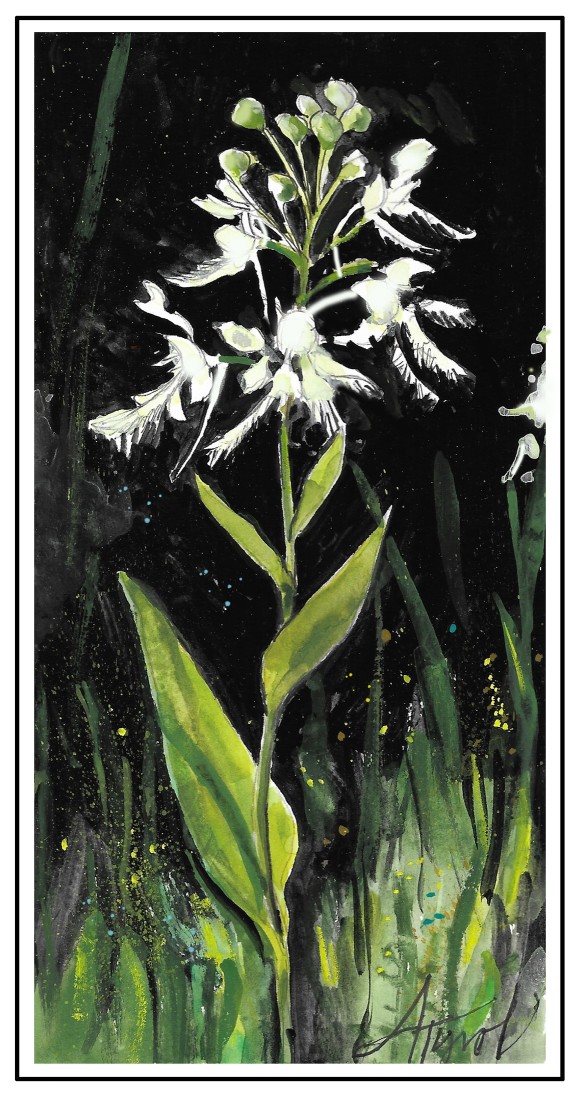
Along the edge of a remote pond, among a spongy carpet of interlaced vegetation, an orchid of graceful and gossamer beauty rises. Its mass of exquisite white flowers, perched atop a slender stalk, resembles at one glance a medieval mace, at another a bog-wandering spirit in its torn, ghostly shawl. It stops me in my paces.
White-fringed bog-orchid (Platanthera blephariglottis) is the showiest of our region’s 13 bog orchids, all members of the genus Platanthera. Others include lesser purple fringed bog-orchid (P. psycodes) and north wind bog-orchid (P. aquilonis). Despite their common name, Platanthera species occur across a variety of habitats, from moist forest openings to the aquatic digs where I came across white-fringed bog-orchid.
Where it occurs, this elegant showstopper is difficult to miss. White-fringed bog-orchid usually flowers in July in our region, with specific bloom times shifting year to year based on temperature and rainfall. (The species will sometimes fail to bloom in a given year if drought or poor environmental conditions are present.) An arrangement of 10 to 20 white blooms, collectively called an inflorescence, encircles the top of a stem that can grow anywhere from one to two feet tall. Each individual flower is a delicate configuration of four snow-white petals radiating in four directions.
One of these petals gives white-fringed bog-orchid both its common and scientific names. The bottom petal, which droops downward, is called a labellum, or lip. Close inspection of the species’ labellum reveals fringed edges like torn fabric, making clear the inspiration for the plant’s common name. Its species name, blephariglottis, combines two words: blephari, for eyebrow or eyelash, which are fringed, and glottis, for tongue.
Another part of the flower’s anatomy illuminates the plant’s pollination ecology. Extending behind each flower is a roughly inch-long nectar spur, a narrow structure that harbors a sweet liquid lure for long-tongued pollinators. These include yellow and half-black bumblebees and monarch and eastern tiger swallowtail butterflies, among many others, but a 1976 study published in the journal Botanical Gazette found that nocturnal moths are the chief pollinators of white-fringed bog-orchid.
When thirsty visitors alight on one of the orchid’s flowers for refreshment, they do not leave empty-handed (or, in this case, empty-eyed). To access the nectar within the flower’s spur, the pollinator must press its face into the spur’s opening. As they do so, they come in contact with a minute dollop of pollen, or a pollinarium, which adheres to the insect’s eyes. The carrier will then pollinate other white-fringed bog-orchids as it repeats the pollination process in search of more nectar. While shorter-tongued pollinators will stop at the orchids, they are less able to avail themselves of the sugary treat within and, by extension, do not serve as effective pollinators of the species.
White-fringed bog-orchid is more than a source of sustenance for pollinators. According to the Native Plant Trust, the species is a strong indicator of the health and integrity of the open peatlands it often inhabits. An abundance of white-fringed bog-orchids in a bog suggests that the Sphagnum mosses, which form the peat substrate of such ecosystems, are intact and relatively undisturbed by human activity.
The species’ sensitivity to environmental changes helps explain its rarity in our region. Threats to white-fringed bog-orchid, which is classified as rare in Vermont and uncommon in New Hampshire, mirror those to other Platanthera species; five out of the 13 are ranked as either rare, extremely rare, or threatened in one or both states.
Disturbance or destruction of wetlands is the primary threat to bog-orchids. Many Platanthera species are sensitive to stressors like acid rain and waterborne pollution, as well as rising temperatures that influence rainfall regimes and water levels in aquatic environments. Illegal removal of orchids from natural habitats has depleted populations in some places. A prolonged lack of natural disturbance, such as fire or storms, can also negatively affect white-fringed bog-orchid by allowing woody encroachment on its preferred habitat.
Sensitive as it may be, white-fringed bog-orchid’s beauty is a treasure of the botanical world – and a sublime sight if you’re lucky enough to spot one blooming in your local bog, fen, or wetland.