Skip to navigation Skip to content

Sleep, Creep, Leap

Pollinator garden
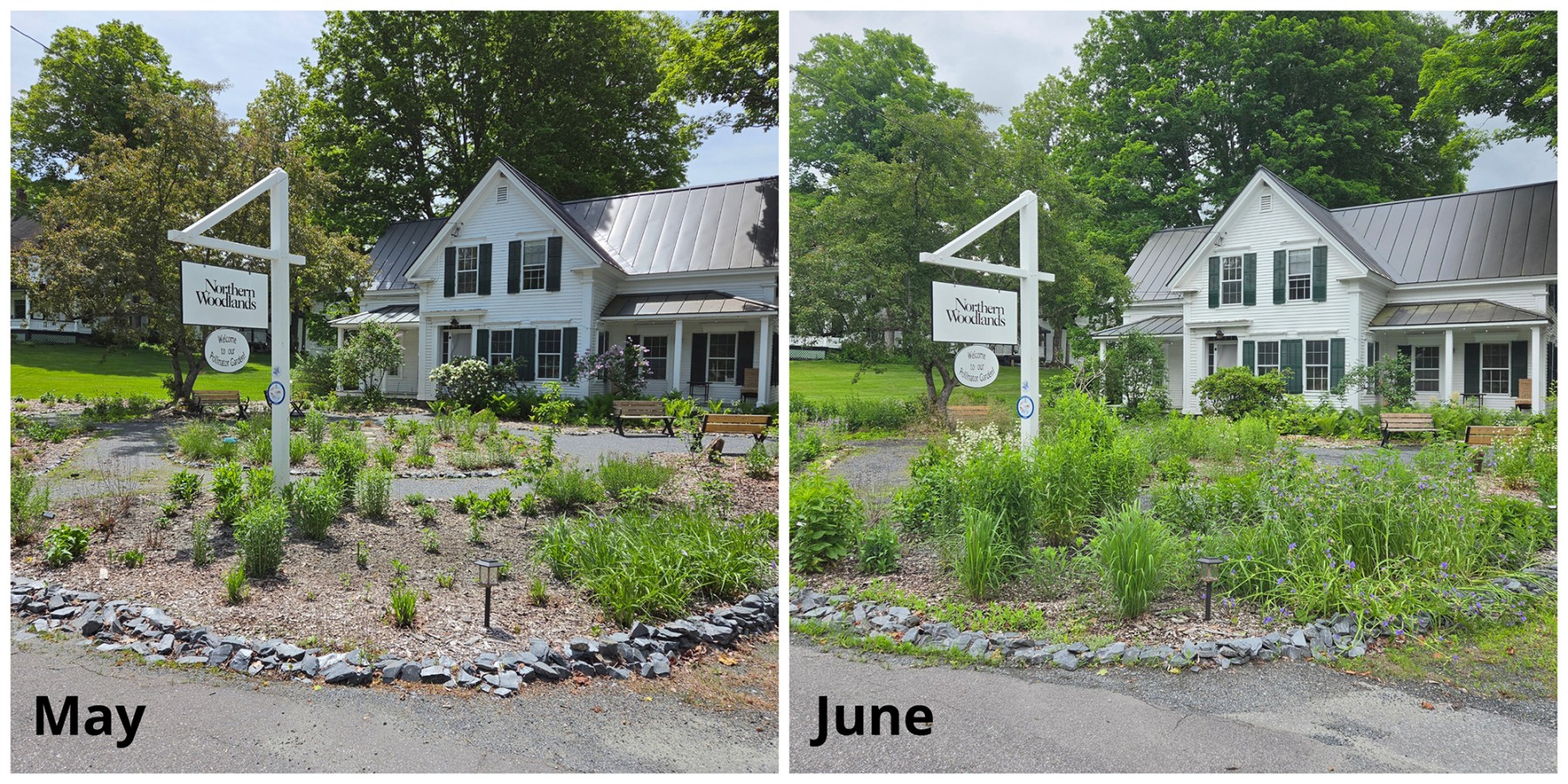
The difference one month made! Photos by Northern Woodlands staff.

Now in our third year, this is our Pollinator Garden's leap year. If you've heard the native plant rule of thumb - sleep, creep, leap - you know what that means.

During the first summer the plants appear to sleep as roots quietly establish underground. In the second year they creep, with significantly more growth and decent flowering as they settle comfortably into their locations. But the third year? Look out. The plants take off, taller, fuller, denser, and the gaps between them are disappearing. They're becoming swaths of species rather than individuals. A true native plant community.

This leap year also brings many new plants from the abundance of seeds left behind last season. Mature plants will feed more pollinators, shelter more insects and other small creatures, and offer up seeds for birds, wildlife, and eventually our own collecting to share with others.

Our thanks to the Jack & Dorothy Byrne Foundation, The Lyme Foundation, the Utility Club of Lyme, and the many generous neighbors who make this garden possible.

Sleep, Creep, Leap Gallery

Pollinator garden Photo: Emily S. Rowe
Our garden is certified pollinator-friendly through both University of New Hampshire and University of Maine and is on the Pollinator Pathways map. | Photo: Emily S. Rowe
Percy Photo: Emily S. Rowe and Nancy Farwell
Percy enjoying the sunshine on Canadian thimbleweed we’re trying to establish. These plants came from a neighbor down the street and are starting to spread into a somewhat neglected strip along the side of our office. This species can be a bit aggressive, but in this location, that will be fine. | Photo: Emily S. Rowe and Nancy Farwell
Tiny mushrooms Photo: Emily S. Rowe
June’s persistent rains created the perfect conditions for these mushrooms that are growing everywhere. | Photo: Emily S. Rowe
Pussytoes Photo: Nancy Farwell
The pussytoes put on a fabulous show this spring. Tough, resilient, and beautiful in mass, these are plants we’d recommend to anyone. | Photo: Nancy Farwell
Golden alexander Photo: Jack Saul and Emily S. Rowe
This golden Alexander is proof that patience is required when gardening with native plants. In years one and two, we weren’t even sure this plant would make it. It proved us wrong! This eastern boxelder bug is delighted with the blossoms. | Photo: Jack Saul and Emily S. Rowe
Pollinator on flower Photo: Jack Saul
The wild strawberries are spreading everywhere, and that’s just fine. | Photo: Jack Saul
9-early-blooms-garden-collage-er.jpg Photo: Emily S. Rowe
Wild geranium, spiderwort, and columbine bring early color to the garden. | Photo: Emily S. Rowe
Orchid garden Photo: Emily S. Rowe
We were honored to receive a box of showy lady slipper seeds from the New Hampshire Academy of Sciences, located just down the road. They have been working to propagate these beautiful and elusive plants, and we’ll be tracking growth and reporting data back as ours establish. Happy to report: ten shoots are already coming up. | Photo: Emily S. Rowe
Prairie smoke Photo: Jack Saul
Another wonderful plant that bloomed this year: prairie smoke. It was hard to establish and only four plants have made it to year three. | Photo: Jack Saul
School visit Photo: Emily S. Rowe
We were delighted to host the second-grade class from our local elementary school, who had recently been studying pollination. They were excellent observers, and a few students even made some discoveries for us! | Photo: Emily S. Rowe
Student discovery Photo: Emily S. Rowe
One student discovery: We believe this caterpillar is columbine sawfly. | Photo: Emily S. Rowe
Blooms Photo: Emily S. Rowe
Downy woodmint, monarda, coreopsis, and the new trumpet vine are already in bloom. | Photo: Emily S. Rowe
Thriving garden Photo: Emily S. Rowe
Our garden is thriving and changing. We are happy with how it is maturing, though like all gardens it has its challenges. Some plants have died off, silt has accumulated in the path from runoff, and weeds are filling in. Maintaining it is a balancing act, and we’re still learning what needs attention and what we can let go. | Photo: Emily S. Rowe

No discussion as of yet.

Leave a reply

To ensure a respectful dialogue, please refrain from posting content that is unlawful, harassing, discriminatory, libelous, obscene, or inflammatory. Northern Woodlands assumes no responsibility or liability arising from forum postings and reserves the right to edit all postings. Thanks for joining the discussion.