
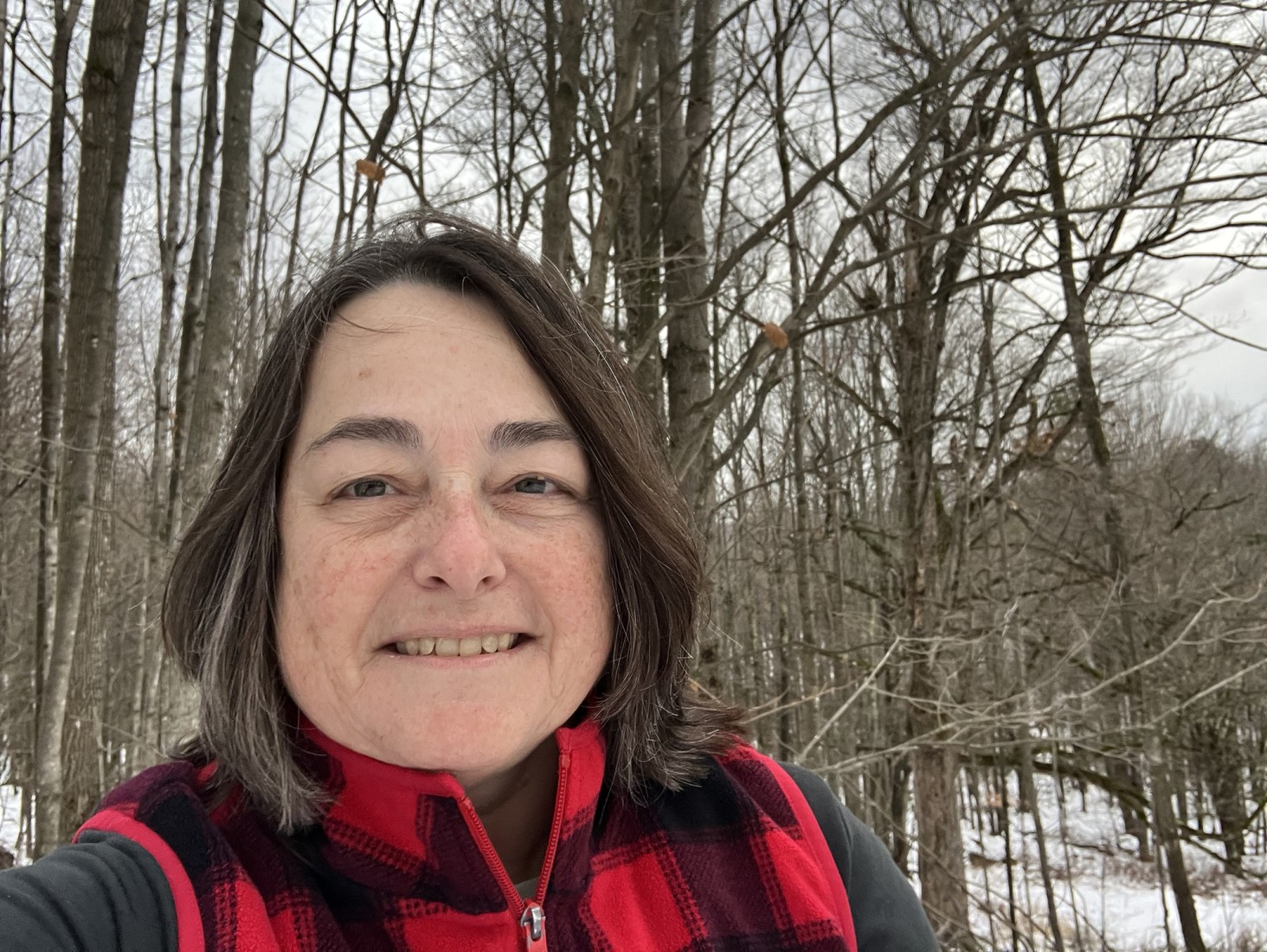
Kathy Beland is a consulting forester and the Vermont Tree Farm program administrator at Vermont Woodlands Association. She owns and runs a forestry consulting business, Not Just Trees, Inc., with forester Frank Hudson. Originally from Maryland, she moved to Vermont in 1986, not long after graduating with her associate’s degree in forest technology from Allegany College. When she’s not in the woods, Kathy enjoys spending time with her grandkids, brook trout fishing on small mountain streams, and gardening.
I grew up on a dairy farm in Westminster, Maryland, and at the time it was farms all around us. Around 1968 my dad sold the herd, and then eventually sold the farm, but we kept the house and 7 acres and a barn. I had big meadow to play in and a small area of woods down below the house. It was rather idyllic. My dad was a farmer through-and-through, so we had a huge garden, and my hands were always in the dirt. That probably dictated the rest of my life; I always needed to be doing something outside with my hands in the dirt.
I loved the woods, and I started investigating what that might mean for a job. Junior year of high school, I connected with the first female forest technician in Maryland. She was in our county. She was pretty inspiring and a good mentor. She graduated from Allegany College in western Maryland. It was the only forestry program in the state, so I went there to look at it and I thought, “This is where I belong.”
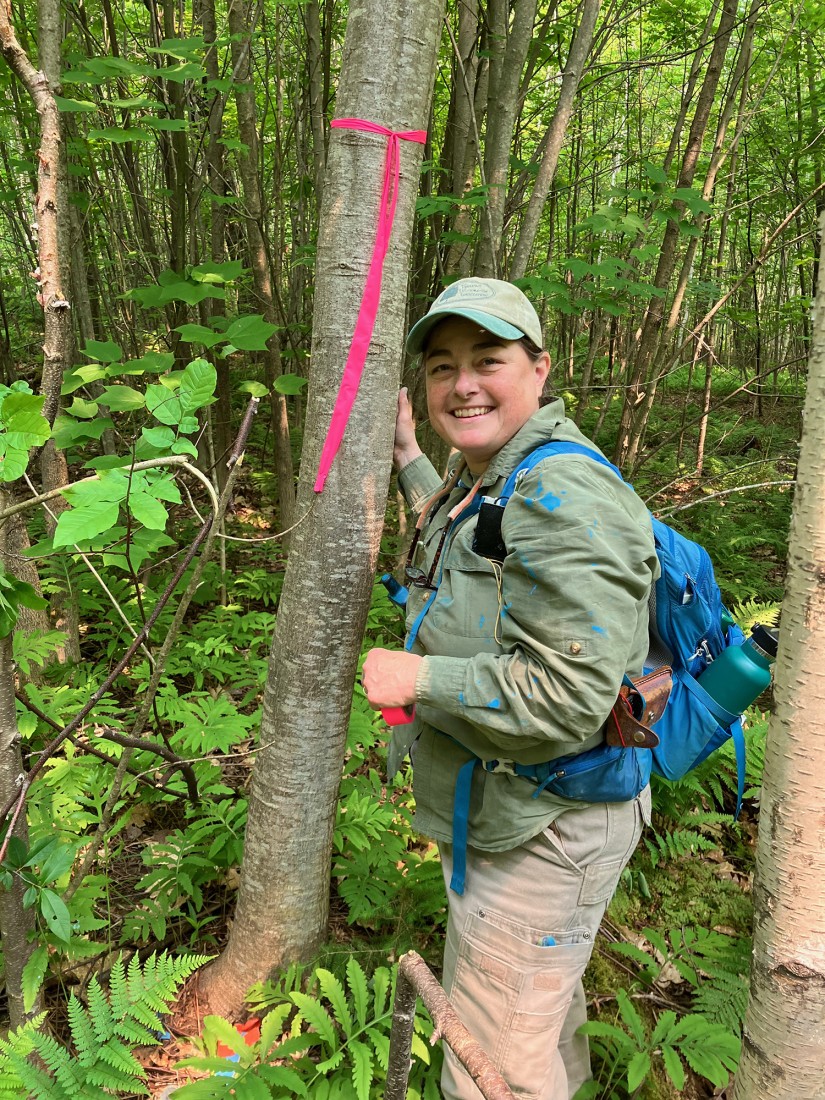
I learned a whole lot there, made lifelong friends, and met my husband, Tom. Almost every class had a lab that was out in the woods, which was great. My class at Allegany started with 35 kids in the forest technology program and ended with 16. It was probably about 75 percent male. I look at the ratio now and feel like it’s still not too different. I got my associate’s degree in two years. When I finished up in 1982, I did what everyone did at that time: I filled out all the application forms I could find for temporary federal jobs. I probably sent out hundreds, which generated maybe one interview. Reaganomics were in full force and there were not a lot of those jobs left, so it was not easy coming out of school and hoping to get a forestry job.
I started out working at park in Sykesville, Maryland, where a lot of my relatives were. I learned a lot about grants and what managing a community park was like. Eventually the Forest Service revamped their retirement system, and a lot of people took retirement, which opened up a lot of jobs across the state. I got a position as a forest technician in 1983. I did inventories and wrote management plans. I also marked sales and did fire control and maintained roads. I even did some Smokey the Bear fire prevention education in local schools. There was a lot of good variety in the work.
Eventually Tom and I decided we were done with Maryland. We were visiting friends in New Hampshire and drove home to Maryland through Vermont, cutting across the Route 4 corridor, and we both just went, “This is what we’re looking for.” More woods and less people. We picked up the Rutland Herald on the way home and then started getting it delivered to us. Within a couple of months, we were packing up everything and driving back to Vermont to live here. That was June of 1986. We didn’t tell our parents we didn’t have jobs – we just laughed and told ourselves we would figure it out, because that’s what you do in your 20s.
I took a job as a housekeeper at first, but I quit as soon as I could. Tom got a job as the resident carpenter at the Cortina Inn in Mendon. It was a good job, and he enjoyed the freedom to be creative. I started sending my resume out all over the state looking for a consulting forester job. I got an interview with Mark Skakel who asked me to come out and interview by doing some work on Dick Rose’s land in Stockbridge. Dick was the first consulting forester in Vermont. I went out and marked a stand of timber with Mark and a logger. I was used to Maryland where most of the woods were oak, but I guess I did alright because Mark hired me.
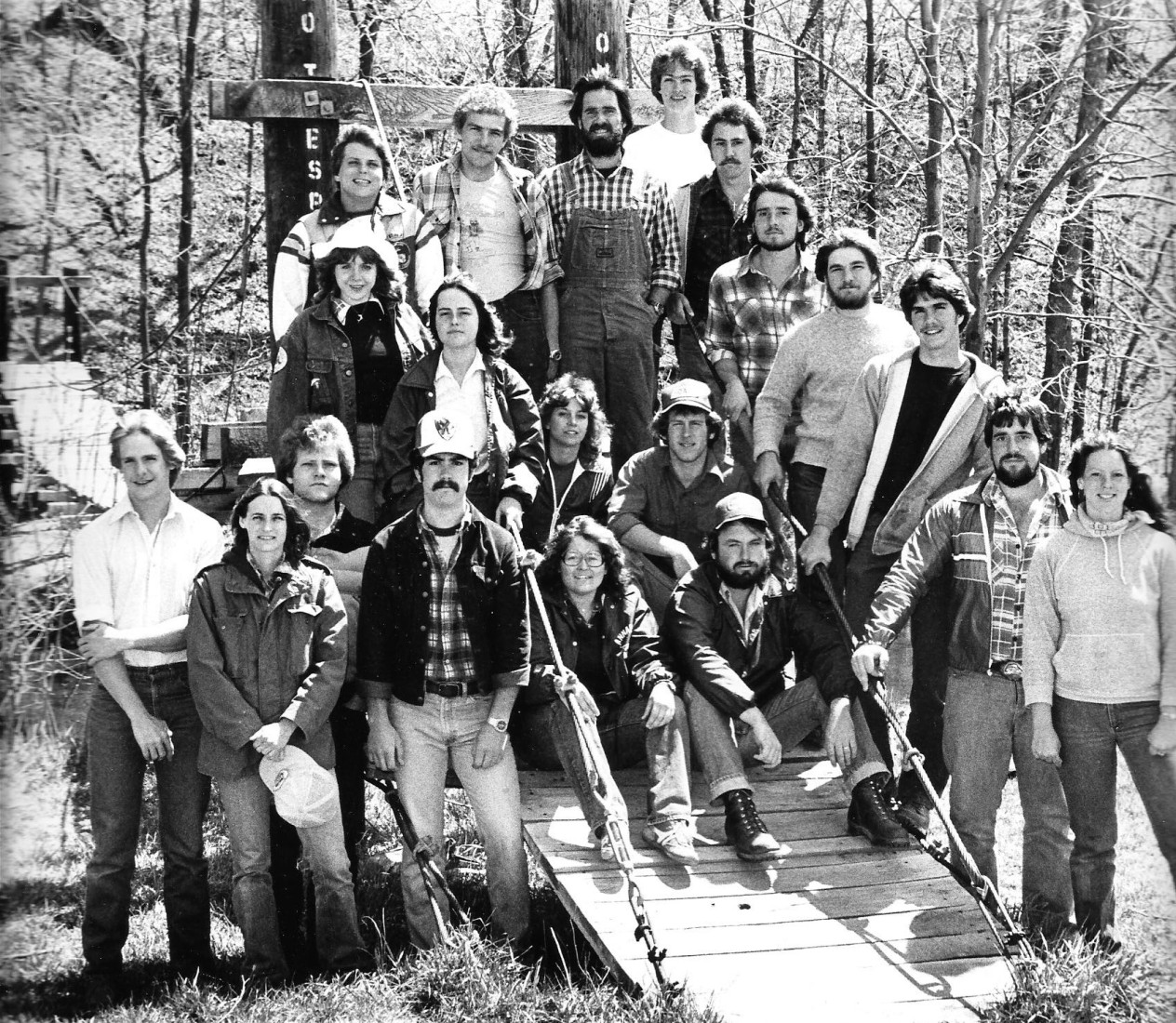
So I started working as a forester in Vermont in 1986 and I’m still doing it. After managing many properties for 40 years, I have completed improvement thinnings and harvests three times or more on some of those lands. It’s really fun to see the results now. In April 2001, we incorporated our consulting practice as Not Just Trees, Inc. and put my name on it officially. Mark wanted a change of pace and took a position as a forestry teacher at Stafford Technical Center at Rutland High School, and Frank Hudson bought out Mark’s portion of the company. I’ve been working with Frank now since 2001. Running a business is not easy, especially for a forester who just wants to be out in the woods and who doesn’t necessarily care to talk to people! Lining up the work is a lot of the job; you have to make sure you have enough to pay taxes and pay expenses – and get paid yourself. Most of our clients are in Rutland County, with a few in Windsor and Bennington counties.
I started working as a tree farm inspector in Maryland and then a couple years after coming up to Vermont, I became an inspector up here, which is how I got involved with Vermont Woodlands Association. Most states are part of the American Tree Farm System, a certification program for landowners managing their woods sustainably. It’s a unique breed of landowners because they take an extra step to make sure that their land is being managed for the four tenets of the program: wood, water, wildlife, and recreation. Education is an important component too. I always loved it because the landowners really care about instilling that stewardship ethic and passing it down to the next generation. Every five years, an inspector visits each farm to make sure it’s meeting the standards required of the program. I used to do the inspections, and in 2021, I became the program administrator.
Forestry in the Northeast has definitely changed a lot since I started doing this work. The industry is different now; there used to be a little sawmill in every town where someone could sell a small load of hemlock or pine, and that’s no longer the case. The majority of our logs leave our state as logs now and that’s really bad news. And ecologically, the invasive plants and pests are putting on a new pressure. When I’m putting paint on, I have to think, “Well, I can’t count ash in what I want to leave.” Or when I do a thinning and see regeneration, if I come back in two years, I might find the deer ate it all. There’s a lot of unpredictability. At the same time, the Current Use Program, where landowners with 25 acres or more of forest or farmland can get a tax break for having state-approved management plans, has changed things for the positive. I think the quality of timber across the state is probably better than it has ever been. Current Use is a driving force for that because a lot of people are enrolled in it who otherwise might not have done any work on their land.
Education is really important, especially with this major generational changeover in landowners right now. Whether you’re writing a management plan for a client or taking them out in the woods, you have to know how to explain what you’re doing. Foresters need to keep learning how to be better and better at that and also stay current on forest health and what’s going on with markets. So constant learning is a big part of the job, as is communication. I feel like communication is not emphasized enough – it’s probably more important now than ever, as land is handed down and the new generation might not know much about it. It’s critical to figure out what that connection is for the new generation of landowners, whether it’s timber or wildlife or recreation, so that they can understand the pros and cons of their management choices. Even if a landowner chooses to move towards old growth characteristics with little to no harvesting, it is still a management choice!
When the importance of forestry gets downplayed, that gets under my skin. Some people think if we leave the woods completely alone, that’s better. Well, I can honestly say that I don’t think that’s true. I can see places where people left it alone and now it’s covered in a sea of bittersweet. There are threats to our woods out there. We’re going to see a lot less ash on the landscape if it doesn’t disappear entirely. That’s sad to me; my little 10 acres is half white ash. It’s hard not to be overwhelmed by it, but then I think about how there are so many people working so hard to come up with some way to control emerald ash borer in a way that won’t hurt something else, and that gives me hope. Vermont has a great, diverse group of foresters working on private, state, and federal lands, and their goal is always to do their best at making the woods better. It’s our most important resource and I can’t applaud the people in our state enough who are really working hard at making sure that our forests are well-managed for the next generation.
Discussion *