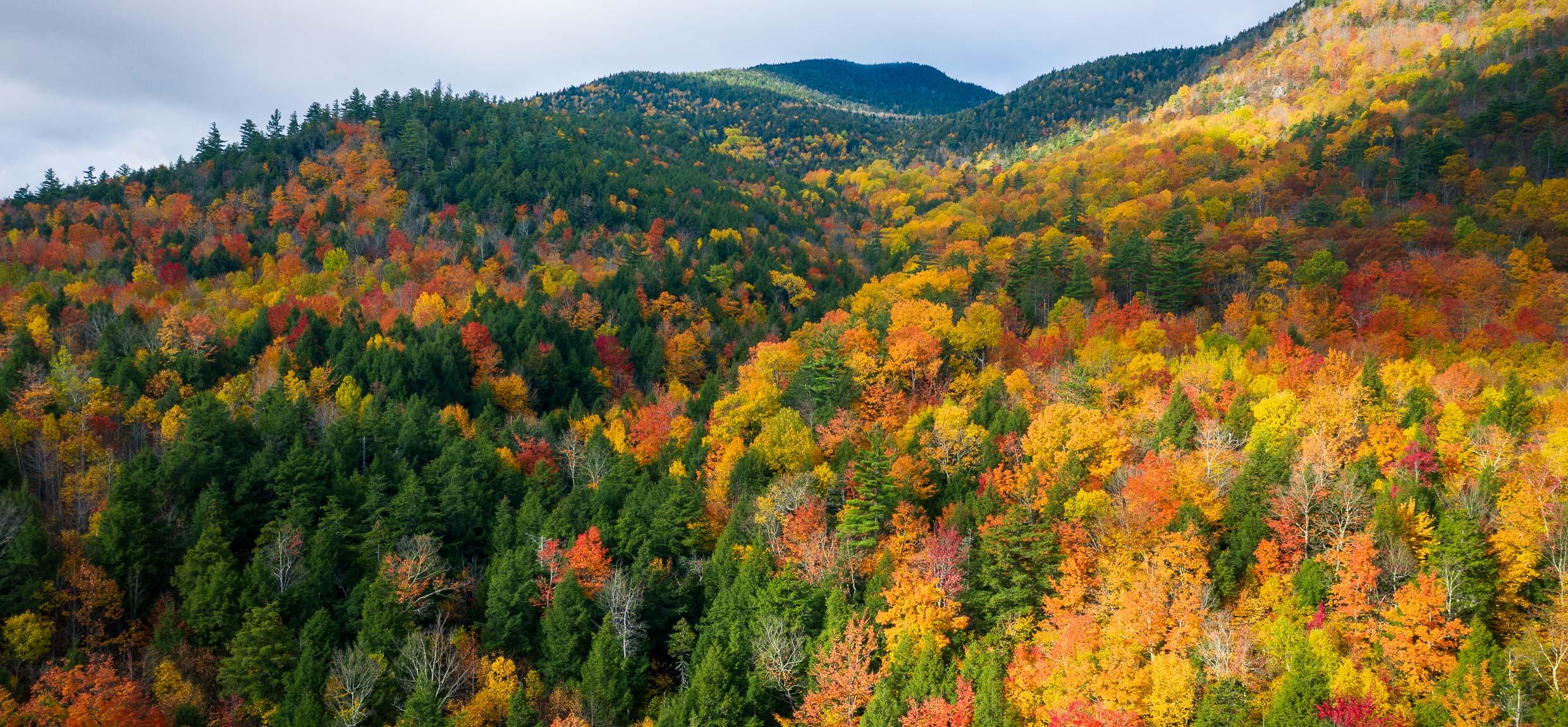


Liz Thompson is an ecologist and conservationist currently based in Vermont. Thompson worked to inventory and conserve land with The Nature Conservancy and Vermont Land Trust for most of her career and taught botany in University of Vermont’s Field Naturalist Program for 20 years. She is a co-author of Wetland, Woodland, Wildland: A Guide to the Natural Communities of Vermont and is the managing editor of From the Ground Up, a regional conservation magazine by Wildlands, Woodlands, Farmlands & Communities, where she also serves on the steering committee. When she is not writing, editing, or teaching, Thompson enjoys walking in nature, often with a camera, noticing the beauty in small things.
I grew up mostly in eastern Massachusetts. I was born there, but then my family moved around – Vermont, California, Maine – before we ended up back there in the town of Chelmsford. Between the time I was six and graduating high school, the population grew from around 25,000 to 45,000, and the forests and fields gradually disappeared. But there were woods out back of our house, and parenting was more free-range back then, so I spent a lot of time roaming in the woods. My parents loved nature too and took us on walks and hikes, and I went to a Mass Audubon camp as a kid. We went on vacations to the Wellfleet Bay Wildlife Sanctuary on Cape Cod; I spent days wandering around the salt marshes. We camped in the pine barrens and spent time on the beach. The National Seashore just goes on forever, and I got to really see the vastness of the ocean.

In my 9th grade biology class, we had a unit on the life cycle of mosses. We went on a field trip and looked at haircap moss – a very ordinary and large moss – and I was just hooked. I was always really interested in wildflowers, and I wanted to know where certain species grew and why. My mother was very supportive; she bought me a book called Spring Wildflowers of New England by Marilyn Dwelley. I had the passion and the tools and the support.
I went to the University of Maine and studied botany. I had excellent mentors there, and it was a fabulous experience. There was no ecology concentration per se, but it was the beginning of instructing in ecology, and that’s what I was interested in. All of these taxonomic specialists – professors who studied insects or mosses or seaweed – put together a course on ecology where they each taught one week. I met a lot of great mentors there: Bob Vadas, who studied seaweeds; Ron Davis, who primarily studied peatlands and bogs; Chuck Richards, who was a botanist; Mac Hunter, who is a conservation biologist and writer. The summer between sophomore and junior year, I went out to the University of Michigan Biological Station and studied under an amazing botanist, Ed Voss. These people had a huge influence on me.
One summer, I worked in Bar Harbor. I was a maid for these wealthy people in their second home. I had a little uniform, and they had a bell they would ring and call “Elizabeth!” My afternoons were completely free, though. I hiked everywhere on the island. It was great preparation for doing plant community and ecological inventory work, which is what I went on to do. When I graduated in 1979, The Nature Conservancy (TNC) had just acquired Great Wass Island Preserve off the coast of Maine, and they hired me to do an ecological inventory. I kept working there for two more summers, continuing the inventory, doing a fire study, and helping create new trail networks. And in the winters, I worked for the Maine Critical Areas Program (now called Maine Natural Areas Program). I helped identify and protect special areas in the state.

When I was working there, I met Ian Worley, who would become my advisor at University of Vermont. He was from UVM but in Maine doing a special study and report on peatlands, which is what I had become most interested in, so I moved to Vermont in 1981 to get my master’s. I studied peatlands near Schefferville in northern Quebec, on the Labrador border. It was buggy, but it was fabulous. It’s a very remote iron-mining town, but there’s a field research station operated by McGill University, and so I got to use their facilities. I did a plant inventory and took peat cores and spent the winter in front of the microscope looking at samples I brought back.
When I was finishing up at UVM, I called the director of TNC in Vermont, and said, “Can I come talk to you?” I knew I was most interested in mapping natural communities, and I knew TNC had that interest as well. I told him I’d like to work on natural communities in Vermont, and he basically said, “Okay, well thanks for coming.” But about a month later he called me up with a job. At the time, the New England-wide Natural Heritage Inventory was being split up by each state. The goal was that eventually state agencies would adopt the programs, but in the interim each state chapter of TNC kept things going. They needed someone who would work on natural community ecology, botany, and data management, and I got that job. It was both sheer luck of being in the right place at the right time, and a bit of assertion – just going, “Here I am!”

I stayed in the role for about six years before the Fish & Wildlife Department took it over. I was not hired to continue in the role. It was a male-dominated department at that time, so a man was hired for the job. That man was Bob Popp, and he was and is fabulous. I’m grateful he held that position for so many years. I went back to TNC for a little while, in a conservation planning role and then went out on my own as a consulting ecologist. I started teaching botany for UVM’s Field Naturalist Program around 2000. I did some work for Vermont Land Trust (VLT), and they hired me fulltime as an ecologist in 2006. I worked there for about 15 years before retiring.
I’ve had the opportunity to work on some really great projects over my career. I worked on this amazing project at Mount Equinox in Manchester, Vermont, as a consultant. The company who owned the hotel there hired me to inventory their forestlands, which cover about 900 acres of the mountain. I recommended that they set aside 700 of those acres as a forever-wild preserve, and they did it! It’s very rich woods with big ash and maple trees, beautiful timber. I’m really proud of that work, and it was just luck, again, that someone running the hotel said yes to the idea. I also am really proud of the Vermont Biodiversity Project, which was the foundation for Vermont Conservation Design. It was a mapping project that identified the highest-priority places for conservation of biodiversity. The report for it came out in 2002, called Vermont’s Natural Heritage.

During my time at VLT, I helped prepare a report called Wildlands of New England, which was a project of Wildlands, Woodlands, Farmlands, & Communities (WWF&C), a New England conservation collaborative. After I retired from VLT, WWF&C asked me to continue working with them and represent Vermont in their New England-wide group of people thinking about conservation. At one point, we started talking about creating a publication, which turned into From the Ground Up, a magazine about conservation in New England. I became the managing editor, and we’re now on the 10th issue. I’m also a board member for Northeast Wilderness Trust and helped organized the Northeastern Old Growth Conference in 2023 and 2025. It was a lot of fun – and a lot of work. I’m now getting started on organizing the 2027 conference, which will be in Maine. I’m still working, despite being retired.
One of the biggest challenges in this work is that it can feel kind of pointless. Climate change and biodiversity loss are really challenging, and there’s tragedy there. Sometimes, it feels like, “What’s the point of our little land conservation work?” Big picture, it can feel like it’s not much when thinking about climate change, human population, and human greed. Another part is that there’s never enough money to do everything we want to in conservation. But I try to find joy, and that means going outside and being in nature. I’m an amateur photographer, and my camera helps me see the world. It makes me look at things more closely and stop to enjoy how things look and how things are interacting with each other. I watch things of beauty, and that keeps me going. I think there is great power and resilience in nature, and I have a great deal of faith in nature, in spite of sometimes feeling like, “What are we doing? Why do we even bother?” My philosophy is to love the world, to pay attention, and to learn from nature. Those are things that I really believe in.
Discussion *