
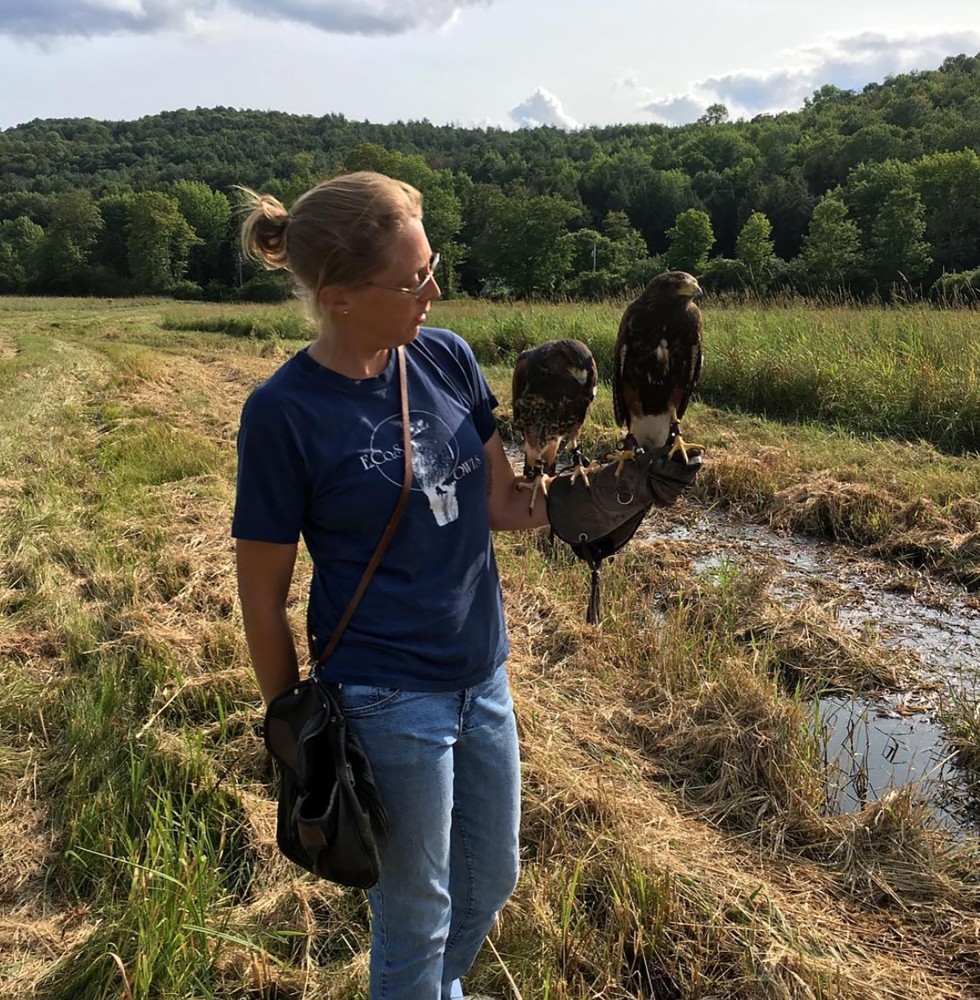
Jessica Snyder is a state and federally licensed falconer who works in Woodstock, Vermont. Jessica has taught at New England Falconry for more than 10 years and has worked with birds of prey for more than 15 years. She leads educational programming on birds of prey and the history and sport of falconry for people of all ages and trains and cares for the hawks, owls, and falcons at New England Falconry. Outside of work, Jessica enjoys exploring the outdoors with her three dogs.
I’m an Army brat, so I kind of grew up all over the place, but I consider Maryland home. We lived just outside of Westminster, in an old farmhouse with some acreage around it. I spent most of my time in the woods, looking under logs and at plants. I was the kind of kid that brought snakes home. My mom volunteered at the front desk of the local nature center, and I would clean up the animal tanks. In school, I was interested in anything to do with ecology. I knew from age 7 or 8 that I wanted to be a naturalist or environmental educator when I grew up. I took all the science classes I could in high school.
I graduated from Neumann University, outside of Philadelphia, in 2009 with a degree in environmental science and education. I did internships at different nature centers in Maryland and Pennsylvania during college. I met a falconer in college and decided I would do that. Falconry – hunting with a trained bird of prey after wild quarry – is around 4,000 to 6,000 years old. It is done as a sport now, not as a means of human subsistence. It’s one of the most highly regulated hunting activities in North America. There are really high standards here, which is great. You have to pass a test in each state, demonstrating knowledge on basic husbandry, care of birds, identification of birds, history of falconry, and falconry techniques. When I finished school, I passed my test.
Once you pass that, your falconry housing facilities (called a mew) are assessed and must pass a federal minimum standard that they are appropriate for the care of the birds. Then you find a falconer – either a master, who has at least 7 years of experience, or a general class falconer, who has been in the sport a few years – to teach you. They agree that they’re going to sponsor you, to hold your hand and give you support and knowledge throughout two years of an apprenticeship. I began as an apprentice in the fall of 2009 with a master falconer in Pennsylvania. I also worked at the Pocono Environmental Education Center conducting environmental education programs to visitors and school groups.
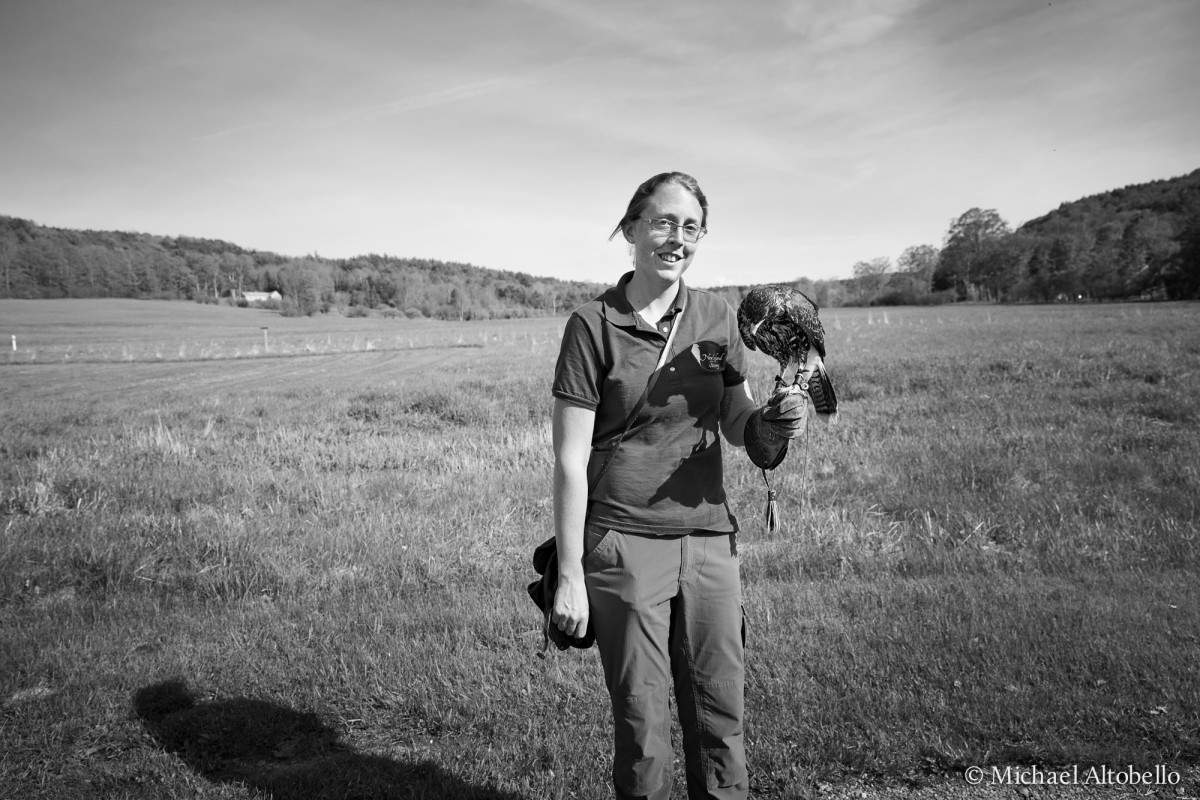
In an apprenticeship, you choose between a red-tailed hawk and an American kestrel. Red-tailed hawks are one of the most popular falconry birds in North America, while kestrels are considered more difficult. Because of a kestrel’s size, they’re more fragile in terms of their care; it takes more to make sure they are healthy and in good shape. My sponsor agreed that I could start with a kestrel since I had worked with birds of prey in the past in environmental education roles, and because it was easier for me to have smaller facilities at that point in my life.
Most states, if not all, require you to capture your first bird. This is because captive bred birds can never be released, but wild ones can, so the stakes are different. You take a juvenile bird in the fall of the first year of its life, hunt with it in fall, winter, and early spring, and release the bird back by summertime. They are still entirely wild because they never imprint on humans – really what you’re doing is taking them through their first winter. Over that time, you build a partnership with them. When you release them, they’re no worse for wear – and in a lot of cases, better off because of it. Mortality is anywhere between 70 to 90 percent in the first year of their lives, but with a falconer, they have the luxury of a safe place to sleep at night and food regardless of if they catch something or not.
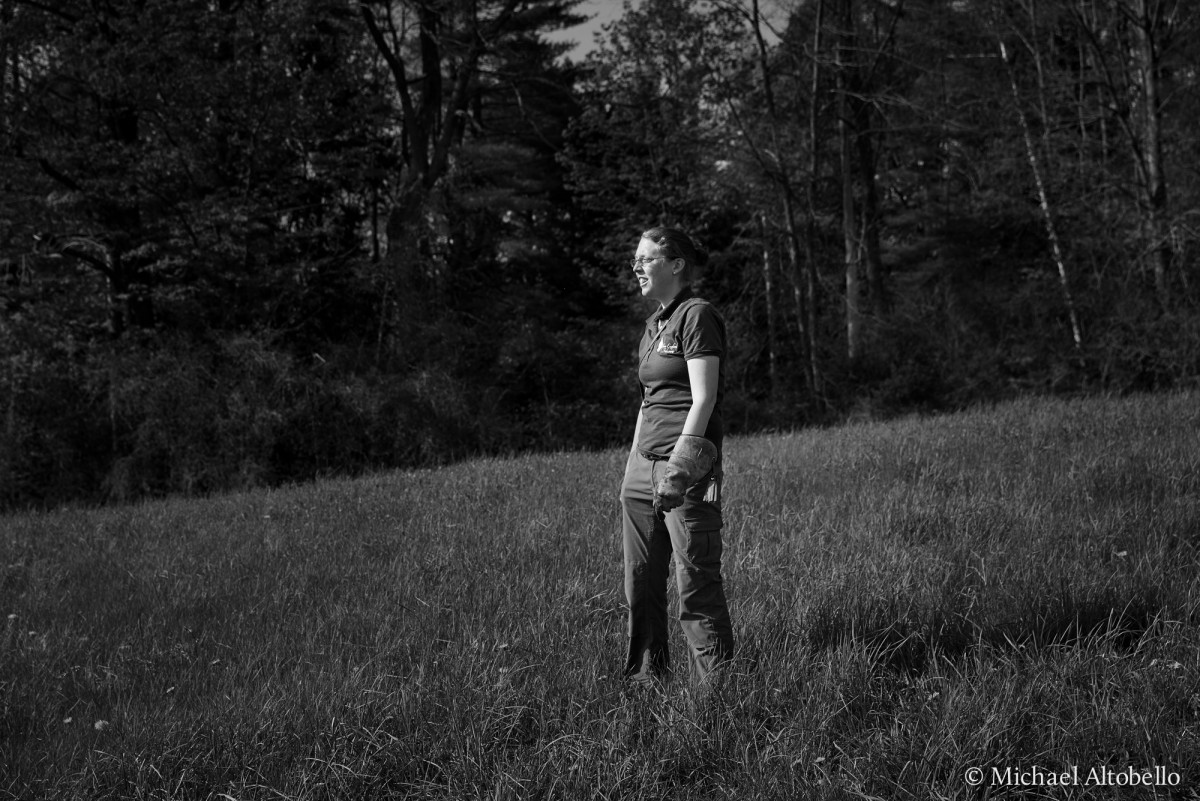
After about three years of working at the Pocono Environmental Education Center, I moved out to Kansas and worked at conservation center there for 2 years. When I was in the Midwest, I learned that Christopher Davis was starting a falconry center in Woodstock, Vermont. I had been working with birds of prey for five or six years at that point, and it was such a unique opportunity. In 2015, I moved here and started up the program with another falconer that had been hired. Our programs were based on what Chris was doing in Hadley, Massachusetts. Over the years, we’ve developed new programs and added new birds.
We have a special purpose falconry education license issued by the U.S. Fish and Wildlife Service and a state falconry education permit from Vermont. There’s only a handful of these permits in the country, and it gives us the opportunity to allow guests to handle our birds. People don a traditional falconry glove, and birds can land on their gloved hand. Most of the people who attend programs are nature lovers and adventurers, and they want to be up close to the birds. The birds are free flying, which means that they could completely ignore us, and sometimes they do. We teach about the history of falconry and the lives of birds of prey and about their ecological role and conservation concerns, but other than that, no two sessions are alike. Sometimes the birds catch prey in the middle of a session or put on a show flying if it’s a windy day.
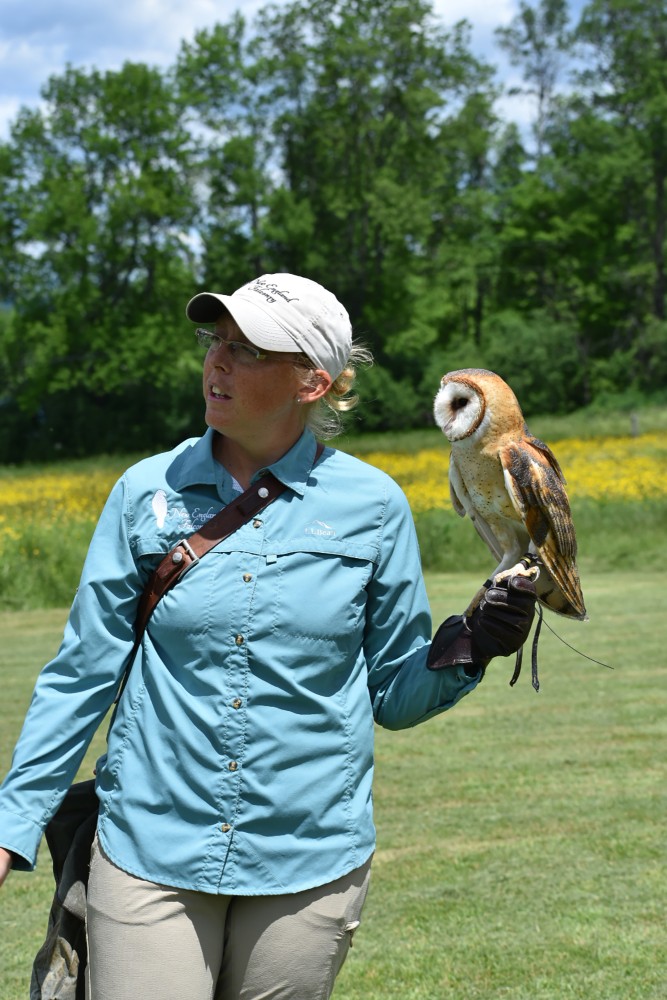
Each bird has its own personality, and they also have good days and bad days. Some of these birds I’ve worked with for 10 years now, so I know their body language and their mood. I can tell when I walk into their chambers if they’re going to want to participate that day or not. Sometimes I get the message, “I’m taking the day off.” It’s my job to listen. Sometimes a bird will decide it’s done in the middle of the session, and I try to remind people that there’s no sense in getting frustrated – it’s a wild bird, it’s not like when your dog runs around and won’t come when you call it.
That being said, we’ve chosen specific species that are well-fitted for these kinds of experiences. I like to use the analogy that it’s like choosing a specific breed, such as a Labrador, to be a seeing eye dog. We often work with Harris’s hawks, an extremely intelligent species that is very trainable and sociable. We work with ones that have the desire and the drive to participate in the programs. We have four Harris’s hawks, two falcons, and four owls. Owls are not traditionally used in falconry; they’re difficult to train, hard to motivate, and easily distracted. Not a dig at them! They are exceptional predators. It is the falconer’s responsibility to learn how each bird communicates. We learn how each individual ticks, what they like and don’t like, what motivates them, what scares them. We adapt each program to that.
The unpredictability of a bird of prey can be challenging. When I was starting out, if a bird didn’t respond as I intended, I would worry it made me look like a bad trainer. That took some personal growth. The juggle of working with a wild animal while also engaging with the public and answering questions can be hard. The birds are reacting to variables just like every other human and animal does – variables that are entirely out of my control. One of our birds is afraid of tractors, and we do sessions in a 50-acre meadow. Sometimes a tractor shows up in the middle of a session. Or sometimes the variable is a peregrine falcon or Cooper’s hawk dive-bombing our birds.
Through time and history, birds of prey have been villainized. The predator is always the bad guy. Teaching people more about the ecology of predator-prey relationships, talking about how our farming practices impact them, that’s really important to me. It gives people a different view. My favorite thing – and my goal for every program – is for people to walk away with a greater appreciation for birds of prey. I love when people ask, “How can I support birds of prey?” and then I can talk about nest boxes, wild meadows instead of lawns, and other small things that make a difference.
Falconers are stewards of the land, much like a lot of other sportsmen are. I always tell people that falconry is a connection to nature unlike any other. The bird is hunting as it naturally would, and so you see the predator-prey relationship; you get to be a fly on the wall. I think it makes a difference to people when the bird is inches from their face, when they can feel the weight of it on their gloved hands, when they can see the detail in every feather – that kind of experience creates a lasting impression.